Get Full Government Meeting Transcripts, Videos, & Alerts Forever!
Get email alerts on the Science Curriculum topic
No spam. Unsubscribe anytime.
District says new science sequencing and curriculum training improving results; some grades still below state
Summary
The district reported being above state averages overall in science but noted a grade‑level dip for one cohort affected by pandemic learning loss; staff described multi‑year curriculum adoption and unit‑by‑unit teacher training to support implementation.
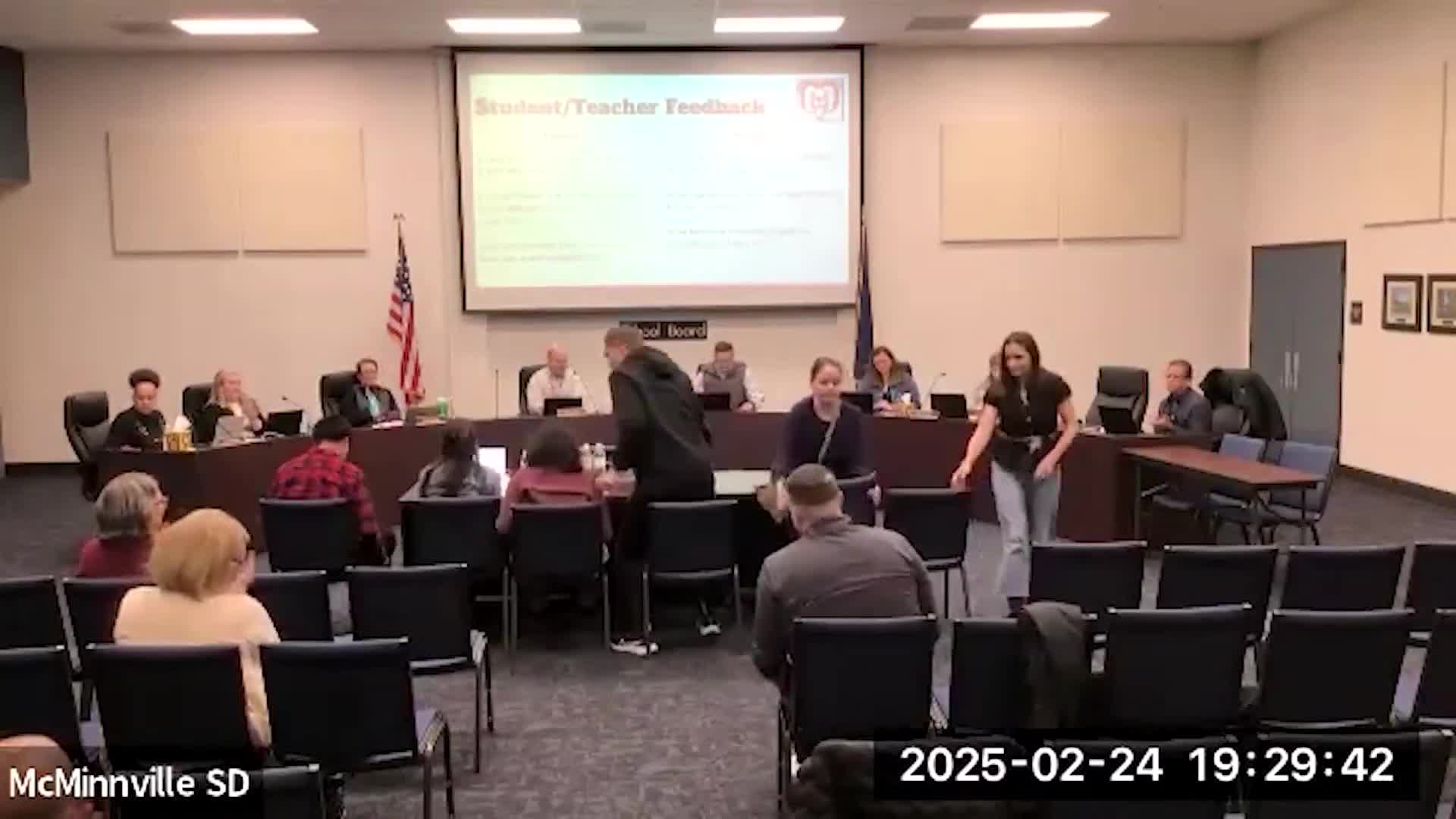
District curriculum staff presented science assessment trends, recent course sequencing changes at the high school and a multiyear professional‑learning plan to the McMinnville School District Board of Directors on Feb. 24.
Courtney Forua, director for curriculum, instruction and assessment, showed state assessment comparisons that placed McMinnville above state averages overall and for most focal student groups, and she described changes to high‑school sequencing that start students with a conceptual physics course to open later access to advanced science classes. Forua said the district adopted Amplify for elementary, Twig for middle school and Pattern Science (an open‑source hub product) for high school.
Why it matters: Forua said the district aims to maintain pre‑pandemic performance levels and address learning loss stemming from COVID‑era disruptions. She said the district is prioritizing unit‑by‑unit teacher training and embedded coaching rather than single‑day, districtwide training events so teachers can implement new materials effectively.
Key points from the presentation - Assessment trends: Forua displayed historical Oregon Department of Education (ODE) data showing McMinnville above state averages overall and by major focal groups. For one tested grade cohort the district scored about 1.8 percentage points below the state average; Forua attributed that gap partly to pandemic impacts on that cohort’s early elementary science exposure and to changes in statewide assessments and standards introduced in 2018–19. - High‑school sequencing: The district introduced a “patterns” sequencing at the high school so every student begins with conceptual physics followed by chemistry and biology, removing math‑heavy prerequisites that previously limited students’ access to advanced science pathways. Forua said the approach was developed with regional “science hubs” and is open‑source, which reduced material purchase costs but required investment in teacher training. - Professional learning and implementation: The district shifted to shorter, recurring training sessions tied to specific units. Forua said staff received daylong sessions and ongoing 112‑minute segments during grading days; trainers have also done classroom walk‑throughs and coaching.
Board questions and responses Board members asked about the grade‑level dip and the relationship between remediation in ELA/math and reduced instructional time for science during pandemic recovery. Forua said the district prioritized acceleration in ELA and math during those years, which limited elementary science time; middle‑ and high‑school schedules resumed typical science instruction and include longer blocks for recovery.
Forua also described how the district purchased enough elementary science kit sets to house them at each building (rather than rotating a smaller central supply), and how aligned pacing calendars will have grade teams teach the same units on the same timeline to simplify resourcing.
Next steps Forua told the board the district will continue unit‑level professional learning, regular coaching visits and progress monitoring of assessment outcomes to judge whether implementation is improving results for the cohorts affected by pandemic learning loss.