Get Full Government Meeting Transcripts, Videos, & Alerts Forever!
Get email alerts on the School Cell Phone Policy topic
No spam. Unsubscribe anytime.
McMinnville High doubles down on 'class time is phone-free time' after mixed feedback
Summary
School leaders told the McMinnville School Board they reinforced an existing decade-old rule that phones be put away during class; administrators say classroom phone sightings are down but hallway and bathroom incidents continue. Staff and students described academic gains and uneven enforcement across classrooms.
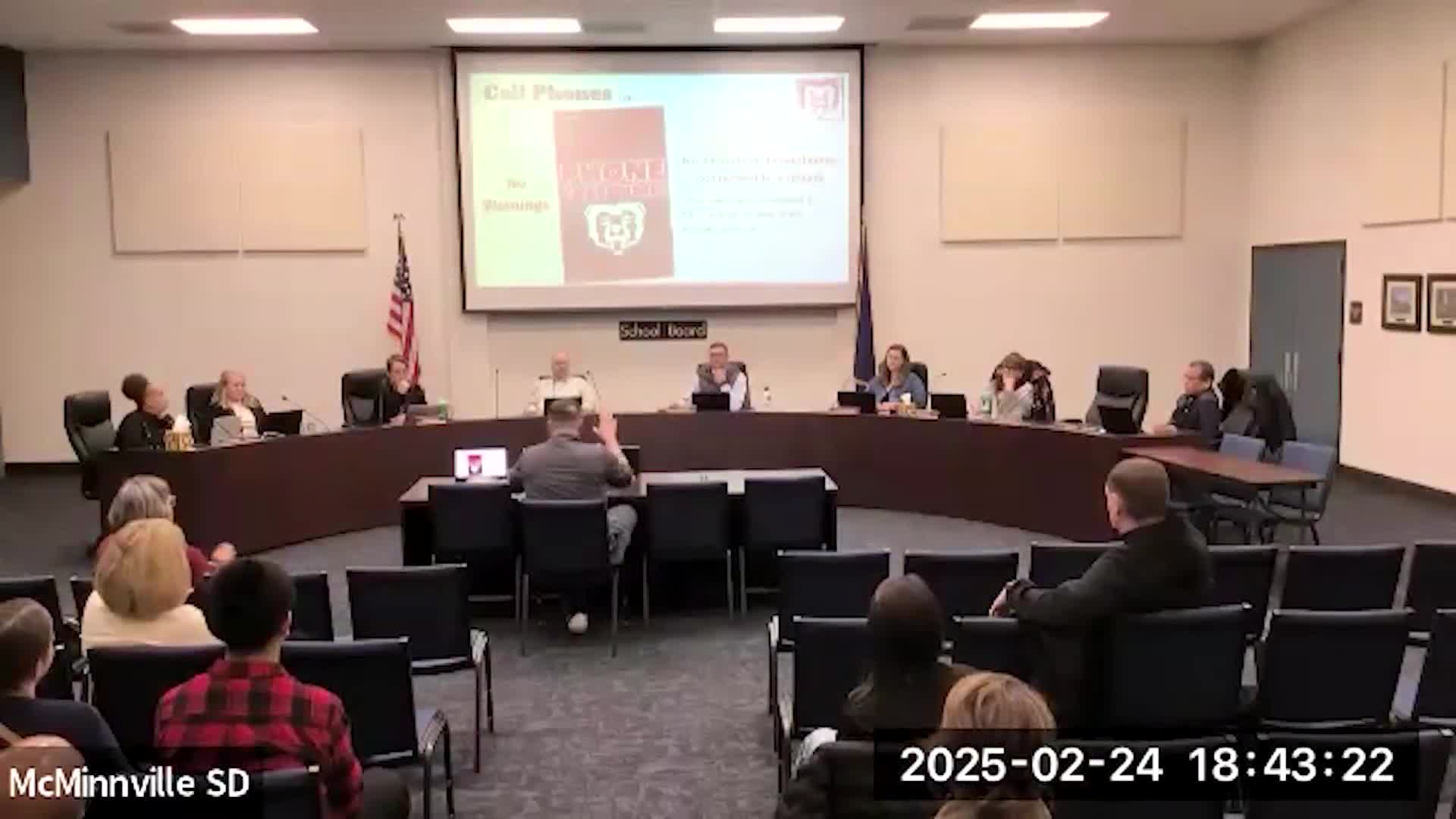
McMinnville High School administrators told the McMinnville School District Board of Directors on Feb. 24 that a renewed effort to enforce the school’s longstanding cell‑phone rule has reduced device use during instruction but left challenges in unsupervised spaces and in consistent enforcement across classrooms.
The update came from Dave Fuhrman, principal of McMinnville High School, who said the school reissued a rule that has appeared in the student‑family handbook for at least a decade: electronic devices must be “turned off and put away during instructional hours unless specific permission is granted by staff for educational purposes.” Fuhrman said the district provided hanging pocket charts to teachers who wanted them and told staff they could enforce the rule without being responsible for physically confiscating students’ phones.
Fuhrman said the district intentionally clarified expectations before enforcing them and used student and family feedback channels over the past year. “When a phone is out, it doesn't matter if it's the person using it or the person near them. It makes an impact on the way that they're experiencing the space that they're in,” he told the board.
Why it matters: School officials said the move was intended to boost engagement and classroom interactions. Teachers and some students told the board they have noticed stronger participation in class discussions and structured activities since the rule was reiterated. But administrators and students also described uneven enforcement and operational tradeoffs that leave open questions about equity and accommodations.
What school leaders reported - Implementation: Fuhrman said staff presented the expectation as “class time is phone‑free time,” covering classrooms and other instructional areas; teachers were given optional pocket charts for collecting phones. Assistant Principal Jeremy Vernon held class‑level presentations. Fuhrman said the rule language itself was unchanged from earlier handbooks but was presented more clearly this school year. - Data: As of the week before the board meeting, the school’s student center had processed 424 reported electronic‑device incidents, an average of about 4.2 incidents per school day, Fuhrman said. He noted the school enrolls about 2,200 students and cautioned that reported incidents are a fraction of possible device sightings because many infractions likely never reached the reporting process. Fuhrman said 82 students had two incidents and eight students were on phone check‑in plans; he said some incidents resulted in lunch or after‑school detentions. - Equity and accommodations: Fuhrman said staff reviewed Individualized Education Program (IEP) accommodations and Section 504 notes related to headphones and device access. He said most accommodations named noise‑cancelling or wired headphones rather than unrestricted phone access. The school purchased wired noise‑cancelling headphones for a small subset of students with documented needs and encouraged staff to use Chromebooks and wired headphones where possible. - Safety concerns: Fuhrman and board members raised safety tradeoffs after a high‑profile “swatting” incident earlier in the year. Some parents urged that phones remain usable in emergencies; Fuhrman said staff were given a protocol to make phones available if school officials and responding authorities agreed it was appropriate during an emergency.
Perspectives from teachers and students Students who spoke to the board described both benefits and frustrations. Axel Arellano Palacios, a junior, said the rule “100% limits distraction” in class but asked for flexibility when phones are needed for school tasks such as social‑media posts tied to choir or quick research not accessible on school devices. Janella Contreras said enforcement varies by teacher and that inconsistency can make the rule feel unfair to students whose classes are strictly monitored. Gerardo, another student, told the board he noticed classmates were less on phones this year and said learning improved in some classes.
Teachers and substitute staff described stronger classroom engagement. English teacher Rachel Klenz said she has seen more students participate in structured classroom talk and Socratic seminars. Substitute teacher Sarah Tokolski said freshmen in particular were more consistently engaged and that clearer, districtwide expectations removed earlier ambiguity.
Outstanding questions and next steps Administrators acknowledged persistent problems in unsupervised spaces such as hallways and bathrooms, where students sometimes take phones out of classrooms. Fuhrman said the school will keep working with staff, students and other districts to refine practices and assess next steps; he said implementing more restrictive approaches, such as Yondr bags or a total ban on phones, would require additional funding or staffing to manage monitoring and operations.
Board reactions included praise for progress and questions about enforcement consistency. Vice Chair Warmbier thanked staff and students for their work, and some directors asked for follow‑up data and clarification about emergency protocols.
Fuhrman said he will continue to gather feedback, monitor incident data and coordinate training for teachers so enforcement is consistent where the rule applies.