Get Full Government Meeting Transcripts, Videos, & Alerts Forever!
Get email alerts on the Recidiviz Software topic
No spam. Unsubscribe anytime.
Idaho corrections director seeks ongoing funding for Recidiviz case‑management tools
Summary
The Idaho Department of Correction asked lawmakers to fund continued use and expansion of Recidiviz tools to automate case management and improve supervision decisions; lawmakers pressed for performance data and confirmation that the state controls its data.
The Idaho Department of Correction on Tuesday asked the Joint Finance-Appropriations Committee for ongoing funding to continue and expand a partnership with Recidiviz, a nonprofit data and analytics group that the department says helps automate case triage and surface outcomes across disparate correctional systems.
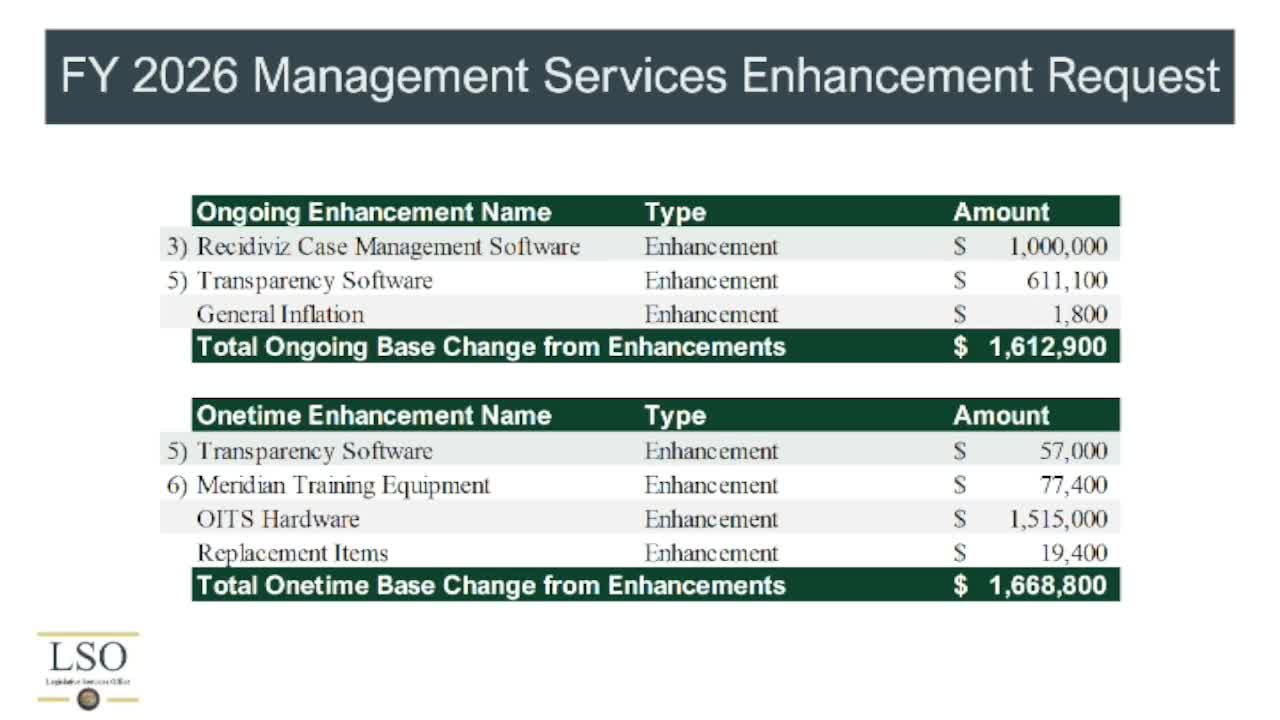
The request is part of the department's Management Services Division presentation to the committee. Noah Peterson, budget and policy analyst with the Legislative Services Office, told the committee the department previously received appropriations to work with Recidiviz in fiscal years 2021 and 2023 totaling about $1.5 million, mostly from federal funds, and that the department is seeking ongoing support to expand the tools into the prisons division.
Why it matters: Department leaders described Recidiviz as a tool that reduces time-consuming manual work, helps parole and probation officers prioritize cases, and can surface officer-level outcomes to support training and supervision — all of which, the director said, could affect public safety and recidivism trends.
Director Josh Tewalt described the partnership as transformative, saying Recidiviz “probably [is] the most transformative partnership we’ve entered into as an agency in my entire tenure.” He told the panel Recidiviz does more than provide a standard software package: it aggregates data from outdated, disparate systems, creates overlays and dashboards, and helps automate back-end work for case managers. Tewalt added the nonprofit leverages private philanthropic dollars alongside state spending so “for every dollar we spend, they match with private foundation money.”
Committee members pressed for measurable results and data. Senator Cook asked for return‑on‑investment data before approving ongoing general‑fund support; Peterson said he did not have hard outcome data at the hearing and offered to work with the agency to provide it. Representative Tanner and others asked the department to provide the dashboards and sample reports it uses in practice so legislators can see what the tool produces and how staff use it.
Lawmakers also asked about data ownership and potential vendor influence. Tewalt said the state controls the source data, that Recidiviz pulls data from Idaho systems under data‑sharing agreements, and that the department has “a high degree of confidence” the nonprofit is not manipulating state records. He added that Recidiviz can allow Idaho to compare outcomes with other jurisdictions while keeping participant jurisdictions private.
Questions remain about long‑term costs and alternatives. Senator Cook asked whether staff had compared Recidiviz to commercial alternatives; Tewalt said the agency has explored other vendors and believes Recidiviz’s model — which minimizes added data entry burden on line staff — is distinctive. The agency agreed to supply follow‑up information on documented outcomes, comparison work, and the philanthropic matching partners mentioned during the hearing.
The committee did not take a vote on the request during the session. Lawmakers asked the department to return with usage dashboards, documented outcomes, and cost comparisons as they consider whether to convert prior one‑time and federal investments into ongoing state funding.
Ending: Committee staff and agency officials agreed to provide follow‑up materials, including dashboards and outcome data on Recidiviz tools and any cost/benefit analyses the department has, before the committee decides on ongoing general‑fund support.