Get Full Government Meeting Transcripts, Videos, & Alerts Forever!
Get email alerts on the Research Ethics Nuremberg Scr104 topic
No spam. Unsubscribe anytime.
Idaho committee rejects resolution reaffirming Nuremberg Code as research foundation
Summary
The Senate Health and Welfare Committee debated SCR 104, a nonbinding resolution presented by Sen. Tammy Nichols to reaffirm the Nuremberg Code and related international bioethics documents; the committee voted 3–6 against sending the resolution to the Senate floor.
The Idaho Senate Health and Welfare Committee voted 3–6 against sending Senate Concurrent Resolution 104 to the floor after a substantive hearing in which supporters said the measure would reaffirm long-standing ethical standards for human research and opponents objected to referencing international declarations.
Senator Tammy Nichols, D10, introduced SCR 104 as an advisory resolution “that reaffirms Idaho's commitment to ethical medical and scientific research by recognizing the Nuremberg Code as the foundation for protecting human rights.” Nichols said the resolution encourages Idaho medical, academic and research institutions to follow recognized ethical guidelines, reiterating "voluntary consent, transparency, and safeguards against harm." She described the Nuremberg Code as a 1947 response to Nazi medical experiments and cited historical abuses such as the Tuskegee syphilis study, the Willowbrook hepatitis studies and experiments in Guatemala to show why the code’s principles remain relevant.
The measure drew questions about scope and necessity. Several senators said Idaho and federal law already embed many medical-ethics protections and questioned why the resolution would reference international instruments. Senator Wintrow asked why the committee would “adopt foreign declarations” such as the UNESCO declaration rather than rely on U.S. standards. Senator Shippey said he was uncomfortable pointing to United Nations bodies as ethical standards for Idaho.
Senator Nichols said the resolution is not an adoption of any foreign law but an express statement that the Nuremberg Code remains a ‘‘cornerstone of ethical research practices’’ and that later documents such as the Belmont Report and the Declaration of Helsinki have provided complementary protections. She also said concerns that arose during the COVID-19 pandemic motivated bringing the measure forward.
Supporters framed the resolution as preventative. Senator Snyder Phil, who spoke in favor, said historical lessons require safeguards and urged adoption as an additional tool to prevent abuses. Opponents focused on the resolution’s international references and the risk of implicitly ceding policy preferences to outside organizations.
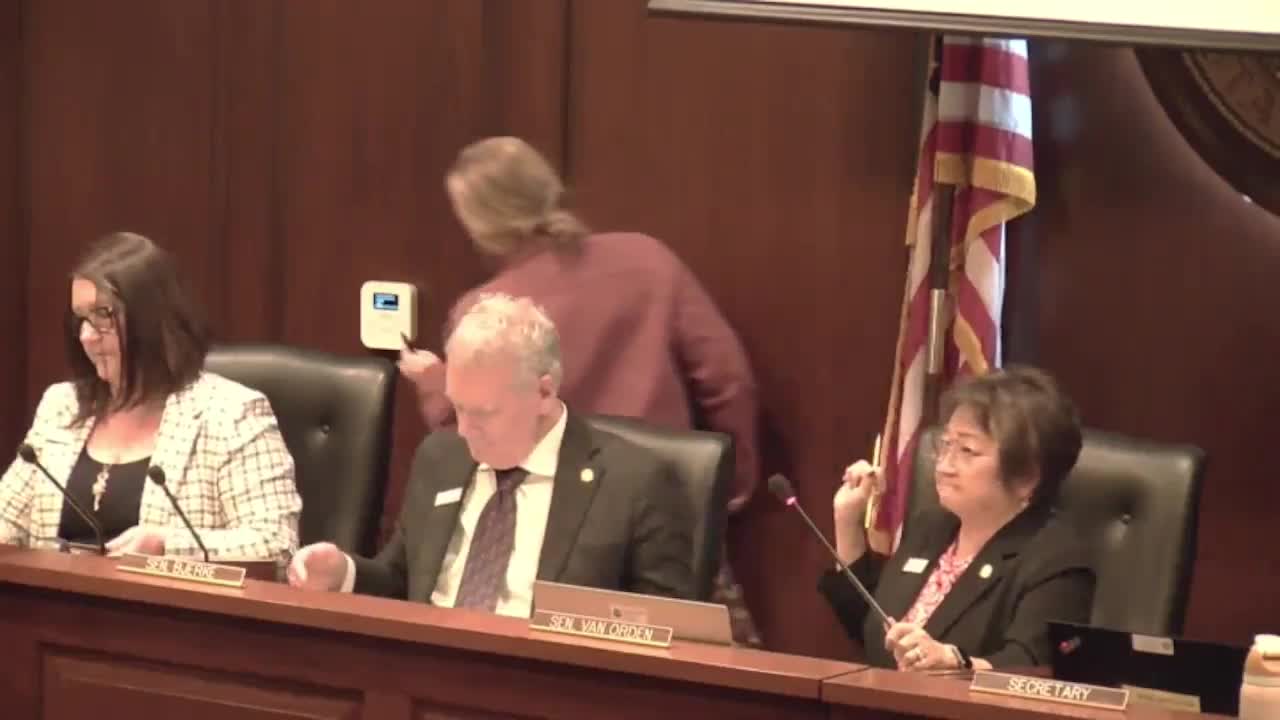
A motion to send SCR 104 to the floor with a due-pass recommendation was moved and seconded in committee. During a roll call the transcript records several named responses; the chair announced the result as "3 ayes and 6 nays," and the chair declared the motion failed.
Because SCR 104 is advisory only, the resolution carried no fiscal impact according to the sponsor and would not create new regulatory authority if adopted. The committee record shows debate centered on whether an advisory restatement of principles would add meaningful protection beyond existing law and practice and whether citing international declarations was appropriate for Idaho policy.
The failed motion leaves SCR 104 without committee approval to advance to the full Senate.