Get email alerts on the Transportation Finance Reappropriation topic
No spam. Unsubscribe anytime.
ITD asks JFAC for larger multiyear spending authority as construction payouts surge
Summary
At a Joint Finance-Appropriations Committee hearing, the Idaho Transportation Department requested expanded reappropriation and continuous-appropriation authority to cover multi-year construction payouts, supplemental spending authority for current-year contractor payments and ongoing federal funding recognition tied to IIJA.
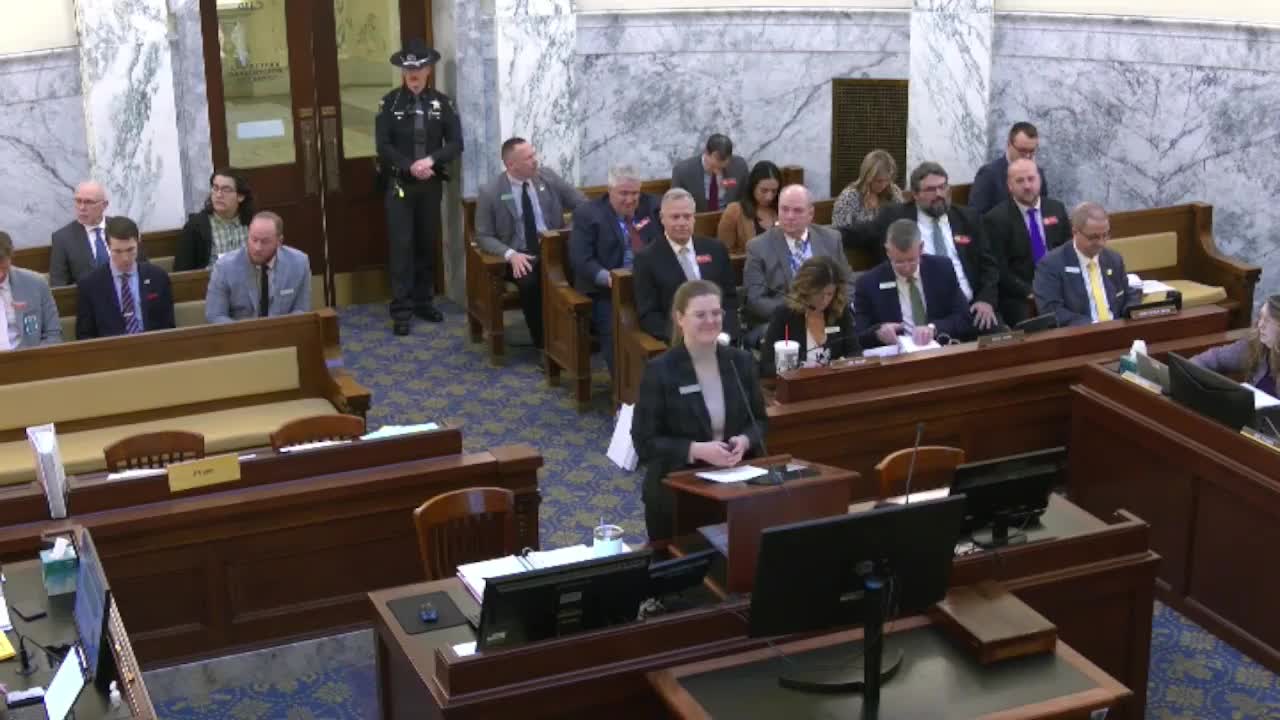
At a Joint Finance-Appropriations Committee hearing, Idaho Transportation Department officials asked lawmakers for expanded multiyear spending authority and code language to ease cash-flow constraints on multi‑year construction projects, saying large contracted payouts this construction season risk exceeding existing appropriation caps.
The department requested a $60 million supplemental for the current fiscal year and ongoing appropriations tied to additional federal funding, including a $57,276,000 ongoing capital outlay tied to federal IIJA allocations and an additional $55,000,000 ongoing capital outlay (50,000,000 federal; 5,000,000 local). ITD also asked the committee to reauthorize reappropriation authority up to $250,000,000 and asked that the Strategic Initiatives Program Fund remain continuously appropriated so prior-year balances could be spent on projects already under contract.
Why it matters: ITD described a wave of multi‑year, multi‑fund projects that produce large monthly contractor payments. Dave Tolman, ITD chief administrative officer, told the committee that as of the end of FY2024 the department had “a little over $600,000,000” of obligated but unspent construction program dollars across funding sources. Tolman said the combination of multi‑year contracts and the current statutory appropriation approach can leave the department with cash on hand but insufficient annual spending authority to make contractor payments on time.
ITD budget analyst Brooke Dupree opened the construction discussion with an overview of funding sources and recent transfers into the Strategic Initiatives Program Fund. She told the committee the department is asking the committee to consider two options: (1) authorize a dedicated fund appropriation for general fund transfers into Strategic Initiatives (the approach used in recent years) or (2) allow the fund’s statutory continuous appropriation to operate so ITD can access prior-year balances without a separate appropriation line. Dupree said the governor recommended the transfers and the request as presented.
Tolman and Director Scott Stokes said the issue is primarily one of spending authority rather than lack of cash. “There’s a sizable amount of projects committed under contract that there is no appropriation for,” Tolman said, and he explained that contractor payouts during the summer construction season can reach $50 million to $80 million per month, which can push the department close to its appropriation limits.
On bonds and long-term financing, Dupree and ITD staff reviewed GARVEE (Grant Anticipation Revenue Vehicle) debt and Transportation Expansion and Congestion Mitigation (TECM) distributions. Dupree summarized prior general fund transfers and bond authorizations used to accelerate large projects and noted current outstanding GARVEE debt of roughly $522 million (scheduled to be paid off by 2040) and related TECM debt scheduled to be paid off by 2050.
Committee members pressed for detail about the size of the current obligation and alternatives. Representative Tanner and others asked whether the shortfall reflected cost overruns or simply the timing of payments on previously contracted work; ITD replied it was mainly a spending‑authority timing issue for projects already under contract. The department said it aims to deliver more of its engineering and design work prior to the fiscal year to smooth cash flows.
The committee did not vote; members indicated they would consider the request and follow up with ITD and Division of Financial Management data on unobligated balances, carryover and the interaction of state and federal funding streams.
Ending: ITD told JFAC it will provide additional breakdowns of obligated unspent balances and project status. Lawmakers signaled they understand the accounting and timing pressures but did not commit to a specific appropriation change during the hearing.
AI generated
The text on this page is AI generated. Summaries, highlights, analysis, and video transcripts are all produced from the original source material.
AI can make mistakes, so if you spot one, and we will fix it for everyone.
Note: the source content is unaltered by us. Any content source we link to, be it a video, an audio recording, or a document, is presented exactly as its publisher released it. That publisher is usually a government body, sometimes an individual official or another organisation.