Get Full Government Meeting Transcripts, Videos, & Alerts Forever!
Get email alerts on the Child Welfare Foster Care Budget topic
No spam. Unsubscribe anytime.
Idaho health department seeks $14 million to boost prevention, recruit foster families
Summary
Director Adams told an interim legislative committee the Idaho Department of Health and Welfare will ask for a $14 million supplemental and budget priority aimed at prevention services and foster-family recruitment to reduce costly congregate placements and curb a pattern of supplemental requests.
Director Adams, director of the Idaho Department of Health and Welfare, told an interim legislative committee that the department will request a $14 million supplemental this year and will prioritize child-welfare funding in its upcoming budget to expand prevention services and recruit and retain foster families.
"It's the right thing to do," Adams said, describing child welfare as the department's strategic priority and citing Office of Performance Evaluations work that identified improvement opportunities. He told the committee the department aims to reduce reliance on congregate care — group homes and other institutional settings — by investing in prevention and foster-family capacity.
Adams said Idaho has about 463,000 children and receives roughly 24,000 calls to its hotline each year; the department responds to about 15,800 reports that require assessment. He said 89% of assessed children are found to be safe and about 11% — roughly 1,700 instances a year — are found unsafe. "For those that are committed to the custody of the department, today 300 cases a year are put in prevention cases, 1,400 a year are in placements," he said.
Adams and Deputy Director Monte Pro described large cost differences between settings. He said a prevention case costs roughly $1.80 per day (about $657 per year) while a foster placement averages about $16 per day (roughly $5,000–$5,800 per year). Congregate care is far more expensive: Adams said 2024 data showed an average of about $385 per day, with some current rates running as high as $1,400 per day — "congregate care, it's over $140,000 per kid, per year," he said.
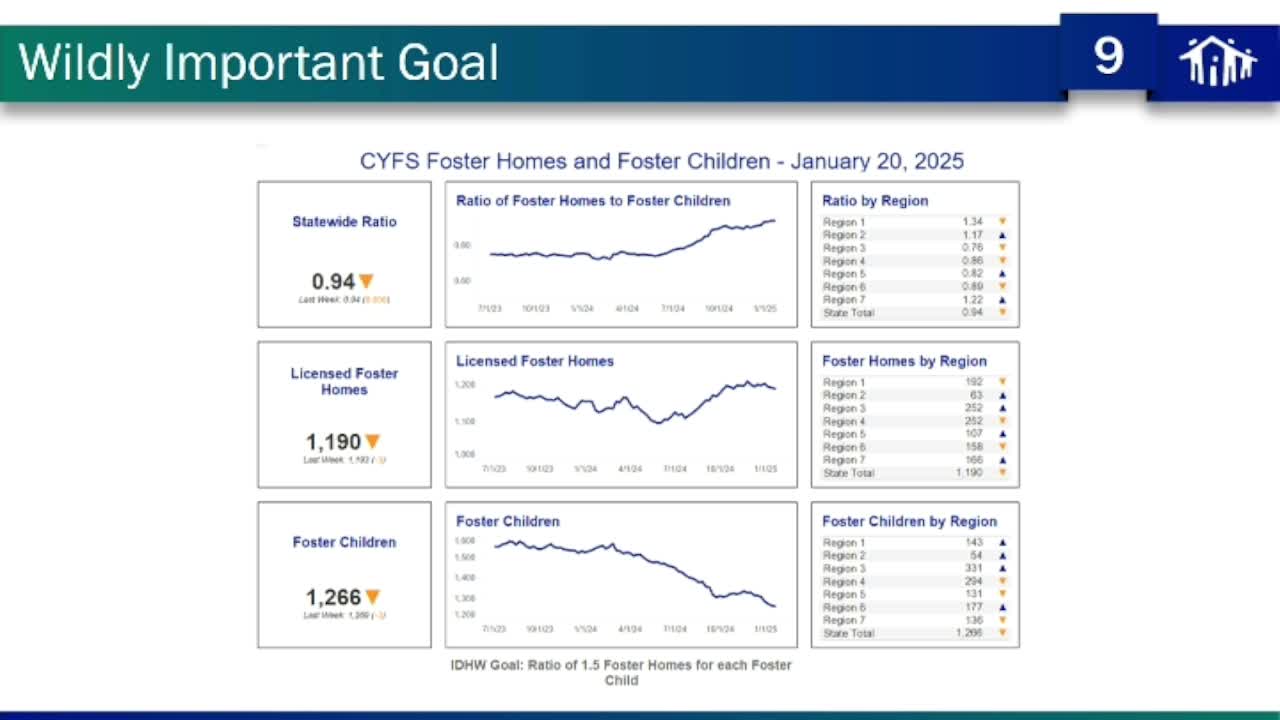
Those cost differences are central to the department's pitch: Adams said prevention and kinship care generally produce better outcomes at lower cost. He set a "wildly important goal" (WIG) to "double the rate of foster families within 24 months," noting that raising the ratio of available foster homes to children gives workers more placement options and helps reduce use of congregate care.
To reach those goals, Adams said the department has changed licensing rules, established reciprocity for families who fostered in other states, launched new outreach and advertising, partnered with organizations to offer perks (free parks passes and fishing licenses), and created a foster-family Bill of Rights and a foster-family newsletter. He said the department has also waived adoption fees and affirmed a rule to provide "maximum transparency" to vested parties in cases.
On operations and caseloads, Deputy Director Monte Pro told the committee the department's average casework target is the national range of 12 to 15 cases per worker, but actual workloads vary widely by region and by case complexity. "It just depends on the region as well," Pro said, describing regional caseloads that can range from roughly 8 to nearly 19 cases per worker in higher-demand areas.
Both leaders said the department has reduced the use of short-term placements it likened to Airbnbs. "I've got 0 Airbnbs and 0 kids," Adams said, noting the last such short-term setting was closed in November. He described a "flywheel" strategy: invest in prevention to free up foster beds, then use freed capacity to move children from congregate care into family settings, producing budget and outcome improvements over time.
Adams outlined specific budget requests the department plans to present to JFAC, including targeted pay increases for foster families (larger increases for harder-to-place children and sibling groups and smaller increases for infants), funding for recruitment and licensing staff to shorten licensing times, and a 24-hour warm line with clinician support for foster families. He said the department is also investing in software to better identify kinship placements early in a case.
Committee members pressed for further detail. Senator Wintrow asked what is keeping out-of-state placements down; Pro said many children with the highest needs require specialized programs that only a few providers can provide, but that the department is working to support in-state providers so more children can be served locally. Senator Ziderfeld asked about regulatory barriers; Adams pointed to recent rule changes that removed duplicative requirements, established reciprocity for families coming from other states, and in some cases allow remote inspections or payment for small remediation items (carbon monoxide detectors) to speed licensing.
Adams said the department's budget has seen repeated supplementals in recent years and displayed a supplemental trend that grew from roughly $1.5 million to $2.5 million to $5 million and now to a $14 million request this year. He characterized child welfare as an "open-ended entitlement program" — the department has a legal obligation to care for children committed to its custody — and said the prevention focus is a bet to slow or reverse the long-term growth in costs.
The department did not present a formal committee motion or vote during the hearing. Adams said he expects further discussion with JFAC at the department's budget hearing in the coming weeks.
Adams closed by thanking the committee for prior oversight and said the department will continue to report progress on the WIG and other measures in its offices and to the legislature.