Get Full Government Meeting Transcripts, Videos, & Alerts Forever!
Get email alerts on the Gun Violence Overview topic
No spam. Unsubscribe anytime.
Oregon experts tell legislature current laws are reducing deaths but more measures needed
Summary
Public-health and advocacy witnesses told a joint Senate and House judiciary informational hearing that Oregon’s background checks, child access prevention, ghost‑gun ban and extreme‑risk protections have reduced some harms but the state still faces higher-than-neighboring-state gun fatality rates, driven largely by suicide and rural impacts.
Oregon lawmakers held a joint informational hearing on firearm safety where public‑health researchers, advocates and practitioners summarized recent data showing progress from laws enacted over the last decade, but urged additional policy steps to reduce preventable deaths.
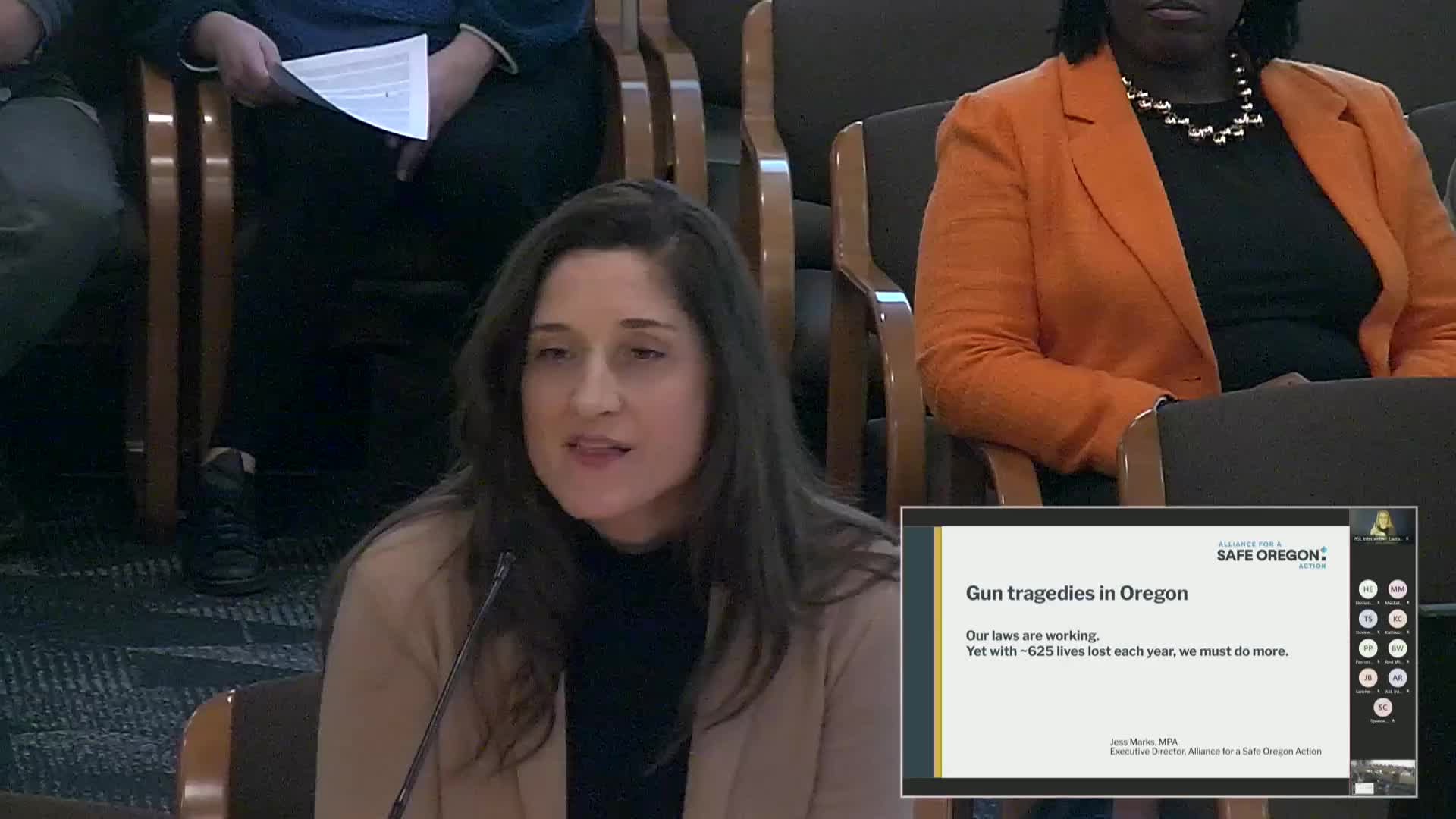
"Our laws are making a big impact on reducing our rates of gun deaths while continuing to respect our tradition of historic firearm ownership," said Jess Marks, executive director of the Alliance for a Safe Oregon, citing background checks, the state—s child access prevention law, the ghost‑gun ban and the extreme risk protection order (ERPO) statute.
Dr. Kathleen Carlson, an injury epidemiologist and founding director of the Gun Violence Prevention Research Center at OHSU–PSU School of Public Health, told the committees that Oregon—s gun death rate is higher than the U.S. average and substantially higher than California and Washington. "In Oregon, 77 percent of all of our firearm deaths are related to suicide," Carlson said, noting rural residents and veterans are disproportionately affected.
Why this matters: witnesses said recent state laws have prevented sales and removals that saved lives, but gaps remain in supply‑side oversight and in addressing suicides and community violence. Marks said over a recent five‑year span background checks stopped more than 10,000 firearm sales or transfers; Carlson highlighted a 25 percent lower youth firearm‑suicide rate in states with child access prevention laws.
Details and evidence: speakers emphasized different parts of the problem. Marks pointed to the state—s ranking on strength of gun laws and to enforcement of Oregon—s new ghost‑gun law. Carlson presented 20‑year trends showing both firearm homicide and suicide rising nationwide and noted Oregon—s firearm fatality rate of about 14.8 per 100,000—higher than the national rate. Spencer Cantrell of Johns Hopkins Center for Gun Violence Solutions summarized five evidence‑based policy areas—community violence intervention programs (CVI), firearm removal laws, purchaser licensing, limits on public carry and secure storage—and said these strategies reduce injuries and deaths when fully implemented.
Context and limits: witnesses repeatedly noted the state—s strong firearm ownership culture—roughly half of Oregon households own firearms, higher in rural areas—and cautioned that policy design must account for that context. They also said research and implementation resources remain limited: Dr. Carlson called for better Oregon‑specific evaluation of laws and Spencer Cantrell and others urged investments in CVI and clinical storage counseling.
Looking ahead: testifiers urged lawmakers to consider additional steps including dealer licensing and oversight, measures to reduce illegal diversion of guns, stronger age restrictions on certain semiautomatic rifles, and continuing to strengthen ERPO implementation and safe‑storage policies.
The hearing was informational; committee staff said written follow‑up answers to legislators— questions would be posted to the official record (OLISS).