Get Full Government Meeting Transcripts, Videos, & Alerts Forever!
Get email alerts on the State Public Defender Reform Budget topic
No spam. Unsubscribe anytime.
State Public Defender seeks millions in ongoing and one‑time funding after early transition and caseload surge
Summary
Agency created this year requests reappropriation, ongoing operating increases, personnel and onboarding funding after higher than expected caseloads and transition costs; lawmakers asked about scope, transcripts and county facility responsibilities.
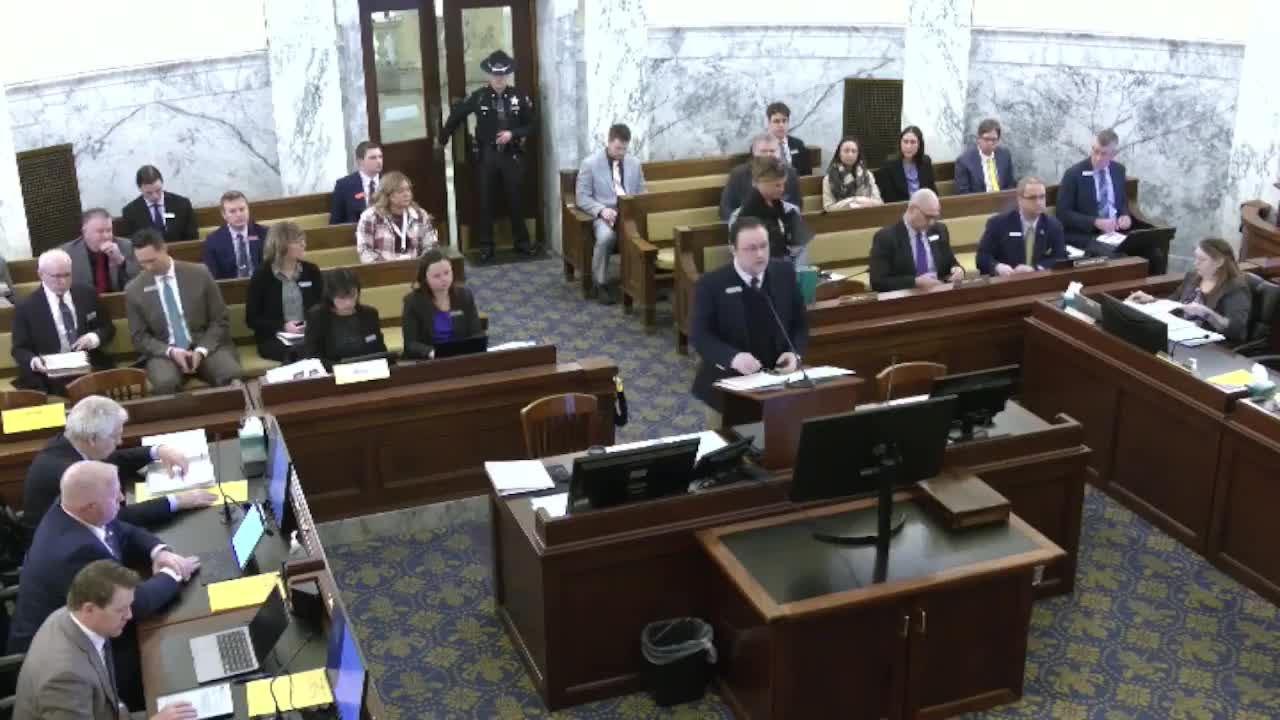
Christopher Lahoset, a Legislative Services Office budget analyst, told the Joint Finance‑Appropriations Committee the newly formed State Public Defender agency is seeking multiple supplemental and ongoing appropriations and additional positions to implement a statewide public defense system.
Lahoset said the State Public Defender was created in “title 19 chapter 60 section 3 of Idaho Code” and that the new agency’s budget relies heavily on a dedicated State Public Defense Fund. He said the Legislature directed the state controller to transfer $39 million from the tax relief fund into that dedicated fund (Lahoset cited the code reference as “section 57, 8 20 7 of Idaho code” in the presentation). The agency’s personnel budget was described as about $37.7 million, with a base appropriation just under $49 million and a current fiscal year appropriation of roughly $52,000,015.30.
Lahoset reviewed a series of supplemental and ongoing requests. For the current fiscal year, the agency requests a one‑time supplemental appropriation of $2.5 million to fully utilize the $39 million cash transfer; the governor also recommended a $390,200 one‑time supplement for transcript costs following an Idaho Supreme Court decision in State v. Blasick that made the state responsible for transcript costs. The governor recommended a one‑time $5,427,600 appropriation for additional personnel and contracting costs for the current fiscal year; Lahoset said counties subsequently provided additional financial information showing earlier forecasts were short.
For fiscal year 2026, the agency requested $2.5 million ongoing to use the cash transfer, $16,000,380 plus $80,800 from the General Fund for increased operating costs (for primary and conflict contract attorneys, investigators, experts, capital litigation, technology, training and transcripts), and authorization for about 17.96 full‑time positions to onboard institutional offices bringing Benewah, Elmore, Jerome and Shoshone counties into the state system. The governor recommended an ongoing $1,290,200 for transcript costs, a fund shift contingent on legislation, and a one‑time general fund cash transfer of $16,867,400 to the state public defense fund for recruiting, retention and contract rate increases.
Eric Fredericksen, the State Public Defender, and his staff described operational challenges during the October 1 transition into state control. Fredericksen said the office “walked into 1,300 withdrawals and cases” and that district defenders and leadership had to handle cases while new institutional offices were organized. He said COVID‑era case projections used in initial fiscal notes understated later needs because trial volumes and case activity have shifted since the pandemic.
Fredericksen told the committee the agency is handling some non‑criminal appointments and evaluations that have been pushed onto the state office; he cited psychosexual evaluations at roughly $2,500 apiece and other valuation services previously paid by counties. He also said legislation requires counties to continue providing facilities for state public defender offices until 2029, an issue committee members asked be clarified in statute or future policy work.
Lawmakers pressed for details about contracting, vacancy filling, salary structures and whether the agency should be limited to core public defense work. Fredericksen said the office has worked with DHR to standardize pay across counties and to adjust rates to attract attorneys to rural areas. Committee members asked for more detailed breakout of “miscellaneous” operating requests and for documentation on projects and county arrangements. Brady Ellis of the Idaho Housing and Finance Association and other witnesses later answered separate budget questions; Fredericksen and Lahoset closed by standing for follow‑up requests.
Committee members did not take votes during the hearing; the budget requests remain under legislative consideration.