Get Full Government Meeting Transcripts, Videos, & Alerts Forever!
Get email alerts on the Substance Abuse Funding topic
No spam. Unsubscribe anytime.
Substance-abuse budget: grants, opioid settlements and a federal compliance-driven fund swap
Summary
Analysts and the department told the committee about ongoing opioid and substance-treatment grants, Millennium Fund appropriations, and a requested fund swap so the state stays within a federal administrative cap for the substance use block grant.
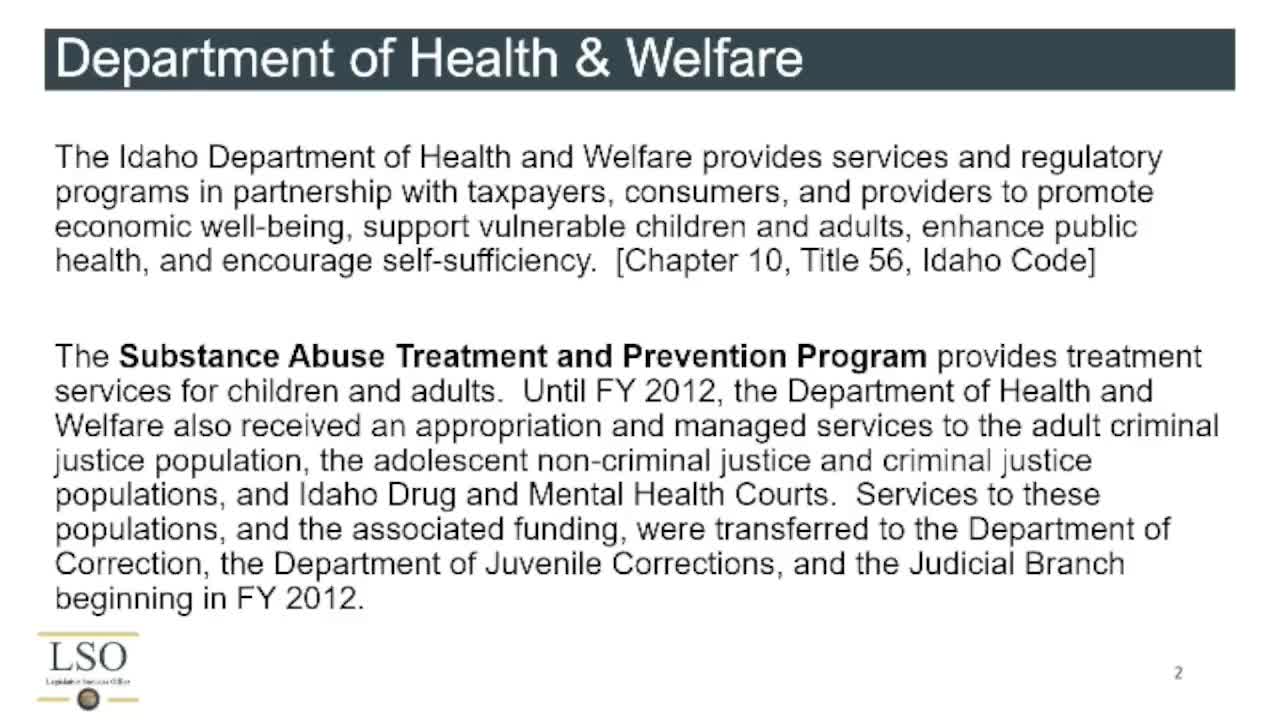
The Joint Finance-Appropriations Committee reviewed the Department of Health and Welfare's substance abuse treatment and prevention budget, including federal opioid grants, Millennium Fund appropriations and a requested fund reallocation intended to resolve a federal compliance issue.
Alex Williamson, budget and policy analyst, told the committee the division spent $22.7 million in fiscal 2024 and that most of that spending (about 70.6%) was in trustee and benefit payments (subgrants and provider payments). He noted a multi-year federal state opioid response grant that was appropriated in FY2023 and made ongoing in FY2024 for roughly $8 million.
For FY2026 the division requested a one-time supplemental to align Millennium Fund spending and several net-zero fund shifts. Williamson explained that federal guidance changed for the substance use block grant and placed Idaho on a corrective action plan because the state had exceeded the 5% cap on administrative (personnel) spending for that federal grant. To address the federal cap while maintaining staffing, the department proposed shifting $533,900 from liquor-control dedicated funds to cover personnel costs and moving $673,900 of federal personnel costs to trustee and benefit payments on the federal side. The governor's recommendation supported these net-zero shifts.
Senator Cook expressed concern the change looked like shifting money to avoid federal limits. Williamson and Director Adams said the department's proposal uses available dedicated funds to pay personnel costs so federal grant dollars can be used for allowable subgrants and provider payments. Adams said the department also reduced its requested FTP and net personnel costs in the proposed budget year as part of broader adjustments.
Committee members asked about opioid settlement-funded projects such as Boise State University's collegiate recovery program and the Idaho Drug Free Youth grant funded from the Millennium Income Fund. Adams said the department is a pass-through for many of these grants and that Boise State reported launching a collegiate recovery program that has hosted seven social events reaching roughly 375 students; Adams offered to send an update to the committee. On the Idaho Drug Free Youth program, Adams said the program has nine chapters in schools and hosts events including an Idaho Youth Summit; he said he would provide written reports for legislative review.
The department asked the committee for transfer flexibility in other budget areas as well; Williamson and Adams framed several of the requests as tools to allow the department to use underspent funds elsewhere rather than return to the legislature repeatedly for small supplementals.
No votes were taken during the hearing. The department said it will provide more detailed reports on settlement-funded projects and documentation for the proposed fund shifts.