Get Full Government Meeting Transcripts, Videos, & Alerts Forever!
Get email alerts on the Boise State Budget Launch Dei Lawsuit topic
No spam. Unsubscribe anytime.
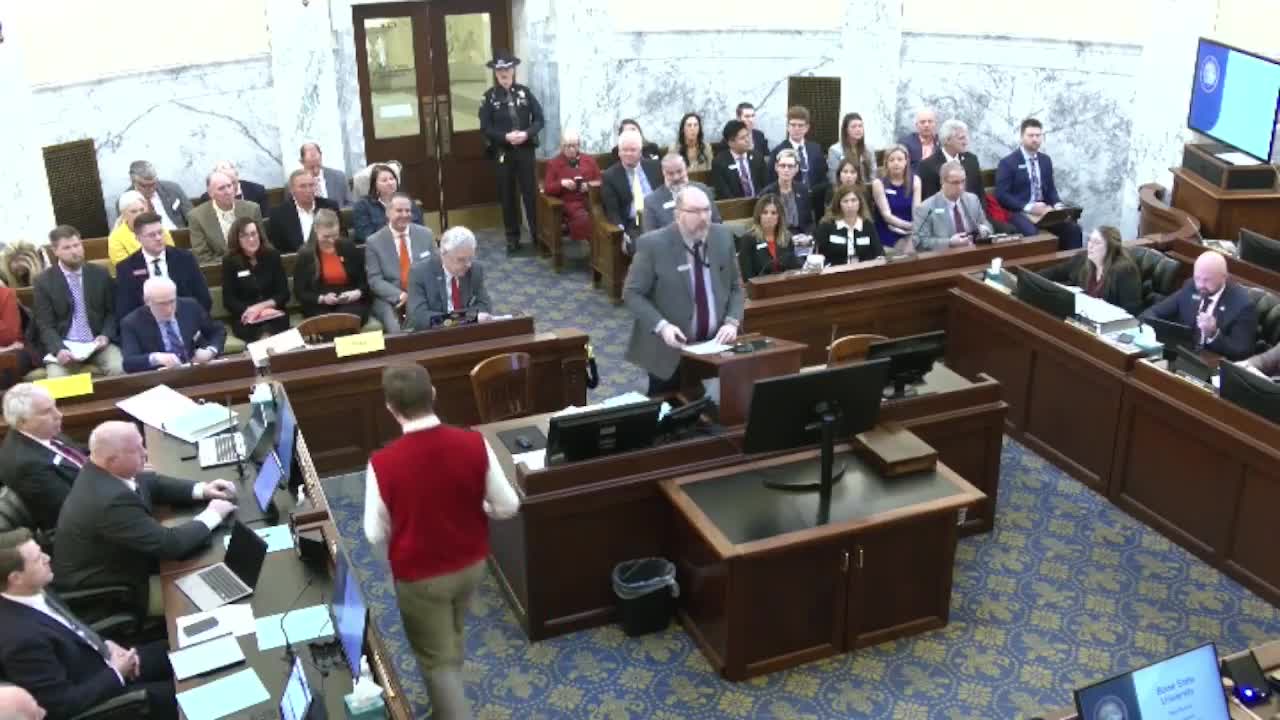
Boise State briefs JFAC on budget, LAUNCH enrollment and DEI changes; president says university used non‑tax funds to defend lawsuit
Summary
Boise State University presented its FY2026 budget overview to the Joint Finance‑Appropriations Committee on Jan. 29; President Marlene Tromp told lawmakers the university is refocusing student success programs, enrolling 1,300 students through the state LAUNCH program and has used non‑tax university funds to cover litigation costs.
Boise State University President Marlene Tromp told the Joint Finance‑Appropriations Committee on Jan. 29 that the university is continuing a multi‑year effort to refocus student success programs while presenting its FY2026 budget overview, and she provided figures and updates on several items legislators raised in questioning.
Kevin Campbell, the Legislative Services Office budget analyst, opened the overview by noting Boise State has “an enrollment of more than 27,000 students supported by 1,980.9 FTE.” Campbell summarized recent budget adjustments and enhancements, and said a five‑year look shows personnel is the largest expenditure category.
Tromp described the university’s participation in the statewide LAUNCH program and said 1,300 students are enrolled through LAUNCH, with about 600 of those students relying on LAUNCH as their only financial support. “What we're really excited about is the way that it's going to give students access to critical areas like nursing, computer science, radiological sciences, health sciences, business, mechanical engineering, elementary education, and criminal justice,” Tromp said.
On campus centers and staffing tied to diversity, equity and inclusion (DEI), Tromp said Boise State previously had several centers that were restructured over recent years. “We had 8 staff and we had centers like Student Equity and Gender Equity… The reduction in numbers of staff is 5,” she said, and added the university has redeployed functions into student success work and other offices. Tromp and committee members emphasized that no single DEI‑specific course is required for students: UF100/UF200 general‑education sequences have many sections, and students choose which sections to take.
Tromp described the Institute for Advancing American Values as part of the university’s effort to foster civil discussion and a range of viewpoints on campus. She noted faculty governance adopted the Chicago principles and that student government passed a similar commitment.
On litigation, Tromp told the committee that Boise State used non‑taxpayer funds to defend the university in the Big City Coffee lawsuit and that the university spent about $1,500,000 on the legal defense to date. “We used only non taxpayer funds to support the defense of that lawsuit,” she said. Tromp said she did not expect the appeal to add a significant amount to the total at this time.
The committee probed potential impacts of a federal memorandum and subsequent injunction that momentarily put some federal funding questions on hold. Tromp said university staff estimated a potential short‑term risk to roughly $25,000,000 in federal support before a court injunction paused the directive; she emphasized the university was reviewing affected grants and working with state and national partners to understand the implications.
Legislators also asked about employer partnerships and workforce needs tied to Micron’s expansion and semiconductor training. Tromp said BSU is expanding engineering, computer science and related programs and highlighted that the school has a device called an XTRON used in materials research that is unique outside private industry in North America.
Tromp closed with student debt statistics and budget posture: she said Boise State has a balanced budget and reported that 54% of graduates have no federal student loan debt and that median debt for students who borrow is under amounts cited in prior committee presentations.
Committee members requested additional written details—among them, itemized legal costs and confirmation that course offerings comply with Idaho law cited in committee (Idaho Code sections referenced on the record). Tromp said the university would provide requested details to the committee.