Get Full Government Meeting Transcripts, Videos, & Alerts Forever!
Get email alerts on the Injection Wells Recycled Water topic
No spam. Unsubscribe anytime.
Committee approves updated injection‑well rules, including framework for recycled water injection
Summary
The committee approved revised injection‑well rules that reorganize standards, clarify definitions and add a framework for potential injection of recycled municipal or industrial water into aquifers.
The Idaho Senate Resources and Environment Committee approved revised rules and minimum standards for the construction and use of injection wells (docket 3703032301), including a newly drafted section establishing standards for the quality of recycled water derived from municipal or industrial wastewater.
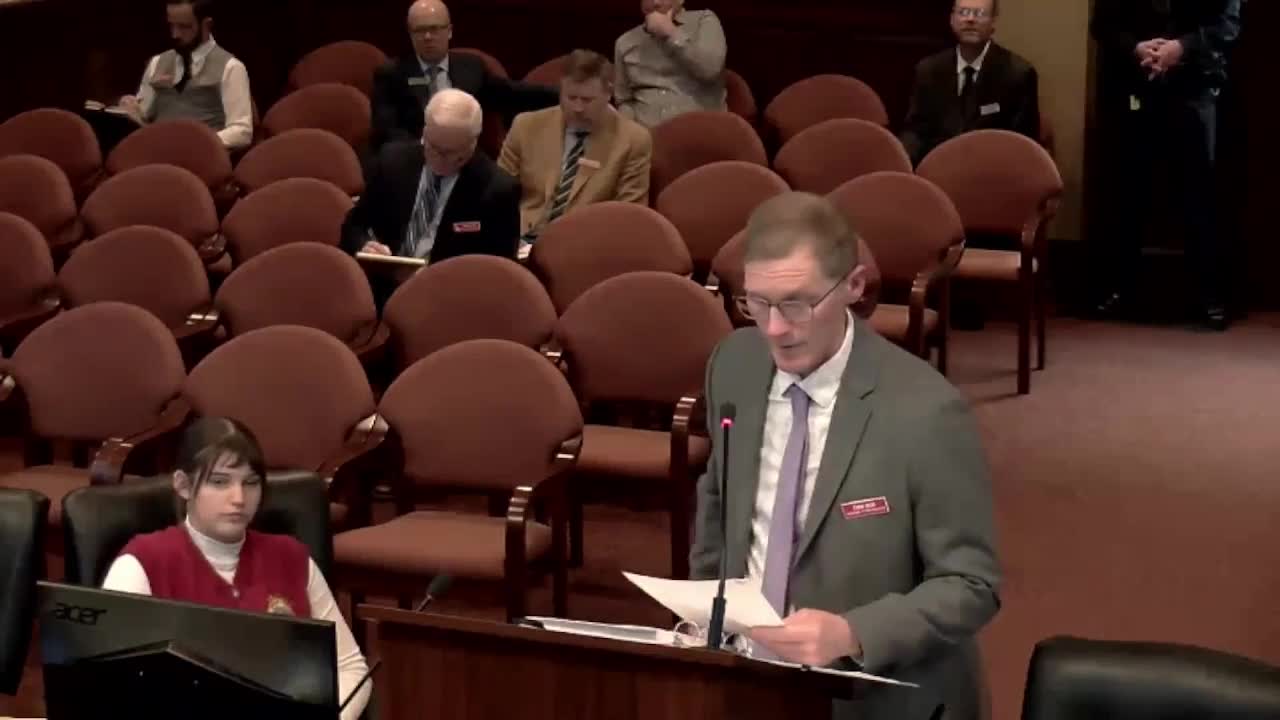
Eric Boe, the department’s Water Compliance Bureau Chief and rules regulation officer, told the committee the chapter was reorganized to make content easier to locate and to align definitions with other rule sets such as the Department of Environmental Quality’s recycled‑water rules. Boe said the chapter preserves primacy for Idaho to regulate Class 5 injection wells under the federal Safe Drinking Water Act, a primacy the department has held since 1985, and that it contains procedural and construction requirements intended to protect groundwater and public health.
The injection well rules break out classifications, permitting, construction and monitoring requirements (Rules 20, 30, 35, 50, 52, 55, 57, 58, among others). The department told the committee it added a new Rule 5506 setting standards for recycled water quality when injection of treated municipal or industrial wastewater into drinking aquifers is proposed. The department also said the proposed rule streamlines procedures to allow municipalities more flexibility for land‑application methods and removed unnecessary definitions.
Senator Guthrie asked for basic information about injection wells. Boe explained the EPA class system: Class 1 (hazardous) and some other classes are prohibited in Idaho by statute; Class 5 covers non‑hazardous fluids injected into or above underground sources of drinking water and is regulated by the department; Class 6 (carbon sequestration) is prohibited in Idaho. He said injection wells in Idaho vary in depth — the department defines an injection well as 18 feet or deeper — and subclassifications include aquifer recharge and heat‑pump return flows.
Jason Van Gilder, public‑works director for the city of Middleton, testified in favor of the revised rules. He described Middleton’s pilot use of subsurface drip irrigation to apply highly treated effluent to alfalfa fields as a way to reduce discharge to the Boise River. Van Gilder said the updated rules address situations like Middleton’s without undermining groundwater protection.
The department published the proposed injection well rules Oct. 2, 2024, and published the pending rule without modification Dec. 4, 2024. Boe asked for committee support; Senator Harris moved to accept the docket and Senator Ben Orton seconded. The motion carried by voice vote with no recorded opposition, and the committee approved docket 3703032301.
Key points: the rules maintain state primacy for Class 5 injection wells, reorganize content for clarity, align definitions with DEQ, add a standards framework for recycled water injection, and clarify permit, monitoring and enforcement procedures.