Get Full Government Meeting Transcripts, Videos, & Alerts Forever!
Get email alerts on the Employee Health Insurance topic
No spam. Unsubscribe anytime.
Joint finance panel approves $14,130 health‑insurance allocation per FTE for FY2026
Summary
The Idaho Joint Finance-Appropriations Committee on Jan. 31 approved a $14,130 per‑full‑time‑equivalent allocation for state employee health insurance in FY2026, choosing a compromise amid competing motions and discussion of reserve balances and actuarial projections.
The Joint Finance-Appropriations Committee voted on Jan. 31 to set the fiscal‑year 2026 health‑insurance appropriation at $14,130 per eligible full‑time equivalent position, a compromise figure the committee described as the midpoint between the CEC committee recommendation and the governor’s request.
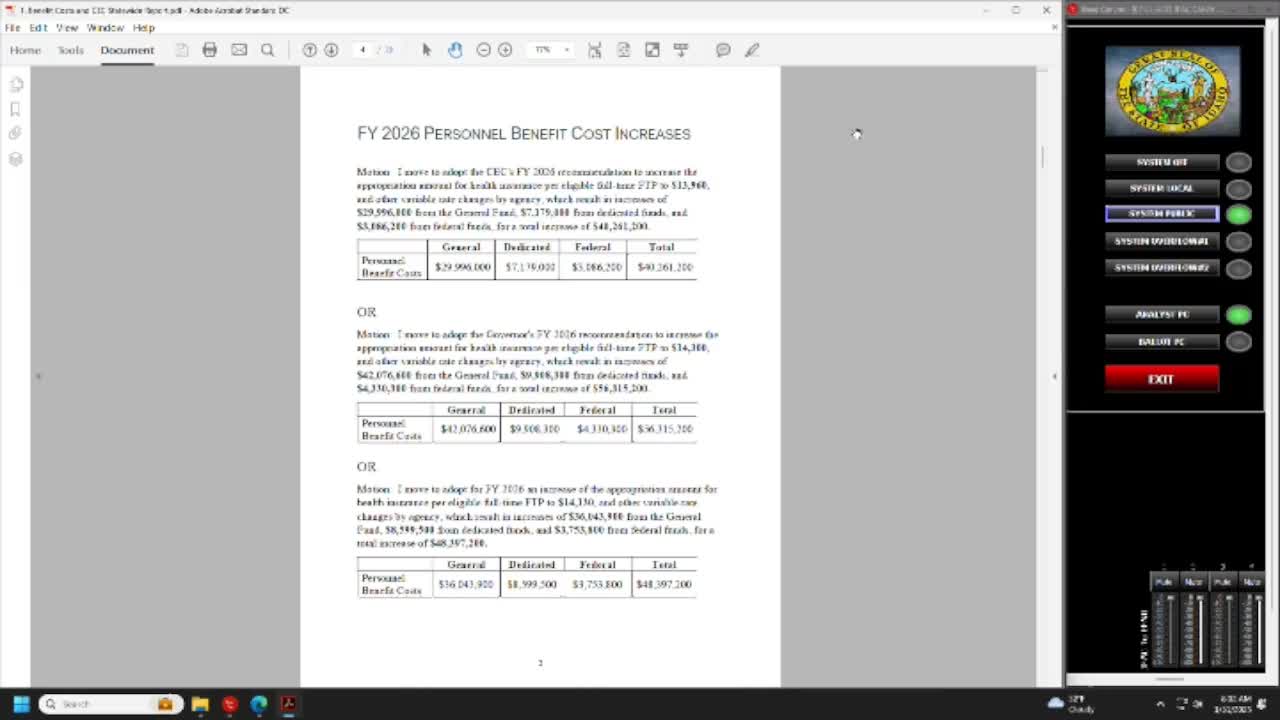
Committee analyst Erik Bybee described three dollar‑amount options on the screen: $13,960 per FTE (CEC recommendation), $14,300 per FTE (governor’s recommendation) and the midpoint of $14,130. The $14,130 motion, moved by Senator Woodward and seconded by Representative Tanner, carried with a joint committee vote of 17 ayes, 0 nays and 3 absent/excused, and will carry a due‑pass recommendation.
Why it matters: the per‑FTE figure determines how agencies budget for rising medical and employer‑paid personnel costs statewide. Committee members debated how each choice would affect the insurance reserve account and future premiums.
Most important facts: Mr. Bybee told the committee the projected ending reserve balances for FY2026 would be about $51.6 million under the $13,960 motion and $61.4 million under the $14,300 motion; he said the midpoint figure would fall between those amounts. Representative Furness challenged actuarial projections and presented a historical reserve narrative, saying past projections have been “too conservative” and arguing the recommended floor might be higher than needed. Senator Ward Engelking urged the committee to “reflect the actual cost of insurance,” warning that using reserves to buy premiums down can make future increases look larger.
The committee followed the agreed voting procedure for joint items and Ms. Figueroa conducted roll calls for both chambers. The recorded joint outcome: Senate 8 ayes, 0 nays, 2 absent/excused; House 9 ayes, 0 nays, 1 absent/excused, for a total of 17 ayes, 0 nays, 3 absent/excused.
The committee chair said the motion will carry a due‑pass recommendation and the panel moved on to Change‑in‑Employee‑Compensation (CEC) discussions, which did not produce a decision on raises.