Get Full Government Meeting Transcripts, Videos, & Alerts Forever!
Get email alerts on the Beneficial Use Examinations topic
No spam. Unsubscribe anytime.
Committee holds beneficial‑use examiner rules after questions about definition of "beneficial use"
Summary
Senators asked whether the revised beneficial‑use examination rules define "beneficial use." The committee voted to hold the docket for further consideration.
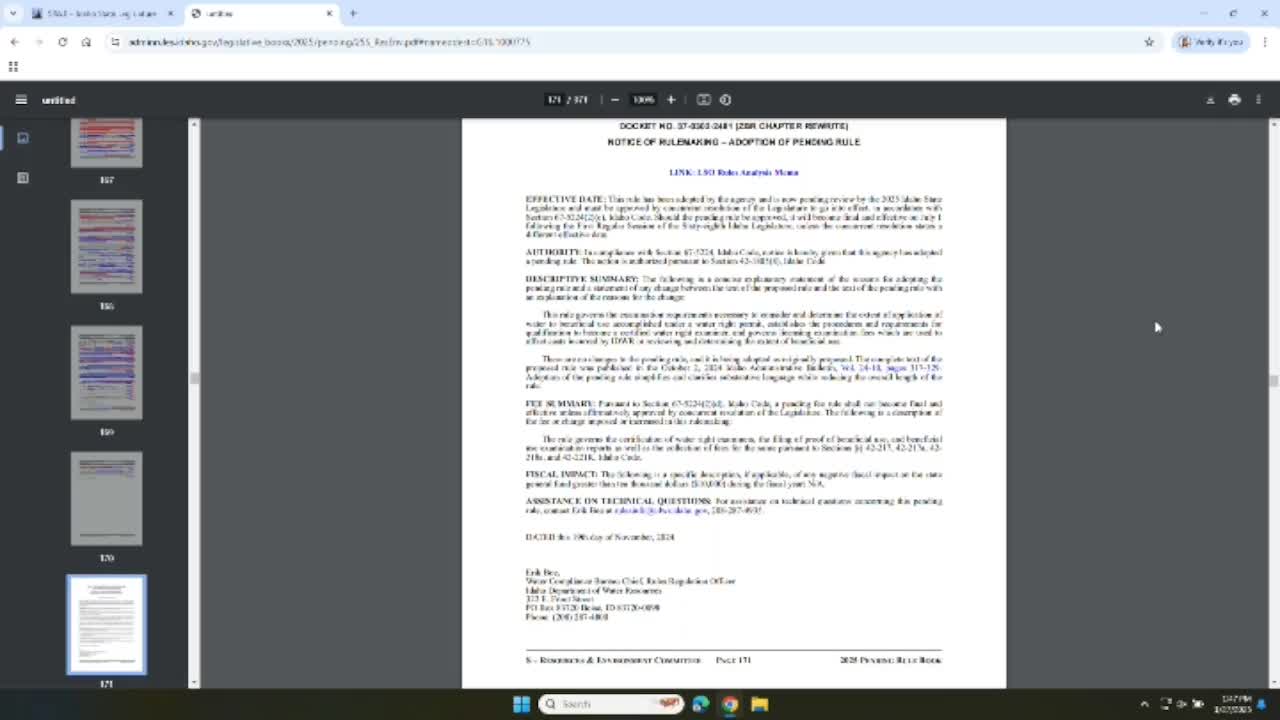
The Idaho Senate Resources and Environment Committee held the pending beneficial‑use examination rulemaking (docket 3703022401) after committee members raised questions about whether the rules define the term “beneficial use.” The Department of Water Resources presented the negotiated rule chapter and staff answered technical questions but the committee opted to hold the docket at the chair’s call for further review.
Eric Boe, Water Compliance Bureau Chief and rules regulation officer for the Department of Water Resources, said the chapter sets procedures to certify water‑rights examiners, establishes reporting standards for examination reports and governs licensing fees. The department emphasized that it did not change fees in the chapter and that the proposed text reorganizes and clarifies definitions, measurement standards and reporting requirements. Boe said the department published the proposed rule Oct. 2, 2024, and the pending rule without modification on Dec. 4, 2024.
Committee members asked technical questions. Senator Harris asked why some units were changed from cubic feet to gallons; Phil Hummer, water rights section manager and subject-matter expert, said the change aligns the chapter with the state’s water‑appropriation rules. Senator Guthrie and other members pressed about whether the rules include a definition of “beneficial use.” Deputy Director Shelly Keane, who worked in the department’s water‑rights section for more than two decades, told the committee the department does not rely on a single statutory definition; rather, it evaluates beneficial use in the context of each water‑right record and uses a list of common beneficial uses (irrigation, domestic, stock water, commercial, industrial) in its water‑rights database.
The department also described specific substantive changes in the chapter, including allowing the use of 50 years of climate data for commercial snowmaking permits to adjust volume calculations (aligned with department practice) and replacing vague municipal volume‑reporting terminology with statutory definitions. The department said it received minimal public participation during negotiation but did consider written comments.
Senator Van Orden moved to hold docket 3703022401 at the call of the chair; Senator Guthrie seconded. The motion passed by voice vote with no recorded opposition.
The department asked the committee to consider whether a statutory definition or additional rule text is needed to define beneficial use; committee members signaled interest in reviewing the statutory and case‑law context before deciding.