Get Full Government Meeting Transcripts, Videos, & Alerts Forever!
Get email alerts on the Training Post topic
No spam. Unsubscribe anytime.
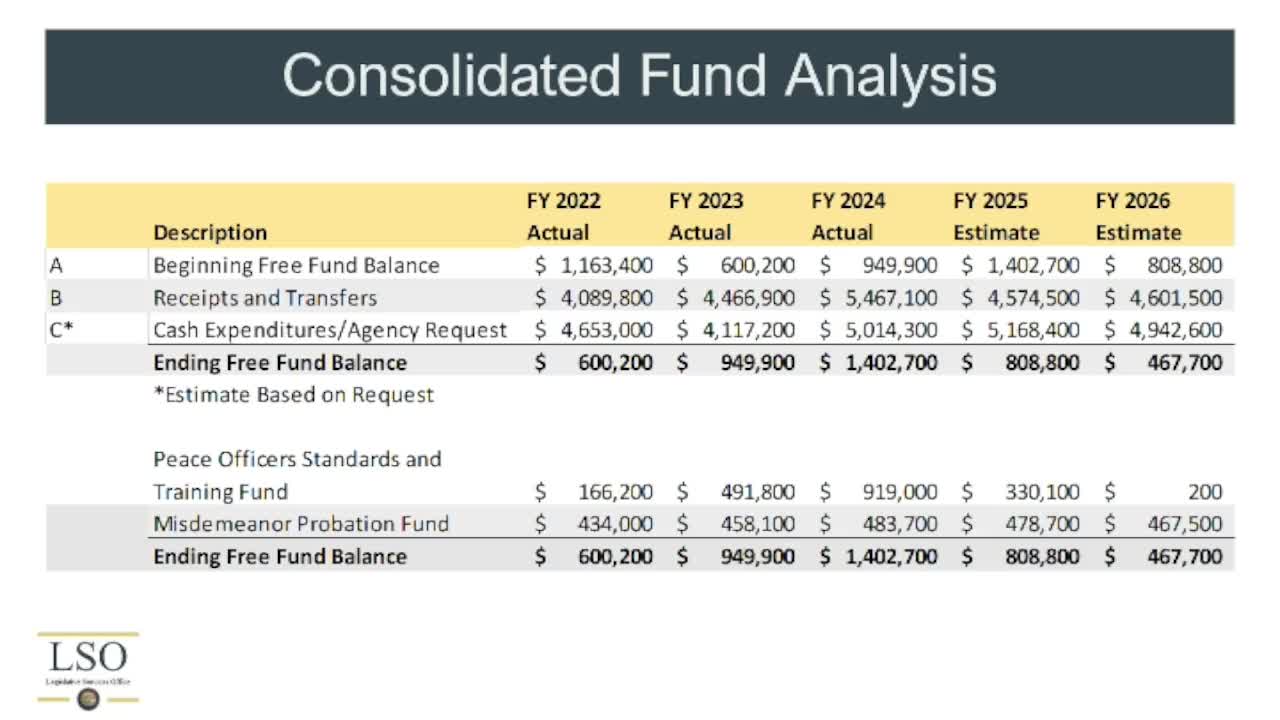
POST reports strained dedicated fund, rising collection revenue and plans for statewide basic‑training review
Summary
The Peace Officer Standards and Training Academy told the Joint Finance committee its dedicated fund has declined in recent years, that collections on fall‑off agreements have increased miscellaneous revenue, and that a working group will present a plan for basic‑training delivery within about a year.
The Peace Officer Standards and Training (POST) division told the Joint Finance and Appropriations Committee on Feb. 12 that dedicated revenue pressures and rising training costs have required occasional general‑fund transfers and a closer look at how basic training is delivered across Idaho.
Noah Peterson, budget policy analyst, summarized POST’s revenue sources and trends, noting a recent liquor‑fund transfer created by 2022 legislation and an increase in miscellaneous revenue tied to post‑attendance repayment agreements when trainees leave the profession within their contractual period.
Brad Johnson, administrator of Peace Officer Standards and Training, said each POST student signs a two‑year agreement obligating them to repay training costs if they leave law enforcement during that period. “We send those automatically, if we're unable to work out some kind of a payment plan with that student… it goes to collections and collections agencies have been much more effective in collecting those monies due than what we were able to in the past,” Johnson said, explaining why miscellaneous revenue in the POST fund has increased.
POST reported that its patrol academy cost is currently about $12,000 per student and that academy length varies by program; the patrol academy is the longest at roughly 14 weeks. The division requested a technical record specialist conversion (net 0.33 FTP, $20,800) to reduce certification backlog, and replacement items including a 15‑passenger van and IT hardware (the agency requested $111,600 for vehicle replacements and $61,600 for IT items, as recommended by OITS).
Johnson described a newly created POST council working group that is studying statewide basic‑training delivery and the mix of providers — POST, agency‑based programs and college programs — with the goal of bringing a recommendation to the legislature within about a year. He said one practical barrier to broader college‑based delivery is a lack of facilities such as a dedicated training track; Meridian is currently the only location with a dedicated track.
Committee members asked about enrollment trends, tuition/repayment amounts and how to recruit and retain officers. Johnson said POST does not recruit hires for agencies; it trains personnel agencies send. He and staff said they will provide the committee with updated tuition and program cost breakdowns and other financial details on request.
The committee did not take a formal vote on POST funding during the session; staff and members requested follow‑up material, including revenue detail and a clearer picture of training provided by colleges and local agencies across the state.