Get Full Government Meeting Transcripts, Videos, & Alerts Forever!
Get email alerts on the Safe Haven Placement topic
No spam. Unsubscribe anytime.
Committee advances bill to speed placement of newborns surrendered under safe‑haven law, with tribal notification rules
Summary
The Senate Health and Welfare Committee on Thursday advanced Senate Bill 1058, which would require the Department of Health and Welfare to maintain a list of licensed adoption agencies and, where possible, transfer custody of newborns surrendered under Idaho's safe‑haven law to those agencies within 24 hours.
The Senate Health and Welfare Committee voted to send Senate Bill 1058 to the floor with a do‑pass recommendation after hearing testimony from adoption agencies, tribal representatives and a foster/adoptive parent. Sponsor Senator Tammy Nichols said the bill updates Idaho’s safe‑haven law to speed placement of infants surrendered at licensed locations and to clarify Indian Child Welfare Act (ICWA) notifications.
Under the bill as presented, hospitals, fire stations or law enforcement personnel receiving a surrendered newborn would have procedures to transfer custody to a licensed adoption agency within 24 hours when an appropriate adoptive placement is ready. The bill requires immediate notification to a child's tribe or the Bureau of Indian Affairs if the child may be an Indian child and states that ICWA notices must be issued within 10 days. Senator Nichols said the changes aim to avoid unnecessary entries into foster care and place surrendered infants with vetted adoptive families more quickly.
"These boxes provide a safe and anonymous alternative for parents to surrender newborns," Nichols said, noting Idaho opened its first baby box in Blackfoot last year and that adoption agencies across the state stand ready to receive placements.
Adoption agency representatives and supporters backed the bill. Kara Walsh, a licensed social worker with New Beginning Adoption Agency, said early bonding and continuity matter and that "by making this change we reduce unnecessary transitions." Terry Marcroft of Unplanned Good said the bill "decrease[s] the amount of time to which the Department of Health and Welfare has already expressed their consent" and would not change longer procedural milestones in the adoption process.
Tribal representatives described close collaboration on the bill's language. Tyrell Stevenson, legislative director for the Coeur d'Alene Tribe, explained ICWA's purpose: "ICWA is really a law designed to keep families together," and said the bill was crafted with tribal input to ensure tribes would be notified promptly when appropriate. Blake Hude of the Shoshone‑Bannock Tribes said the tribes and Health and Welfare worked together on language to align state procedures with federal ICWA requirements.
Not all witnesses supported the approach. Whitney Wunderlich, who adopted a baby surrendered under the Safe Haven Act through the foster care system last year, urged caution. "I disagree with this bill because it would place vulnerable babies with potentially complex unknown medical and behavioral conditions with adoptive parents that would not likely have the same interest experience and training of Idaho foster parents," she testified, and suggested expediting adoption within the foster system as an alternative.
Committee discussion reflected those tensions. Senator Wintrow expressed concern about normalizing anonymous surrender and the risk of not knowing a child's medical history or whether coercion occurred, saying she was "struggling" with approving the bill despite supporting tribal provisions. Sponsor Nichols and tribal advocates said the bill preserves anonymity for surrendering parents while allowing voluntary identification of tribal status and that the amendments were intended to balance safety, anonymity and rapid placement.
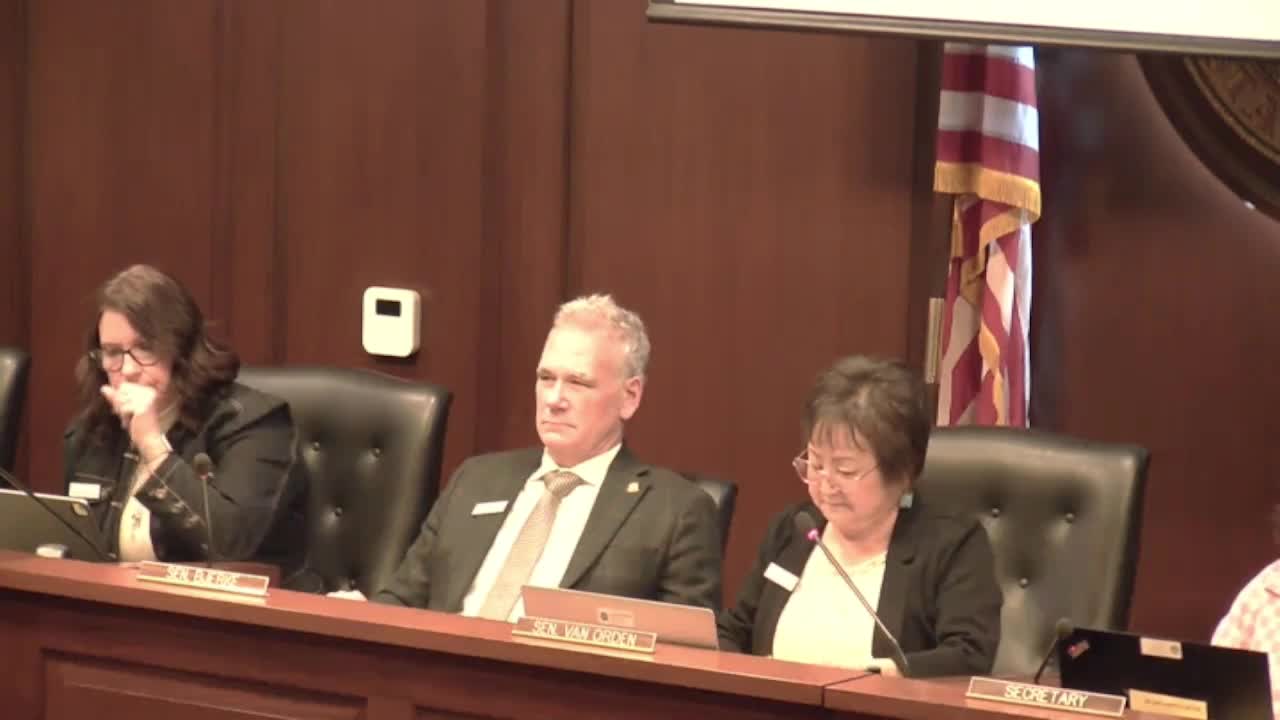
Senator Keiser moved and Senator Beierke seconded that the committee send Senate Bill 1058 to the floor with a do‑pass recommendation. The motion carried on a voice vote; Senator Wintrow stated she intended to vote no.
Votes at a glance: The committee moved Senate Bill 1058 to the floor on a do‑pass recommendation (motion moved by Senator Keiser; seconded by Senator Beierke; voice vote; at least one recorded opposition by Senator Wintrow).