Get Full Government Meeting Transcripts, Videos, & Alerts Forever!
Get email alerts on the Able Accounts topic
No spam. Unsubscribe anytime.
Senate committee advances bill to let Idaho join multistate ABLE account consortium
Summary
The Senate Health and Welfare Committee voted to send House Bill 26 to the floor with a "do pass" recommendation after hearing testimony that joining a multistate ABLE consortium would reduce account fees for Idahoans with disabilities and allow in‑state outreach and oversight.
The Senate Health and Welfare Committee on Thursday advanced House Bill 26, which would authorize the state treasurer to join a multistate consortium that operates ABLE accounts for people with disabilities. Treasurer Julie Ellsworth asked the committee for a "do pass" recommendation, saying the change would let Idaho offer an in‑state ABLE option while lowering fees for account holders.
ABLE accounts allow people with disabilities to save for disability‑related expenses without jeopardizing eligibility for benefits such as Medicaid and Supplemental Security Income. "By joining a consortium ... it will take it down to 19 to 33% basis points," Treasurer Julie Ellsworth told the committee, contrasting that range with the higher fees Idahoans currently pay through out‑of‑state programs.
The bill would let the State Treasurer select and join an existing multistate program after required legal review. Ellsworth said the state already recognizes ABLE accounts under Idaho law and that the change would have "not a fiscal impact" to state government while allowing the state to capture some account fees to support outreach and financial literacy efforts.
Advocates and people who use ABLE accounts testified in favor. Lisa Anderson, advocacy director for AARP Idaho, told the committee that ABLE accounts are "a common sense solution that permit Idahoans with disabilities to save and manage their money without worrying about losing the critical benefits they need." Rochelle Tierney of the Idaho Council on Developmental Disabilities said an Idaho program would "help keep fees down for account holders" and "provide greater oversight and protection for Idaho account holders."
Several account holders described practical difficulties from having out‑of‑state accounts. Tara Rowe, who said she has an ABLE account established through the Tennessee State Treasurer, described the administrative hurdles: "If I need money from my own account ... I have to call Tennessee who then has to call their bank in Boston to cut me a check that they then will mail to me," she said, adding that large transfers to her regular bank could risk exceeding Medicaid asset limits. Self‑advocate Ian Bott and parent advocates such as Britney Shipley and Dwight Johnson also spoke in support.
Committee members asked clarifying questions about several provisions. Senator Several members asked about a state "clawback" — the practice by which unspent funds remaining in an ABLE account at the account holder's death may be used to reimburse the state for Medicaid costs. Ellsworth confirmed the bill includes a clawback provision, calling the requirement "a clawback" and noting some states do not have one. "It is a clawback. That is, not necessarily a popular thing with the people that want the ABLE accounts," she said, adding that including it would also protect Idahoans from being targeted by out‑of‑state programs.
Ellsworth also described an advisory council that the treasurer's office plans to use for stakeholder input; she said appointees would "serve without honorarium compensation or expense reimbursement of any kind." The treasurer noted a federal change expanding the age eligibility for ABLE accounts in 2026, raising the age cap to 46 and potentially extending benefits to more veterans and older people who developed disabilities later in life.
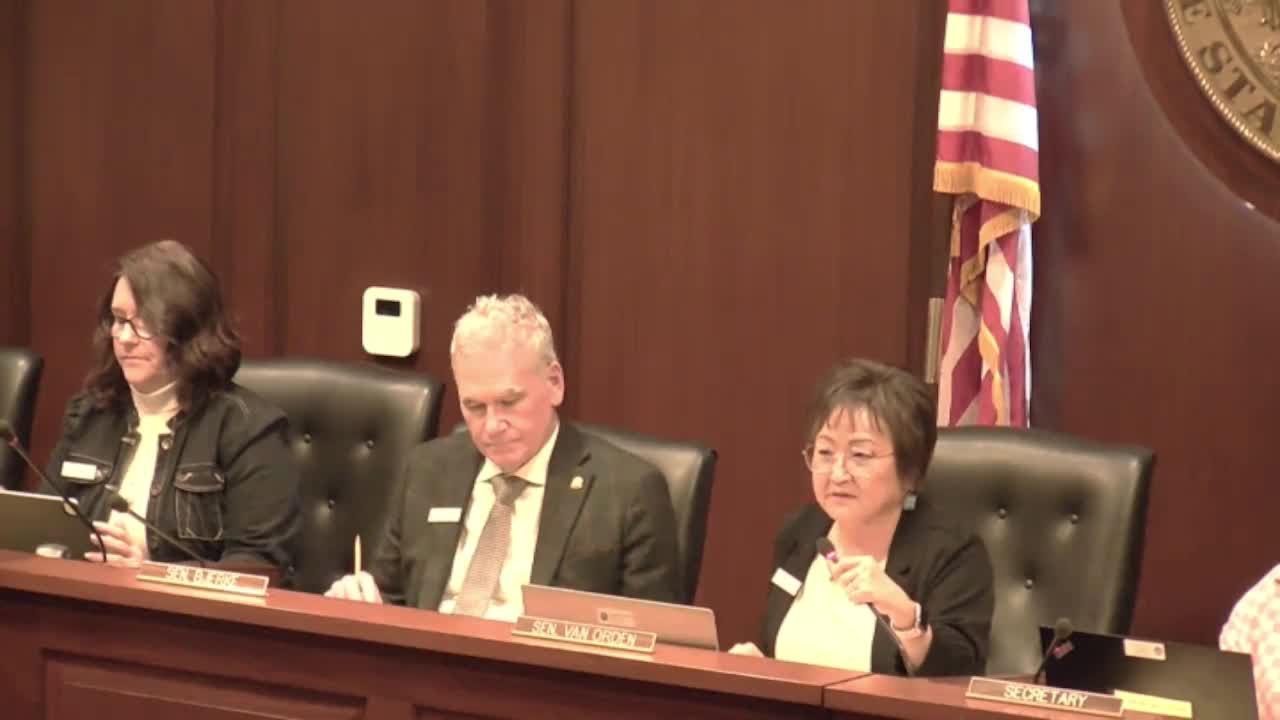
After testimony and brief committee discussion, Senator Shippey moved and Senator Wintrow seconded that the committee send House Bill 26 to the Senate floor with a do‑pass recommendation. The committee approved the motion by voice vote; no recorded nays were announced.
Votes at a glance: The committee moved House Bill 26 to the floor on a do‑pass recommendation (motion moved by Senator Shippey; seconded by Senator Wintrow; voice vote).