Get Full Government Meeting Transcripts, Videos, & Alerts Forever!
Get email alerts on the State Public Defender topic
No spam. Unsubscribe anytime.
New State Public Defender agency seeks millions for operations, transcript costs and county onboarding
Summary
The newly formed Idaho Office of the State Public Defender presented its first budget to the Joint Finance‑Appropriations Committee, requesting supplemental and ongoing appropriations tied to a $39 million cash transfer into a dedicated state public defense fund and seeking authorization for new staffing and county onboarding.
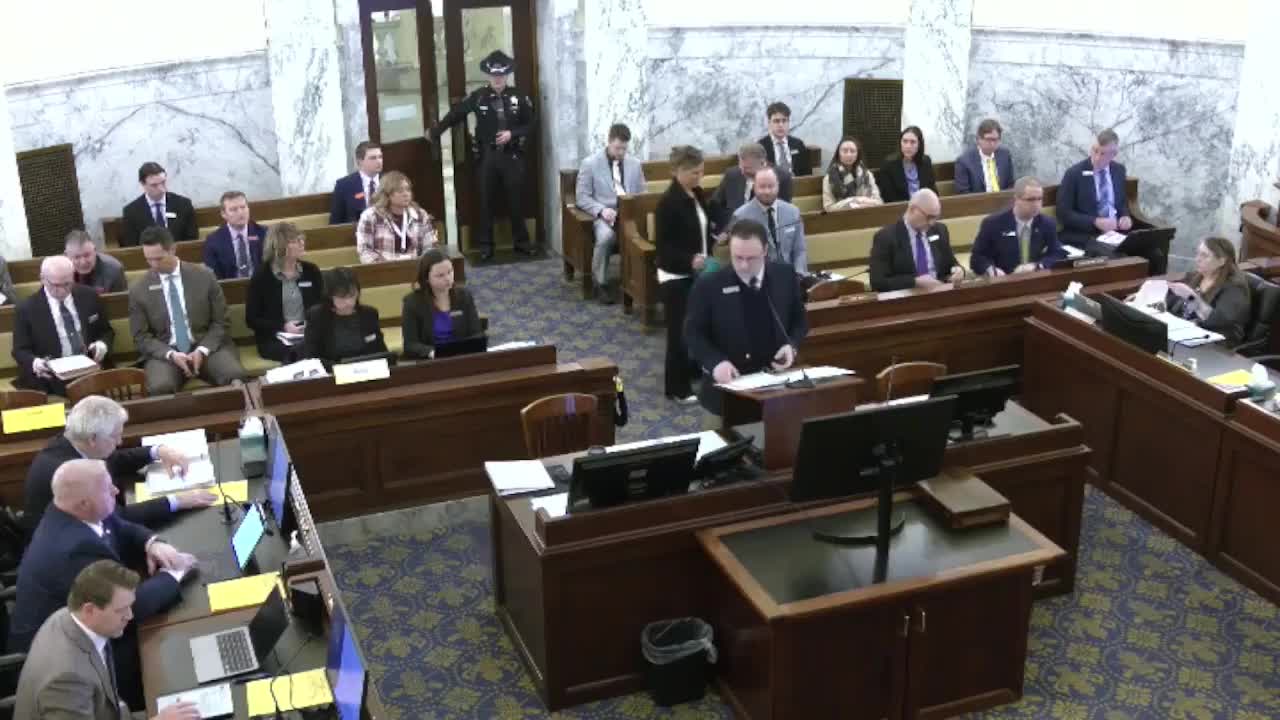
Christopher Lahoset, budget analyst with the Legislative Services Office, presented the Office of the State Public Defender’s first agency budget to the Joint Finance‑Appropriations Committee and outlined its funding sources, staffing and enhancement requests.
Lahoset said the new agency was established by statute in “title 19, chapter 60, section 3 of Idaho Code” and that a one‑time transfer directed by statute (cited in the presentation as section 57‑8207) required the state controller to move $39 million from the tax relief fund into the state public defense fund. Lahoset said roughly two‑thirds of the agency’s fiscal 2025 funding will sit in that dedicated state public defense fund and that, because cash transfers require both cash and legislative appropriation, the agency needs supplemental spending authority to use the transferred cash.
Lahoset summarized several supplemental and ongoing requests. For the current fiscal year the agency requests a one‑time supplemental appropriation of $2,500,000 to fully utilize the cash transfer into the state public defense fund; Lahoset said the money is earmarked “to provide representation for children and parents who qualify under the Child Protective Act.” The governor recommended an additional one‑time $390,200 for transcript costs after the Idaho Supreme Court’s Dec. 5, 2024 decision in State v. Blasick, which Lahoset said requires the state to cover court‑ordered transcripts. The governor also recommended a one‑time supplemental of $5,427,600 for additional personnel and contracting costs to recruit and retain staff and increase contract rates.
For fiscal 2026 the agency seeks $2,500,000 ongoing to fully utilize the earlier $39,000,000 transfer and an operating request listed in the budget book (identified in testimony as roughly $16,000,380 and other smaller line items) to fund contract attorneys, investigators, expert witnesses, capital litigation costs, training and transcripts. The agency also seeks authorization for about 17.96 full‑time positions to staff four new institutional offices as counties are onboarded (Benewah, Elmore, Jerome and Shoshone counties were named in testimony).
State Public Defender Eric Frederickson appeared before the committee with staff and said the agency has been working through a volatile transition since Oct. 1, when the state took over public defense for some counties. Frederickson said the office “walked into 1,300 withdrawals and cases” at the outset and described a rapid increase in filings as the state learned more about the workload; he said COVID‑era caseload estimates used in earlier fiscal notes proved lower than actual demand. Frederickson said the agency lost contract attorneys and some experienced staff during transition and that rates and contract structures required revision.
Committee members pressed for detail on several line items. Senator Ziderfeld asked what “experts” (a $2,000,000 line in the budget book) covers; Frederickson said it primarily pays for experts in capital cases and other expensive evaluations. Senators and representatives asked for a more detailed breakdown of “training, transcripts and miscellaneous expenditures” (described in testimony as about $3,581,000) and for lists of services and vendor types; Frederickson said some evaluations (for example psychosexual evaluations) run about $2,500 each and that counties previously covered many of those costs.
Members also asked about facilities and county responsibilities. Frederickson said legislation requires counties to provide facilities until 2029, and that memoranda of understanding—not leases—have been used in many cases to allow the state agency to occupy county space without formal contracting for 1:1 ownership transfer.
Several legislators urged clearer statutory limits on the agency’s appointment scope. Frederickson said the office has sometimes been appointed to matters outside criminal defense—including custody and private terminations—and has litigated to relieve itself of improper appointments. He requested legislative clarity if the committee believes appointments should be limited.
Frederickson and Lahoset said the funding shortfall stems from both underestimates during formation and higher ongoing costs—candidates, investigators, experts and capital litigation—plus the need to equalize pay across counties to recruit in rural areas. Frederickson told the committee that with increases in salary and a return to stable staffing, the agency expects to attract experienced public defense attorneys back into state work.
The committee asked for additional detail on miscellaneous expenditures, the scope of expert costs, the exact composition of the $39,000,000 transfer and the planned timeline and cost breakdown for onboarding additional counties; staff committed to follow up with more detailed lists and cost breakdowns. No formal vote or appropriation was taken at the hearing.