Get Full Government Meeting Transcripts, Videos, & Alerts Forever!
Get email alerts on the Employee Compensation Fy2026 topic
No spam. Unsubscribe anytime.
Committee debates employee compensation proposals; motions withdrawn, decision postponed
Summary
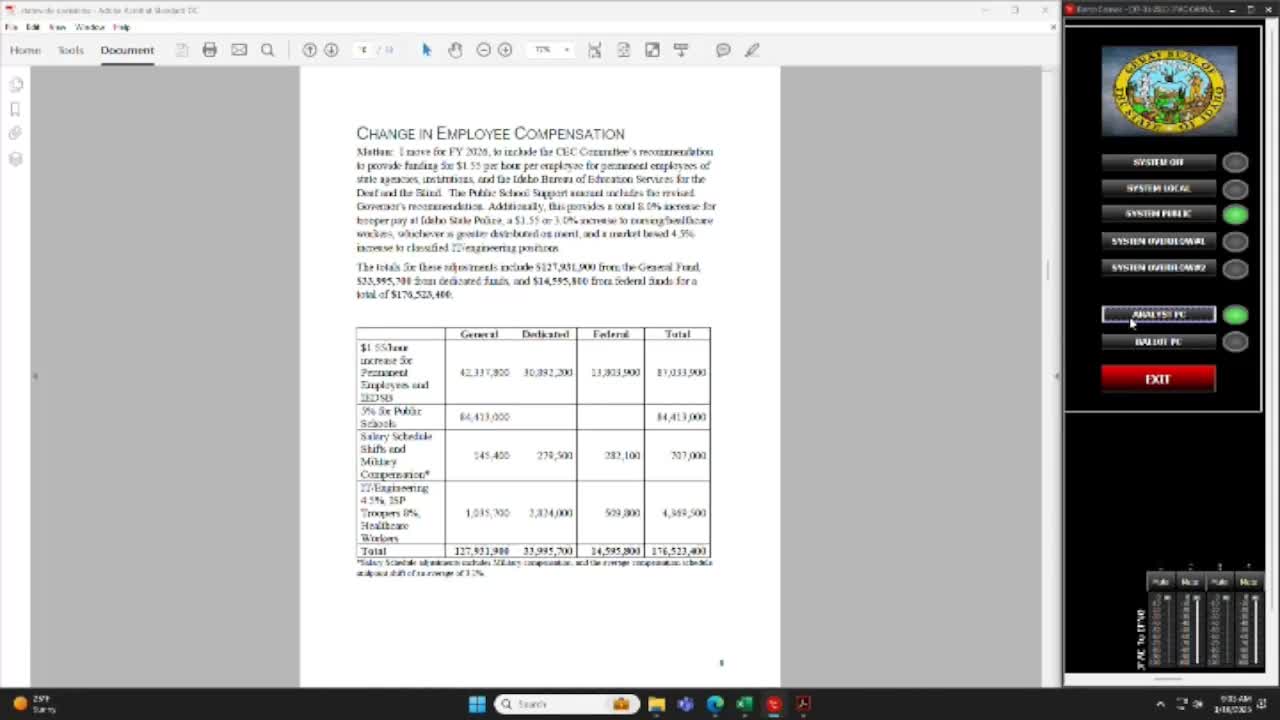
Lawmakers debated competing FY2026 employee compensation proposals—a flat-dollar $1.55-per-hour approach with targeted increases versus a merit/percentage-based substitute—but withdrew the pending motions and postponed a decision so staff could correct omissions and present consolidated numbers.
The committee devoted extended time to competing proposals for FY2026 employee compensation and related policy language. Two primary approaches emerged: (1) a CEC committee recommendation that would provide a $1.55-per-hour increase for permanent state employees (a flat-dollar approach), with additional targeted increases (an 8% increase for Idaho State Police trooper pay, a $1.55-or-3% increase for nursing/healthcare workers, whichever is greater, and a 4.5% market-based increase for classified and non‑classified IT and engineering positions); and (2) a substitute motion offered by Senator Cook to increase ongoing annual salaries by $1.55 per hour or 4%, whichever is higher, with further targeted increases for troopers, nurses and IT/engineering positions, to be distributed on merit.
The proposals provoked robust debate on equity vs. merit, market competitiveness, turnover at different pay scales and the impact on local governments and private-sector labor markets. Supporters of the flat-dollar approach said the dollar increase benefits lower-paid employees proportionally more, while supporters of the substitute urged merit and percentage-based increases to preserve pay equity for higher-skilled positions and to avoid government driving up private-sector wages.
During the meeting staff and committee members identified omissions and clarified language, including adding non‑classified IT employees to the scope. After multiple motions, amendments and a recess to provide corrected text, Representative Furness and Senator Cook both withdrew their motions by unanimous consent so staff could reformat and re-present the proposals with clear numbers and correct inclusions. The committee then agreed to postpone final action to allow staff additional time to finalize language and numbers.
Committee chairs and staff said maintenance-budget work would proceed the next day and that properly formatted compensation proposals would be returned to the committee for action at a later date.