Get Full Government Meeting Transcripts, Videos, & Alerts Forever!
Get email alerts on the Health Insurance Reserve topic
No spam. Unsubscribe anytime.
JFAC debates FY2026 health insurance increase and reserves; no change adopted
Summary
Committee members debated two health insurance funding proposals—CEC's recommendation setting per-eligible FTE at $13,960 and the governor's $14,300 recommendation—citing reserve levels and contractual minimums; neither motion secured the required dual-chamber majorities and the item was left unresolved.
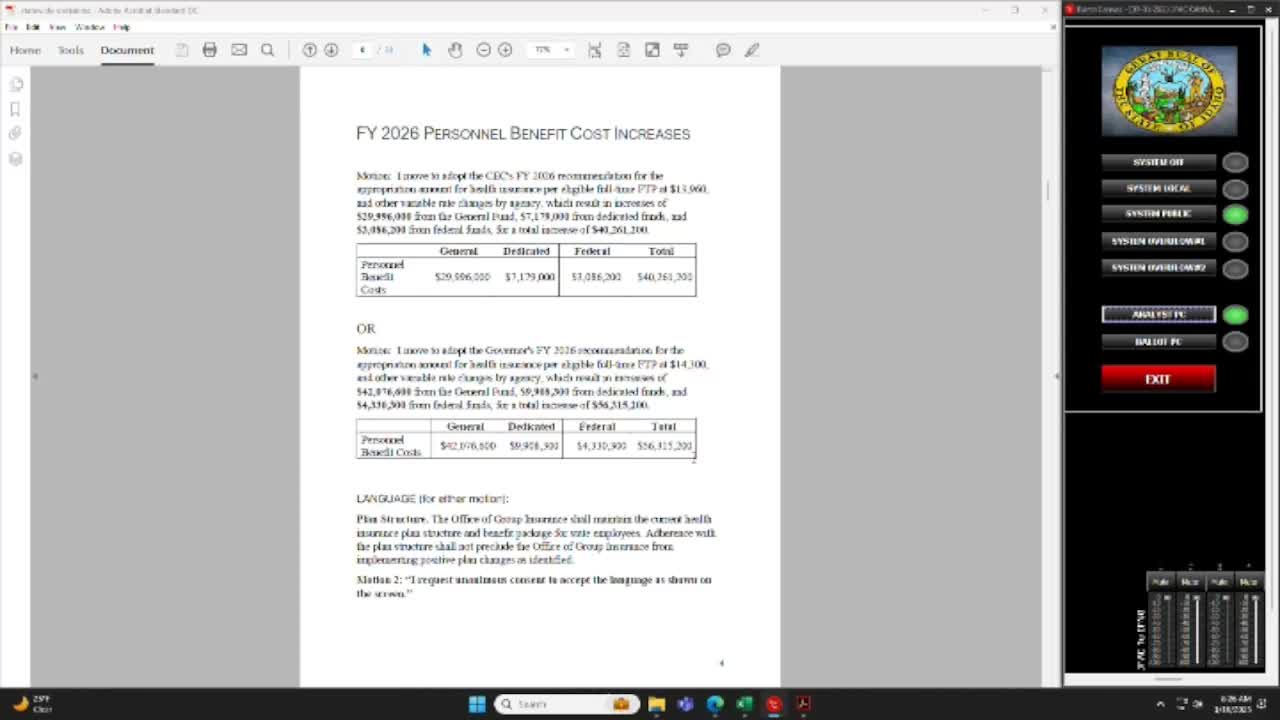
The committee considered two competing proposals for the FY2026 health insurance base per eligible full-time position and related variable benefit charges.
Keith Bybee presented the choices: the Economic Outlook / Change in Employee Compensation (CEC) committee recommendation set the base at $13,960 per eligible FTE (a $960 increase over the prior base) with an estimated general-fund impact of $29,996,000 and a total fund impact of $40,261,200. The governor's recommendation increased the base to $14,300 per eligible FTE (a $1,300 increase) with a general-fund impact described as $42,076,600 and a total increase of $56,315,200.
Analysts and agency staff explained reserve implications using the Milliman actuarial projections. Division of Financial Management Administrator Laurie Wolf and Faith Knowlton, administrator for the division of insurance and internal support, said a 10% contingency reserve is the contractual minimum and that the Milliman projection showed the CEC recommendation would draw reserves down to roughly $51,600,000 (about the 10% statutory/contractual floor) while the governor's recommendation would leave approximately $61,400,000—about $10 million more cushion.
Representative Miller moved to adopt the governor's recommendation ($14,300); Representative Furness offered a substitute motion to adopt the CEC recommendation ($13,960). The substitute motion was defeated on a combined tally (9 yeas, 11 nays in the final recorded total). The later vote on the governor's original motion likewise failed to secure the required majorities in both chambers, so the committee did not adopt either proposal.
Members discussed trade-offs: some supported the CEC figure to avoid overfunding the reserve account (noting the state reserve was reported at roughly $80,491,337 at the time), while others favored the governor's higher figure to reduce the risk of falling below the contractual contingency and to avoid larger future increases. Analysts warned that budgeting at the lower level could require a greater increase the following year if claims materialize.
Because neither motion met the committee's requirement for majority support from both the Senate and House delegations, the committee postponed final action on health insurance per-FTE funding.