Get Full Government Meeting Transcripts, Videos, & Alerts Forever!
Get email alerts on the Higher Education Budget topic
No spam. Unsubscribe anytime.
Lewis-Clark State College seeks operational funding, cites enrollment mix and salary gap
Summary
Lewis-Clark State College officials briefed Idaho’s Joint Finance-Appropriations Committee on the college’s FY2025 base budget, enrollment-weighted funding formula impacts, use of LAUNCH grant dollars for career-technical programs, prison-education expansion and a request to close a faculty/staff pay gap.
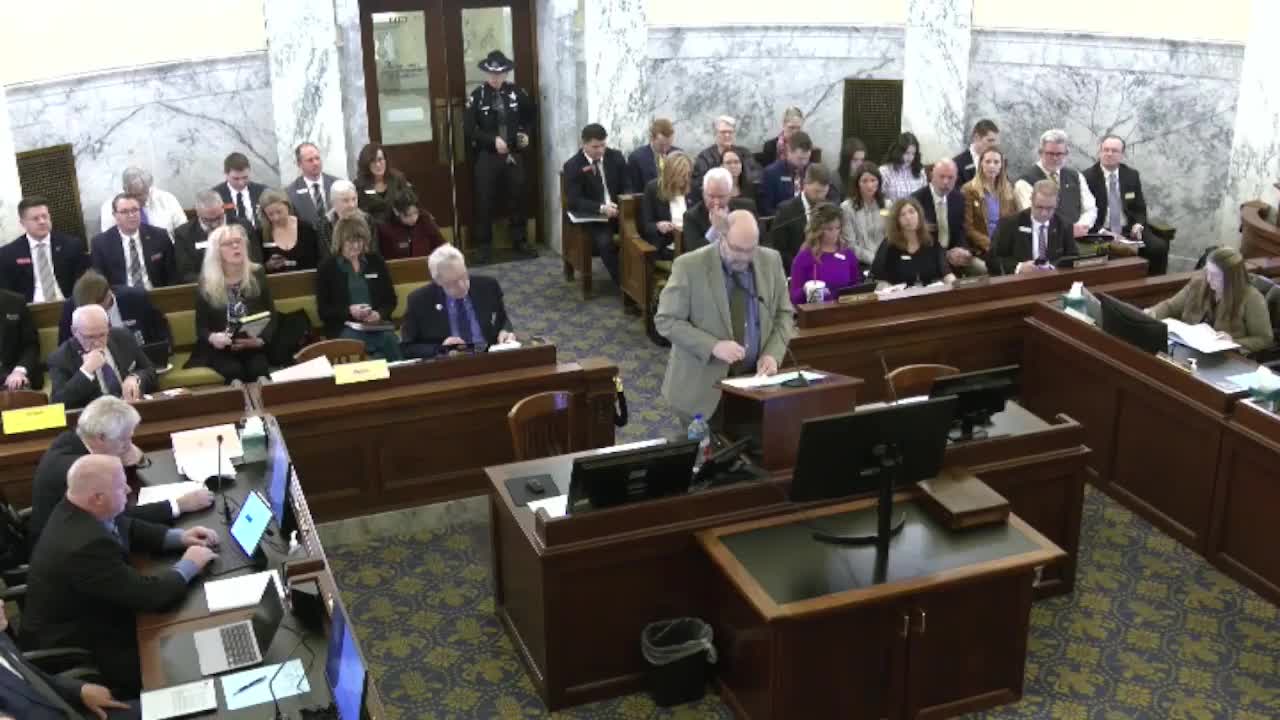
Madam Cochair and members of the Joint Finance-Appropriations Committee heard Thursday that Lewis-Clark State College is requesting modest operational capacity funding for FY2026 while continuing to absorb enrollment-driven formula changes and addressing a multi-year salary gap.
Kevin Campbell, a budget and policy analyst with the Legislative Services Office, presented the college's budget overview and said the college’s FY2025 base general-fund appropriation is roughly $41.7 million and that tuition and fees—about $23.7 million in FY2024—are reappropriated into the state's budget cycle and shown separately in the budget materials.
That distinction matters because the college and universities operate on both General Fund appropriations and reappropriated tuition and fee authority, Campbell said. He also summarized several institution-specific endowment funds and noted distributions for the legacy "normal school" fund are codified in Idaho law.
Why it matters: Committee members pressed college leaders about items that affect pay and program capacity—particularly the Enrollment Workload Adjustment (EWA), which reallocates a pool of funds among institutions based on a three-year weighted credit-hour measure, and operational capacity enhancements that have funded buildings, custodial support and other recurring costs.
Dr. Cynthia Pemberton, president of Lewis-Clark State College, told the committee the EWA formula is about a 30-year-old weighted credit-hour approach that produces net zero system-wide movement of the existing EWA bucket but redistributes money among institutions. She said Lewis‑Clark’s average credit-hour weighting is 1.85 compared with about 2.51 for sister institutions, a structural difference she said has disadvantaged the college in EWA outcomes over decades.
"LC State receives on average 26% less possibility of having the credit hours produced precipitate a positive formula outcome," Pemberton said, adding that the weighting is largely driven by graduate-course production and course-type multipliers at other universities.
Enrollment, LAUNCH and workforce programs: Pemberton said Lewis‑Clark served about 3,881 students and that LAUNCH grant support—state funds that subsidize tuition for students in targeted, high-demand programs—helped about 240 students in the fall, with a disproportionate share in career-technical education. She said career-technical enrollment rose 19% in fall and another 10% in spring, with 10 of 11 industrial programs enrolling LAUNCH-supported students.
The college also reported expansion of prison-education programs: Pemberton said Lewis‑Clark is the first institution in Idaho that completed the full transition from an experimental Pell-eligible prison program to a permanent prison-education program, serving nearly 200 incarcerated students at sites including Orofino, Pocatello and Boise.
Compensation and budget requests: Committee members asked about pay competitiveness. Pemberton said LC State instructors earn about $9,000 less than the K‑12 average and assistant professors about $3,777 less, based on the most recent comparative data she referenced. She said LC State has requested $287,000 in operational capacity enhancement (directed toward compensation) and noted the college would need roughly $1.2 million to substantially close pay gaps toward median benchmarks.
Campbell and Pemberton explained recent budget actions: LC State received $440,200 in operational capacity enhancement for FY2025, $352,200 in endowment adjustments, an extra 2% in CEC (cost-of-living/compensation enhancement) and a $54,700 adjustment through the enrollment workload formula in the most recent cycle. Pemberton said LC State expects a FY2026 EWA reduction of about $102,500 under the three-year weighted calculation and has requested $287,000 in OCE for compensation progress and $255,000 in endowment adjustments.
President Pemberton also described how prior enhancements were spent: finishing occupancy and custodial funding for the Schweitzer Career Technical Engineering Building, investing in marketing and promotion, and upgrading IT and cybersecurity capacity. She described LC State as "North Idaho's health care education leader," noting nursing and allied-health pathway expansions and recent recognition that enables certain army personnel to enroll in their nursing program.
Committee follow-up and data commitments: Committee members asked for comparative salary data across institutions and with K‑12; Dr. Campbell said he is compiling a document of salary comparables for all eight institutions and expected to make it available to the committee. Pemberton offered to provide LC State–specific compensation and enrollment detail by email.
No formal actions or votes were taken during this presentation; the discussion was informational and focused on the FY2026 request and related operational and personnel pressures at Lewis‑Clark State College.