Get Full Government Meeting Transcripts, Videos, & Alerts Forever!
Get email alerts on the Health Insurance topic
No spam. Unsubscribe anytime.
JFAC stalls on state health‑insurance base; committee deadlocks on governor vs. CEC recommendation
Summary
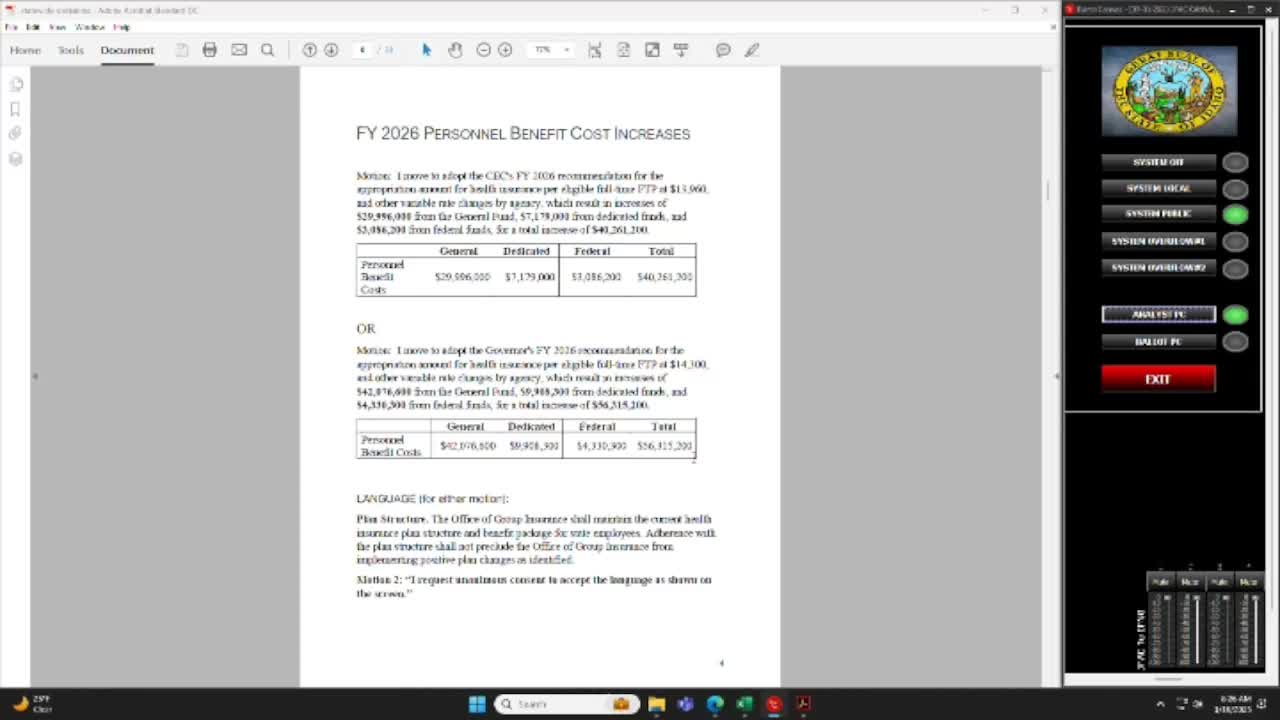
JFAC debated two competing proposals to set the health‑insurance base per eligible FTE for FY2026 — $13,960 (CEC recommendation) and $14,300 (governor’s recommendation) — but neither motion secured the cross‑chamber majorities required and action was deferred.
Committee analysts presented two alternate recommendations for setting the health‑insurance base for eligible full‑time positions in FY2026 and explained the effect each would have on the plan’s contingency reserves.
Keith Bybee (Division Manager, Budget Policy Analysis Division) described the numbers: the CEC recommendation would set the per‑eligible‑position base at $13,960, costing an estimated $29,996,000 from the general fund and $40,261,200 in total. The governor’s recommendation would raise the base to $14,300, producing an estimated $42,076,600 general‑fund increase and $56,315,200 in total (general, dedicated, federal funds combined). Analysts said both actions would keep the same plan design but change the reserve cushion.
Actuarial projections discussed in the meeting (Milliman) showed the state’s current contingency reserve for the plan at about $80,491,337. Under the CEC recommendation the projection would reduce the reserve to about $51,600,000 — the statutory 10% contractual minimum on the plan — and under the governor’s recommendation the reserve would be about $61,400,000, leaving roughly an additional $10,000,000 cushion. Committee staff cautioned that the 10% contingency represented an actuarial point with roughly a 50% chance of being sufficient; staying right at that minimum increases the risk of a required “risk charge” by the carrier if the plan falls below the contractual contingency.
Laurie Wolf (Division of Financial Management administrator) and Faith Knowlton (administrator, Division of Insurance and Internal Support, Department of Administration) told the committee that falling below the contractual minimum exposes the state to a carrier risk charge and that actuary modeling provides a 90th‑percentile option to set aside larger reserves to reduce that risk.
Representative Furness offered the CEC‑recommended motion to set the base at $13,960 (lower cost, smaller reserve), and a roll call failed to produce the cross‑chamber majority needed. The committee then voted on the governor’s $14,300 motion; that motion likewise failed to achieve a majority in both the Senate and the House delegations. Committee leadership announced the item would be revisited at a later time.
Committee debate included members pressing for a conservative reserve policy to avoid risk charges and others arguing that overfunding the reserve wastes taxpayer dollars and places additional burdens on schools and other budgeted entities. Analysts repeatedly cautioned that budgeting closer to the 10% minimum could increase the probability of needing a larger adjustment in the subsequent year.