Get Full Government Meeting Transcripts, Videos, & Alerts Forever!
Get email alerts on the Public Defense State Agency topic
No spam. Unsubscribe anytime.
New State Public Defender agency asks for reappropriation, supplements and hiring funds amid heavier caseloads
Summary
The recently created Idaho State Public Defender requested supplemental and ongoing appropriations to use a $39 million cash transfer, cover transcript costs after a state Supreme Court ruling, increase contract rates, and staff new institutional offices as counties transition into state coverage.
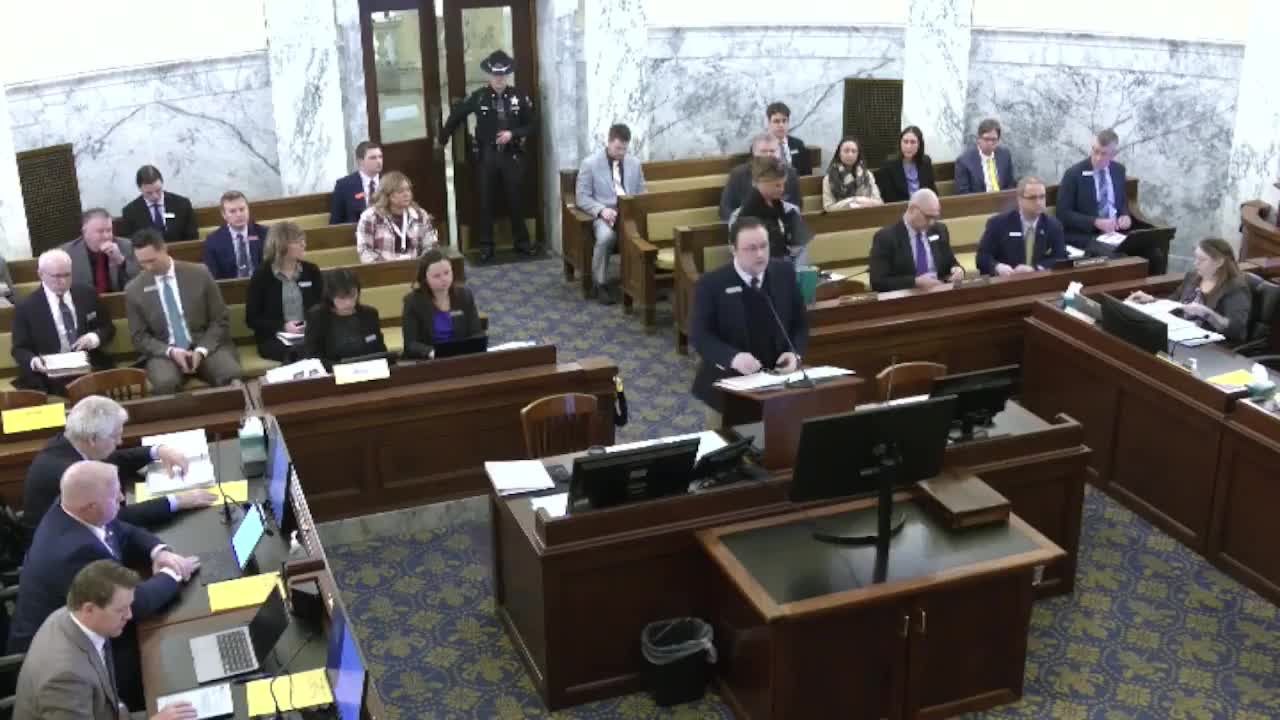
Christopher Lahoset of the Legislative Services Office briefed the Joint Finance-Appropriations Committee on the newly created Office of the State Public Defender, its funding sources and multiple enhancement requests.
Lahoset explained the agency was established by statute (Title 19, Chapter 60) and that a key funding mechanism is a one-time transfer directed by statute for $39 million from the tax relief fund into a new State Public Defense Fund (Idaho Code ). He noted the agencywas funded largely by a dedicated state public defense fund and that the state controller was directed to transfer $39 million into that fund.
Lahoset summarized the agencyrequests for fiscal 2025 and 2026, including: a $2.5 million one-time supplemental to fully utilize the $39 million cash transfer, a $390,200 one-time supplemental for transcript costs following the Idaho Supreme Court decision in State v. Blasick that the state is responsible for transcript costs, and $5,427,600 one-time supplemental for personnel and contracting costs to address shortfalls identified by county-provided financial information.
For FY2026, the agency requested $2.5 million ongoing to fully utilize the transferred cash, $16,000,380 ($80,800 from the General Fund) for operating expenditures to increase contract rates for attorneys and investigators and cover capital litigation and other costs, authority for 17.96 additional FTE and $226,700 to onboard four new institutional offices (Benewah, Elmore, Jerome and Shoshone counties), and other adjustments. The governor recommended ongoing transcript funding and proposed a fund shift contingent on legislation to amend the cash transfer amount.
Eric Frederickson, the State Public Defender, described the operational challenges encountered since the agency started handling cases Oct. 1. He told the committee the agency walked into a large number of withdrawals and cases and that staffing and contractor losses required the office to triage daily operations: "We walked into 1,300 withdrawals and cases," he said. Frederickson described flat-fee contracting in counties as unconstitutional and said the unified system is intended to equalize representation across counties: "An attorney in Ada County should have the same representation as an attorney in Wallace, Idaho." He told members that some costs previously borne by counties (for example, psychosexual evaluations and transcripts) have moved onto state responsibility and that statutory clarification will be needed for some facility and cost questions; legislation in the 2021-22 period created the agency and provided the initial funding assumptions.
Committee members questioned the size and timing of the requested one-time supplement, the makeup of the $3.58 million line for training, transcripts and miscellaneous expenditures, and whether counties will continue to provide facilities until 2029 (Frederickson said statute currently says counties must provide facilities until 2029 and that further statute will clarify transitions).
Frederickson said the agency is moving from caseload-based to workload-based staffing measures and that some counties will remain reliant on contract attorneys where institutional offices are not cost-effective. He also said the statewide case management system rollout and bringing counties into the state system are ongoing implementation tasks tied to future staffing needs.
No formal committee vote was taken during the hearing; committee members asked for follow-up information on the agencybudget breakdowns, contract rates, and the list of items included in "miscellaneous" expenditures.