Get Full Government Meeting Transcripts, Videos, & Alerts Forever!
Get email alerts on the Substance Abuse Prevention Treatment topic
No spam. Unsubscribe anytime.
Substance‑abuse unit cites ongoing opioid and settlement funding, seeks fund swaps to meet federal rules
Summary
The Department of Health and Welfare’s substance‑abuse treatment and prevention program briefed the Joint Finance‑Appropriations Committee on federal opioid grants, state opioid‑settlement allocations and a federal spending cap that requires program accounting changes.
The Department of Health and Welfare’s substance‑abuse treatment and prevention program briefed the Joint Finance‑Appropriations Committee on Wednesday about federal opioid grants, state opioid‑settlement allocations and a federal spending cap that requires program accounting changes.
Why it matters: the division administers prevention and treatment grants statewide. Officials said the program has an $8 million ongoing state opioid response grant in the base, ongoing Millennium Fund awards supporting community recovery centers, and one‑time opioid‑settlement dollars. The federal Substance Use Block Grant has a cap — no more than 5% may be used for administrative (personnel) costs — and the federal agency placed Idaho on a corrective action plan for exceeding that cap.
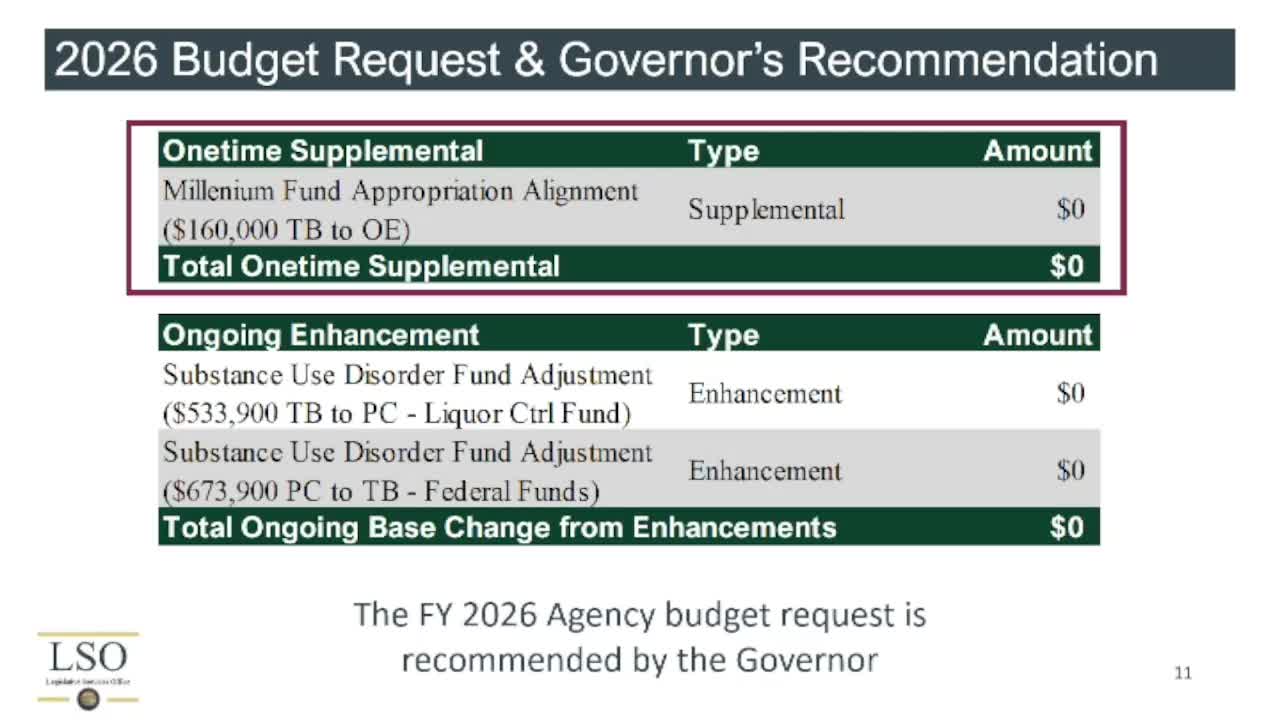
Alex Williamson, the Legislative Services analyst presenting the budget, outlined a department proposal to swap fund sources: shift $533,900 from liquor control receipts (a dedicated fund) to personnel costs so the department can move more federal block‑grant dollars into trustee and benefit payments. Williamson said the requested swaps aim to preserve staffing while meeting federal administrative limits.
Senator Cook called the proposal a cosmetic shift to avoid a federal reprimand and asked whether the department was simply moving money to make the ledger comply. Williamson and Director Alex Adams said the department seeks to preserve existing staff and program performance while complying with federal rules. Adams said the department proposed a net reduction of four FTP in other parts of the behavioral health budget and that the changes were intended to minimize new general‑fund requests.
The committee also heard updates on programs paid from settlement or state funds. Director Adams said Boise State University’s collegiate recovery program, funded with a pass‑through allocation of $100,000, “has established the collegiate recovery program on campus” and that, to date, BSU staff “have hosted seven social events for approximately 375 students.” Adams said DHW serves as a passthrough check‑writer for some Millennium Fund awards and other pass‑through grants but does not operate those programs.
Senators sought follow‑up on performance and outcomes for prevention and recovery programs. Adams said program reports typically include counts of participants and events and that the department would provide written reports to the committee. The division did not request final committee action on fund transfers during the hearing; department staff said they would supply additional documentation about the proposed fund‑source changes and their operational effects.
The committee also discussed the department’s earlier temporary suspension of some children’s mental‑health services, which Adams said stemmed from constraints related to budget rules and entitlement funding distinctions.