Get Full Government Meeting Transcripts, Videos, & Alerts Forever!
Get email alerts on the Psychiatric Hospitals Civil Commitment topic
No spam. Unsubscribe anytime.
State hospitals cite capacity, billing shifts and ask for $2.6M supplemental for civil‑commitment costs
Summary
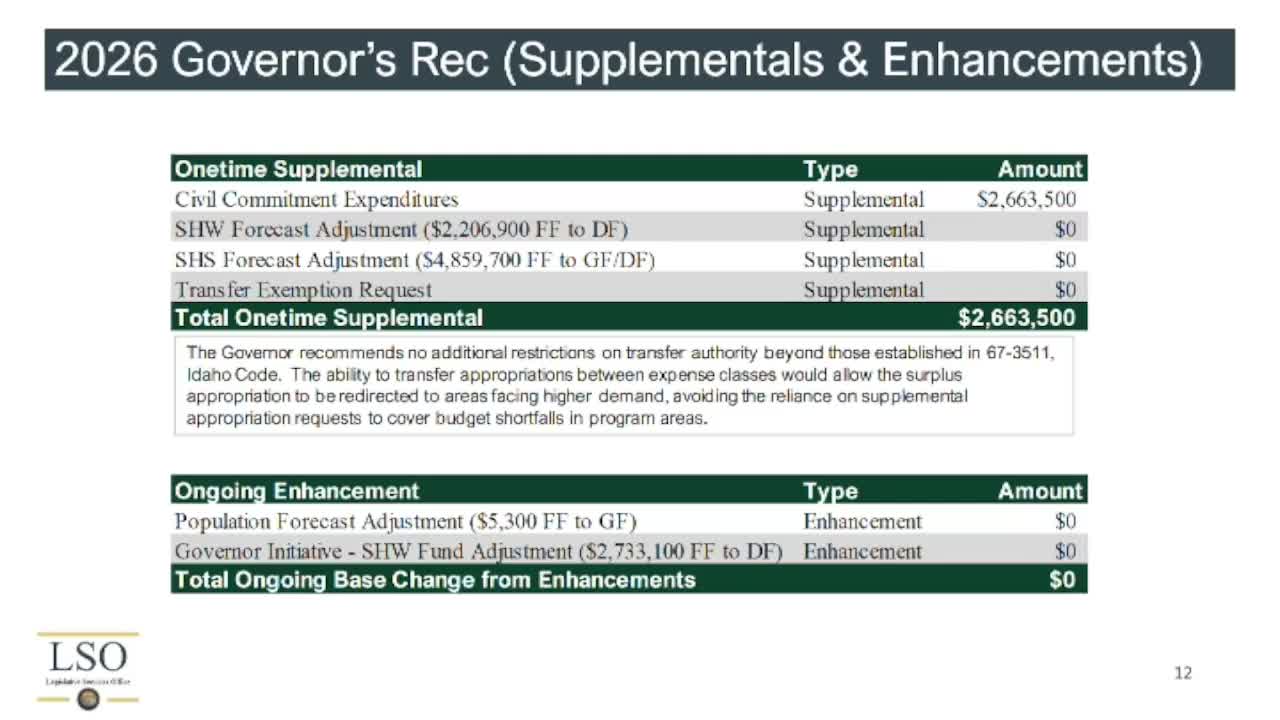
Department of Health and Welfare staff told the Joint Finance-Appropriations Committee that civil‑commitment costs shifted to the state by 2022 law have increased and the department seeks a $2.6 million one-time general‑fund supplemental; administrators also described accreditation gains, billing changes tied to Medicaid and staffing and waitlist
The Department of Health and Welfare’s psychiatric hospitalization division told the Joint Finance-Appropriations Committee on Wednesday it needs a $2.6 million one‑time general‑fund supplemental to cover increased civil‑commitment costs following a 2022 law change that moved the financial responsibility from counties to the state.
Why it matters: State hospitals provide short‑ and long‑term residential treatment for people who require inpatient care. The supplemental request is tied to an increase in mental‑hold and commitment services that the department says is an entitlement when a provider or law enforcement follows the civil‑commitment statute.
Alex Williamson, the Legislative Services analyst presenting the division’s budget, described the request as a one‑time ask to help with increased mental‑hold and commitment costs in fiscal year 2025. She referenced Senate Bill 1327 of 2022, which changed where responsibility falls for those costs.
Alex Adams, director of the Department of Health and Welfare, said the state hospitals’ accreditation work is largely complete: all three state hospitals have received accreditation. The department said accreditation allows hospitals to bill Medicaid and recapture federal dollars; State Hospital West, for example, has billed $1.6 million and received about $1.3 million in receipts that offset general‑fund spending.
Adams and Ross Edmonds, the department’s division administrator for behavioral health, told the committee that staffing and length of stay affect federal billing. A federal rule means hospital stays of more than 60 days may not be reimbursed by Medicaid for certain patients; Edmonds said the share of admissions exceeding 60 days grew from roughly 17% to about 37% and that trend increases general‑fund exposure.
Staffing levels vary across facilities. Adams reported vacancy rates of about 0% at State Hospital West, 2.8% at State Hospital South and 11.5% at State Hospital North. The department said State Hospital North has a waitlist of about eight people and State Hospital South about 18 people waiting for a bed. Adams tied the department’s ability to fill beds to staffing, licensing and accreditation.
The division described a substantial growth in restoration‑to‑competency commitments — cases in which defendants are found not competent to stand trial and are hospitalized to restore competence. Ross Edmonds told the committee restoration‑to‑competency cases have risen sharply over the last decade and now account for a large share of occupied beds; he said approximately 75% of beds at State Hospital North are occupied by restoration‑to‑competency patients. Edmonds added that most patients placed for restoration are ultimately restored: “Nearly all of them... I would say it’s probably 5 percent or less that are not restorable.”
Committee members asked for more detail about whether accreditation has generated sustained Medicaid savings. Adams said State Hospital West’s billing to date demonstrates some federal receipts but noted accreditation was received mid‑year, so full year savings are not yet visible.
The committee did not vote on the supplemental during the hearing. Department staff said they would provide additional follow‑up on billing, the drivers of extended stays and historical trends in commitment and restoration cases.