Get Full Government Meeting Transcripts, Videos, & Alerts Forever!
Get email alerts on the Health Insurance Funding topic
No spam. Unsubscribe anytime.
Joint finance committee approves $14,130 health-insurance funding per full-time position for FY2026
Summary
The Idaho Joint Finance‑Appropriations Committee on Friday approved increasing budgeted health‑insurance funding per eligible full‑time equivalent position to $14,130 for fiscal year 2026, a compromise between the CEC committee recommendation and the governor’s proposal.
The Idaho Joint Finance‑Appropriations Committee on Friday approved increasing budgeted health‑insurance funding per eligible full‑time equivalent position to $14,130 for fiscal year 2026, a compromise between the CEC committee recommendation and the governor’s proposal.
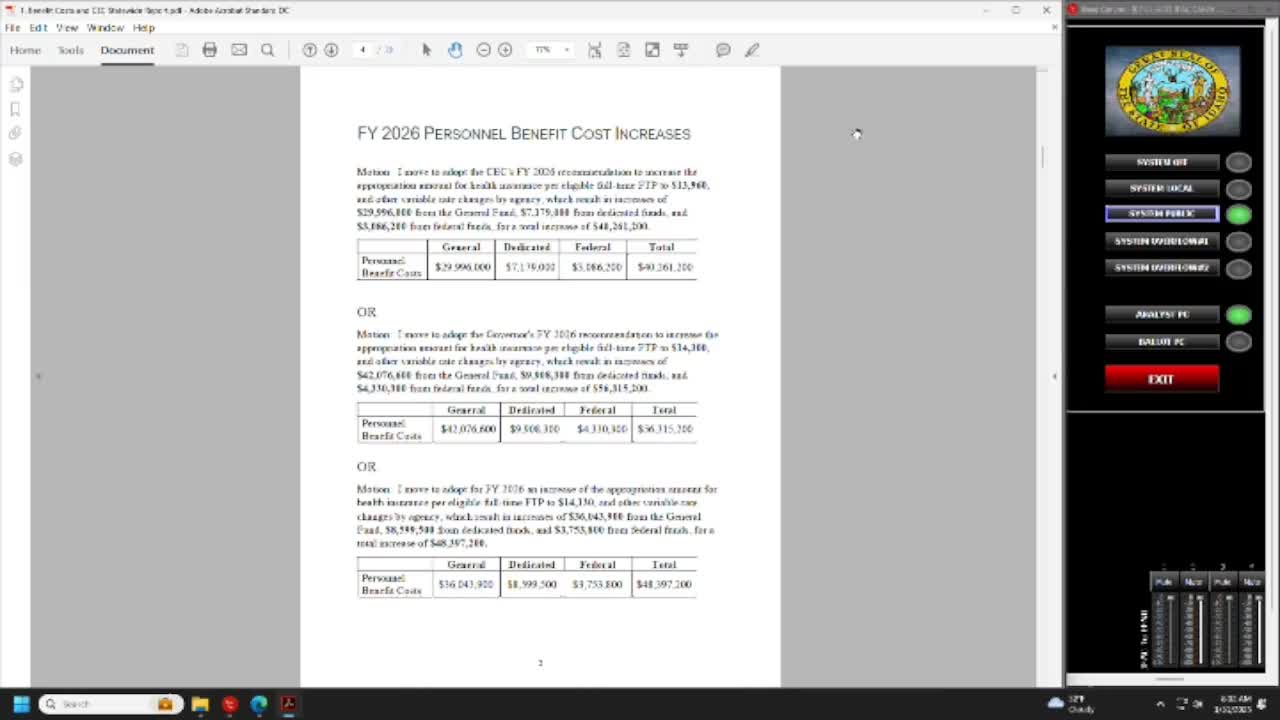
The committee’s fiscal analyst, Mr. Mark Bybee of the legislative staff, told members the packet presented three dollar options: the CEC recommendation at $13,960 per eligible FTP, the governor’s recommendation at $14,300 and a midpoint compromise at $14,130. The motion adopted by the committee would increase state spending for health insurance by $36,043,900 from the general fund, $8,599,500 from dedicated funds and $3,753,800 in federal funds — a combined $48,397,200.
Why it matters: the committee’s funding choice affects the state’s health‑insurance reserve and the amount agencies must budget for employee benefits. Bybee said the projected reserve balance for fiscal 2026 would be about $51.6 million under the $13,960 option and about $61.4 million under the governor’s $14,300 option; he did not provide a separate calculation for the $14,130 midpoint during the hearing.
Senator Woodward moved the $14,130 funding level; Representative Tanner seconded the motion. After roll call the committee recorded a combined 17 ayes, 0 nays and 3 members absent or excused — the Senate vote was 8 ayes, 0 nays, 2 absent; the House vote was 9 ayes, 0 nays, 1 absent. The committee carried the measure with a due‑pass recommendation.
Committee discussion focused on whether the legislature should reflect the “actual cost” of insurance or hold down premium funding using the reserve. Senator Ward Engelking, speaking in favor of reflecting full cost, said the committee had used reserves in prior years to “buy the insurance down” and that withholding the full cost could make next year’s increase look larger than it is. Representative Furness urged a more conservative funding level, saying actuary projections had historically erred on the conservative side and arguing the lower CEC figure could be appropriate.
Bybee also reminded members that the health‑insurance projection and ballot programming would require a joint majority in both the House and Senate under the committee’s voting procedures; staff said the electronic ballot had been programmed to require a majority of the quorum present in each chamber.
The committee’s action applies to the statewide personnel benefit budget lines for FY2026. The committee directed staff to carry the adopted funding level and associated language forward as the committee’s due‑pass recommendation.
The committee then moved on to separate Change in Employee Compensation (CEC) motions, which were discussed but no final CEC package passed during the session.