Get Full Government Meeting Transcripts, Videos, & Alerts Forever!
Get email alerts on the Employee Benefits topic
No spam. Unsubscribe anytime.
Legislative panel approves higher health-insurance funding for state employees
Summary
The Joint Finance‑Appropriations Committee voted Jan. 31 to raise the state's per‑employee health‑insurance funding for fiscal 2026 to $14,130, a change that increases personnel benefit appropriations and alters projected reserve balances.
The Joint Finance‑Appropriations Committee voted 17–0 on Jan. 31 to raise the appropriation for state employee health insurance to $14,130 per eligible full‑time equivalent position for fiscal year 2026.
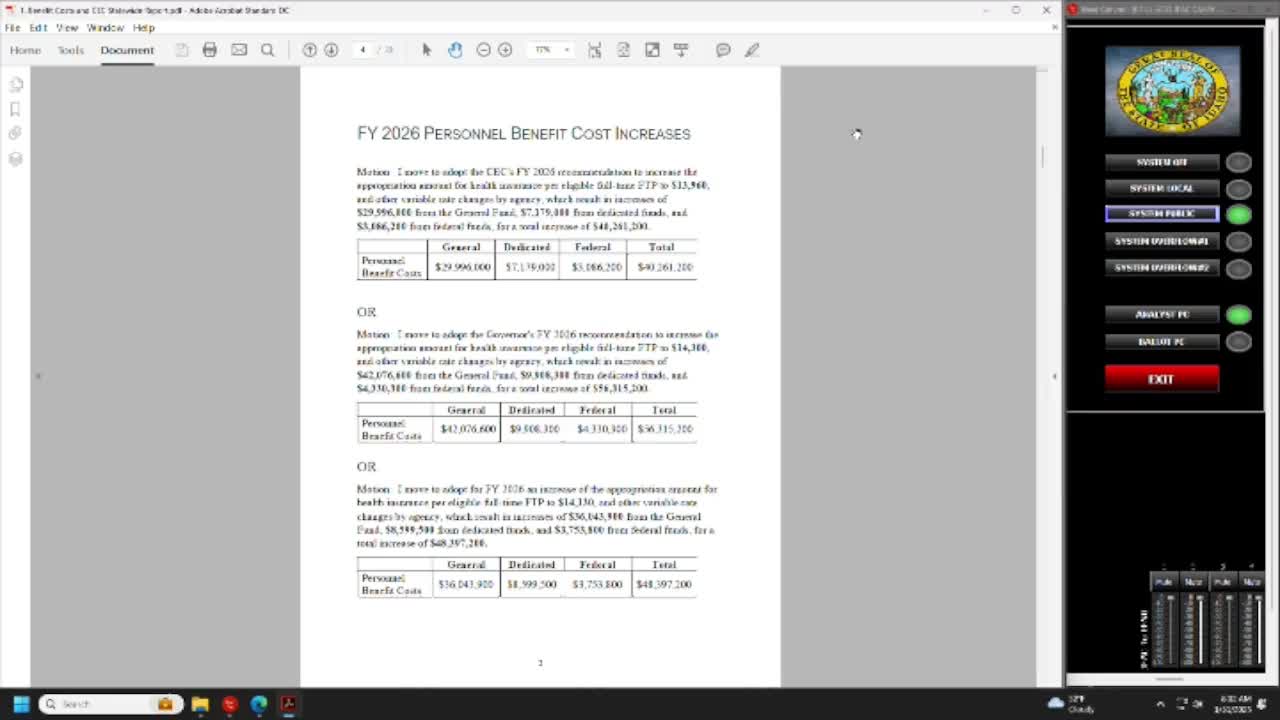
The motion, offered by Senator Woodward and seconded by Representative Tanner, increases personnel benefit appropriations by $36,043,900 from the general fund, $8,599,500 from dedicated funds and $3,753,800 from federal funds, for a combined increase of $48,397,200.
Committee staff presented three funding options at the hearing. Mr. Bybee, a committee staff member who explained the proposals, said the options were the CEC committee recommendation ($13,960 per FTE), the governor's recommendation ($14,300 per FTE) and a midpoint compromise ($14,130 per FTE). Bybee also explained that other employer‑paid benefit adjustments appear by agency for items such as workers’ compensation and Social Security.
Why it matters: the funding level sets the amount state agencies will receive to cover employee health‑insurance premiums and affects the projected balance in the state's insurance reserve account, which the committee uses to monitor future premium stability.
Committee debate focused on whether to set the appropriation at the CEC recommendation, the governor's recommendation, or the midpoint. Representative Furness argued for a lower number, citing historical growth in the reserve and skepticism about actuarial projections: “those projections have consistently been, too conservative,” she said, adding that the reserve account has grown in recent years even as premium policies changed. Senator Ward Engelking urged the committee to “reflect the actual cost of insurance” and warned that using reserves to buy premiums down in one year can make later increases look larger.
Mr. Bybee provided projected ending reserve balances tied to the options: under the CEC recommendation ($13,960) the projected reserve balance at the end of fiscal 2026 is roughly $51.6 million; under the governor's recommendation ($14,300) it is roughly $61.4 million; the midpoint ($14,130) falls between those figures. When moved and called, the committee adopted the midpoint motion ($14,130) with a joint committee roll call showing 17 ayes, 0 nays, and 3 absent/excused (Senate 8–0–2 absent/excused; House 9–0–1 absent/excused). The committee recorded that the motion will carry a "do pass" recommendation.
The committee chair said the adopted funding level will be reflected in the committee's language and directed staff to include the appropriate motion language in the session record. The committee then moved on to consideration of changes in employee compensation (CEC).