Get Full Government Meeting Transcripts, Videos, & Alerts Forever!
Get email alerts on the Operator Safety Partitions topic
No spam. Unsubscribe anytime.
Metro orders bus partitions for new electric coaches, plans retrofits for 1,200 coaches; East Link and spring service changes highlighted
Summary
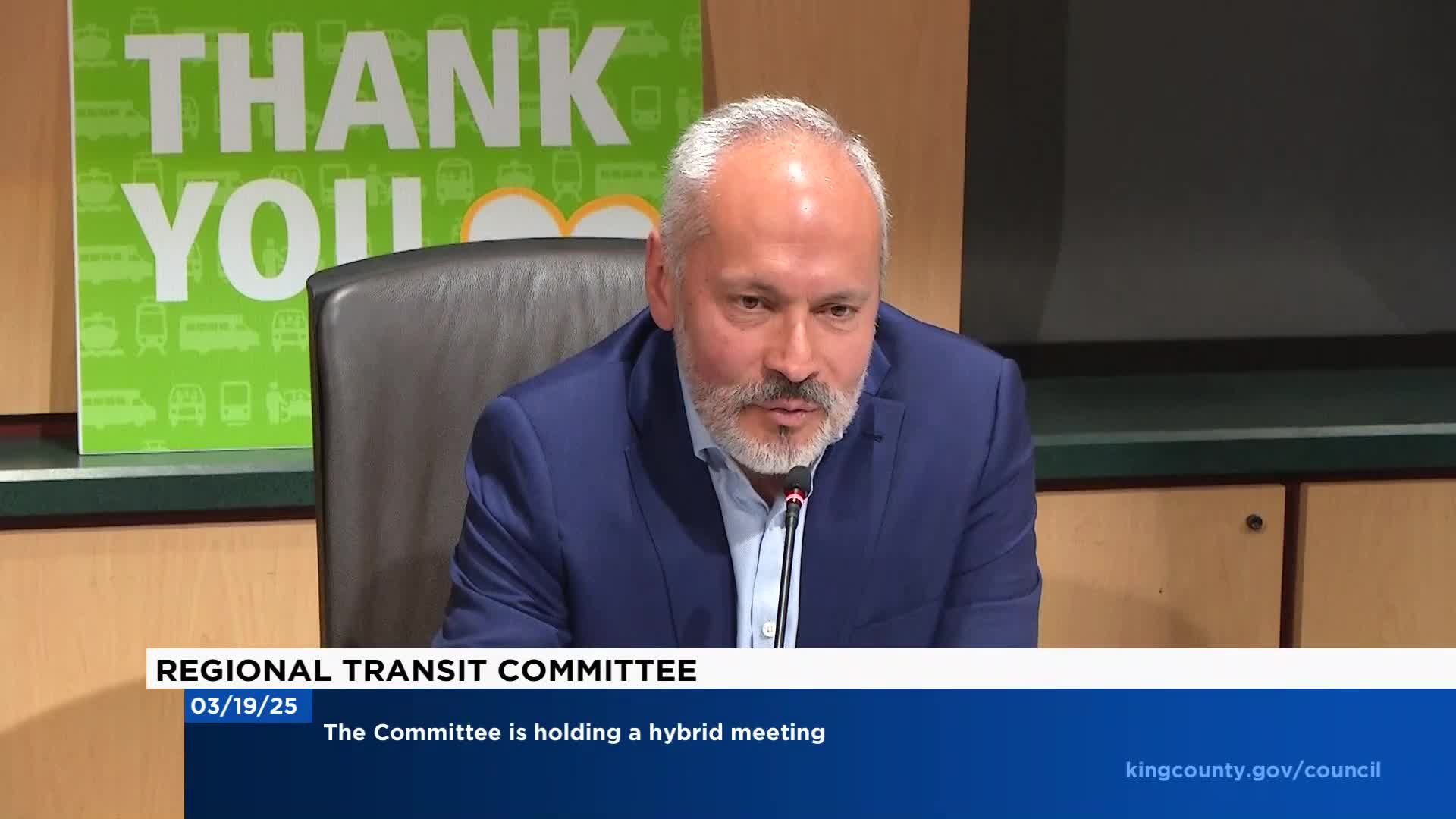
King County Metro will add bus operator partitions to an upcoming order of 89 battery‑electric coaches and will design retrofits for roughly 1,200 existing coaches, General Manager Michelle Allison told the Regional Transit Committee on March 19, 2025.
King County Metro will add bus operator partitions to an upcoming order of 89 battery‑electric coaches and develop a retrofit for roughly 1,200 existing coaches, Metro General Manager Michelle Allison told the Regional Transit Committee on March 19.
‘‘We will now continue to work on a retrofit option for our existing fleet. We have roughly 1,200 coaches that will need to have a partition designed for them so we can complete our commitment to our operator barriers throughout our entire system,’’ Allison said.
Why it matters: Metro said the new prototype partitions use stronger materials (laminated tempered glass), extend coverage toward the ceiling and include a metal door that locks from the driver’s side. Metro framed the changes as an operator safety improvement developed with input from ATU Local 587 and operator feedback; staff also acknowledged the passenger experience will change and that outreach and training are required.
Other safety and workforce measures
- Training and tools: Allison said Metro is adding de‑escalation and behavioral trainings so that operators now have three required trainings instead of one. Metro also plans to hire more transit security officers and to expand programs such as behavioral‑health specialists and transit ambassadors to provide co‑response and outreach services.
- Prototype procurement and vehicle redesign: Metro described multiple procurement streams, including an order from Solaris (a European manufacturer) that may inform future vehicle design to better integrate operator space and passenger experience.
Service changes and ridership trends
- East Link and Redmond: Allison said the East Link Connections restructure will add more than 3,300 bus trips each week on the East Side to link bus routes with new light‑rail stations. Metro is preparing for the Downtown Redmond Link extension opening May 10 and will adjust multiple routes (B‑24, 250, 260, 9) to connect to new stations; one route will gain weekend service.
- South Link and spring service change: Metro completed a second phase of community engagement on South Link connections and plans additional service increases in the March 29 spring service change, particularly evenings and weekends on routes including 8, 36 and 107.
- Ridership: Metro reported the Puget Sound region delivered about 17,000,000 more trips in 2024 than in the prior year, a 12% regional increase across the six ORCA transit agencies.
Committee questions and context
Committee members thanked Metro for engaging operators and labor in the partition design process. Allison described a long history of discussion about operator partitions and said the agency paused earlier efforts to prioritize design and community impacts. She said COVID‑era partitions were designed for public‑health purposes and were not the final safety design for operators; the new prototype represents a different material and coverage standard.
Operational implications and timeline
Metro said partitions will be deployed in phases as maintenance and engineering evaluations identify how to adapt different coach types. Retrofits will require additional engineering and scheduling with maintenance facilities. Allison said the program will evolve as Metro takes delivery of new vehicle models and learns from Solaris deliveries.
Ending note
Allison closed by thanking operators and labor partners and asked the committee for continuing partnership as Metro implements design, training and service changes. Committee members signaled interest in follow‑up briefings on safety outcomes and service impacts after implementation.