Get Full Government Meeting Transcripts, Videos, & Alerts Forever!
Get email alerts on the Public Health Budget topic
No spam. Unsubscribe anytime.
Joint Finance-Appropriations Committee reviews Division of Public Health Services budget, seeks restorations and data modernization
Summary
The Joint Finance-Appropriations Committee heard presentations on the Department of Health and Welfare’s Division of Public Health Services budget, including requests to restore ongoing programs, fund workforce and data modernization, and sustain several federal grant-funded activities.
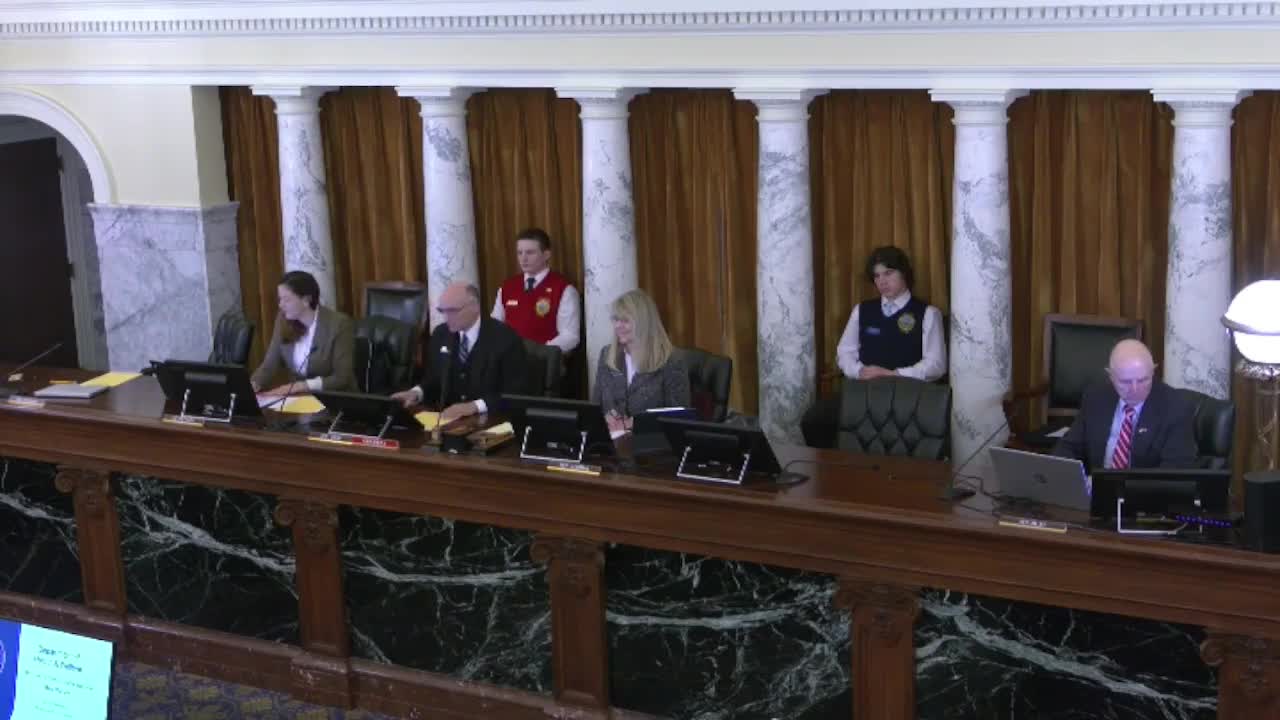
The Joint Finance-Appropriations Committee on Monday heard an overview of the Department of Health and Welfare’s Division of Public Health Services budget as the department requested restorations of several programs and funding for data and workforce modernization.
Keith Bybee, division manager for budget policy analysis, presented the division’s request and structural changes and directed members to the budget book. “Public health services is a big one,” Bybee said while walking committee members through program lines and one‑time versus ongoing funding.
The division’s budget is organized around five program areas: physical health services; emergency medical services and preparedness; laboratory services; suicide prevention and awareness; and health care policy initiatives (including administration of the State Healthcare Innovation Plan, SHIP). Director Alex Adams and Division Administrator Elke Shaw‑Tulloch answered committee questions after Bybee’s overview.
Why it matters: committee members flagged this division for detailed review because it manages large trustee and benefit payments, federal grant carryovers, and several programs that were moved from ongoing to one‑time funding in recent years. Alex Adams said the agency used a “0‑based” approach to ask whether each program still makes sense and described the division’s 2026 request as “a healthy exercise.” He told the committee the changes produce an approximately $10 million reduction — about 6% year over year — from the division’s FY2025 level as the department rebalances one‑time and ongoing funding.
Key details from the presentation: - Overall and structure: The department reported FY2025 base appropriation of about $164,020,000 for the Division of Public Health Services; roughly half of the division’s spending is trustee and benefit payments, with personnel costs and operating expenses making up much of the remainder. The department said prior CARES Act and ARPA flows caused earlier fiscal years to show large appropriations that were not sustained in later years. Adams described the FY2026 request as slimming the budget compared with the prior year while restoring certain formerly ongoing programs that had been converted to one‑time appropriations.
- One‑time requests and ARPA carryovers: The department listed multiple one‑time enhancement requests tied to federal grants and legacy ARPA funds. The packet shown to the committee listed roughly $8,752,500 in one‑time requests recommended by the governor. Those items include Vital Statistics data modernization, WIC system modernization, a public health infrastructure grant focused on workforce and local district support, and a Communicable Disease Prevention grant (year 4) for about $2,041,800 to support 4.4 limited‑service positions.
- Ongoing restorations: The division asked to restore numerous programs to ongoing status. Examples discussed on the record include: - Suicide prevention: $1,807,700 (general fund) and $195,000 (federal) to continue the program established by the legislature in 2016. - Drug Overdose Prevention Program: restoration request including 4 FTE and $2,820,200 ongoing. - Refugee health screening: restore 1.5 FTE and $991,000 ongoing to continue comprehensive screenings for new arrivals in Boise and Twin Falls. - Alzheimer’s and dementia program: $275,200 ongoing. - Fit and Fall Proof (community exercise program for older adults): $140,000 ongoing. - HIV prevention activities: $957,300 ongoing. - Oral health workforce activities, integrated hepatitis surveillance, diabetes and chronic disease programs, and the Women, Infant and Children (WIC) Program: amounts and program descriptions were shown in the committee packet and discussed by staff.
- Dedicated funds and fees: The presentation included a request to increase ongoing dedicated‑fund support for the Idaho immunization program; the division asked for $2,500,000 ongoing from dedicated funds to support immunization access for Idaho children under age 19. The bureau of vital records requested $150,000 ongoing from dedicated receipts to support processing of births, deaths and other records.
- Workforce and rural incentives: The department reiterated the governor’s initiative to continue the Rural Physician Incentive Program and requested $500,000 general fund for medical education loan repayment targeted to physicians working in federally designated health professional shortage areas. Division Administrator Elke Shaw‑Tulloch told the committee the program has a high retention rate among recipients.
Committee discussion and follow up: Members asked for written follow‑up on data modernization and the status of ARPA projects before approving additional funds. Senator Cook asked for a written update on system upgrades and what earlier ARPA dollars purchased; Adams and staff agreed to provide a short briefing memo. Representative Price and others questioned placement of some programs (for example, whether Project ECHO or some prevention programs should be administered outside the department), and Adams said the department is open to conversations about transferring programs where appropriate.
What the committee will consider next: staff emphasized that many of the adjustments are structural — converting ongoing items to one‑time and then restoring some of them — and that JFAC members will likely work outside the hearing to finalize line items and any trailer‑bill language. Adams and administrators encouraged members to contact analysts directly with follow‑up questions.
Ending: Committee members closed public testimony on the division’s budget and moved on to related health care requests later in the hearing. The department will return supplemental material on data modernization and program performance to the committee analysts as requested.