Get Full Government Meeting Transcripts, Videos, & Alerts Forever!
Get email alerts on the School Choice Vouchers topic
No spam. Unsubscribe anytime.
Senate committee advances SB 1025 after contentious hearing on expanded vouchers, red‑tape relief and special‑education funding
Summary
Boise — The Idaho Senate Education Committee voted 5‑4 to advance Senate Bill 1025 to the Senate floor with no committee recommendation after a daylong hearing on expanding Empowering Parents grants, reducing some state reporting and adding directed special‑education funding.
Boise — The Idaho Senate Education Committee voted to send Senate Bill 1025 to the full Senate with no committee recommendation after a contested hearing that ran through public testimony and more than an hour of debate.
The motion to advance the bill passed on a roll call after senators and dozens of witnesses debated whether the measure properly balances parental choice, accountability and the needs of public schools.
What the bill would do (sponsor summary)
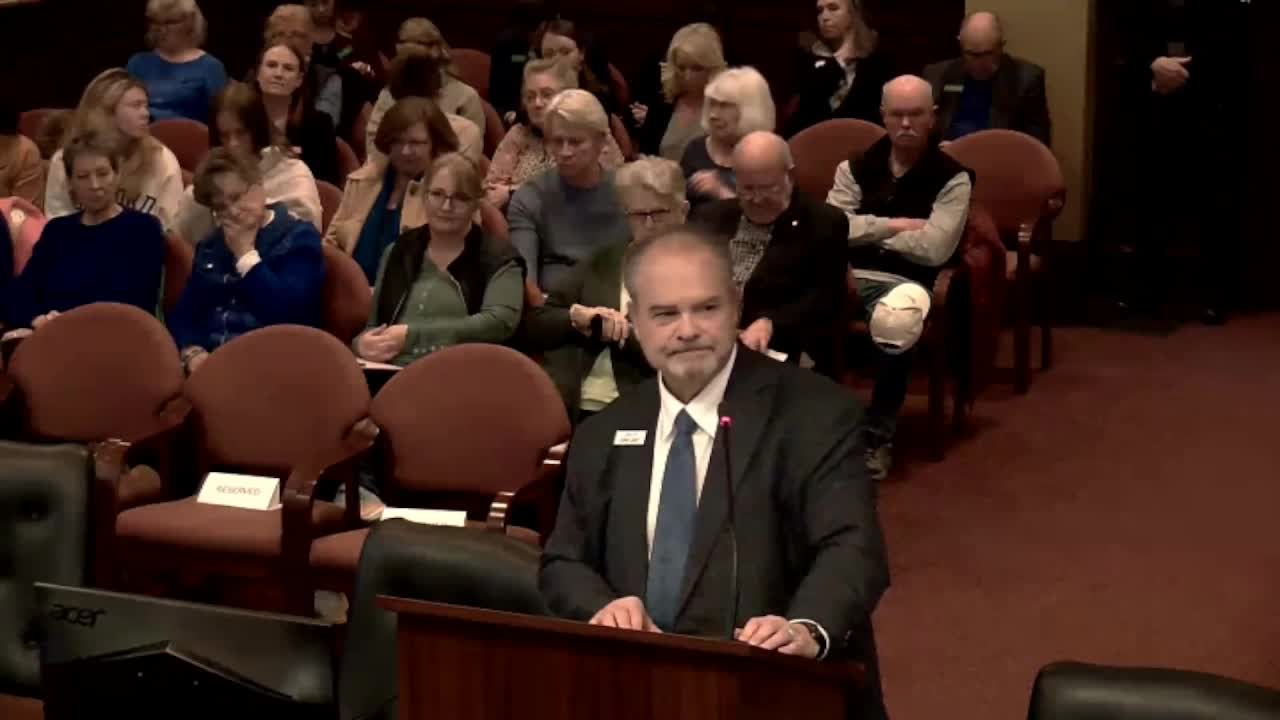
Senator Dave Lent (R‑District 33), who presented the bill, described SB 1025 as a multi‑part package intended to set a threshold of accountability for private schools that receive public funding, simplify some reporting obligations for public schools, and direct additional funding toward special education. Key provisions Lent highlighted:
- Expand the Empowering Parents grant (often called an EPG): Payments intended to give families flexible education funding would increase from prior amounts. The bill sets a grant value of $5,000 per eligible student, with a $1,000 limit for technology purchases and a per‑household cap of $15,000. The sponsor framed the increase as targeting lower‑income families: the draft assigns 75% of funds to households with adjusted gross income under $60,000, 20% to those $60,000–$80,000, and 5% above $80,000.
- Program eligibility and oversight: Participating nonpublic schools must be associated with an accreditation body recognized by the State Board of Education, agree not to discriminate, accept students with special‑education needs, perform background checks on unsupervised staff, and report specified data. The bill also expands eligible ages in certain circumstances and allows parents to use funds for a range of qualifying expenses.
- Red‑tape reduction: The bill directs the State Department of Education to inventory reporting requirements and recommends eliminating roughly 52 state‑level reports that the sponsor said are unnecessary beyond federal reporting. State‑required reports would sunset unless the Legislature approves continuation.
- Special education: The bill contains legislative intent language to add $30,000,000 in directed spending for special education and proposes a total cap of $50,000,000 annually on the expanded grant program. The measure includes a five‑year sunset provision for the expanded grant structure and a three‑year sunset for newly adopted state reporting requirements.
Committee action and vote
After hours of testimony, a motion by Senator Lori Woodward to send SB 1025 to the Senate floor with no committee recommendation passed on a roll call. The committee recorded a 5‑4 vote to advance the bill.
Public testimony and main arguments
More than 40 people signed to speak. Testimony reflected deep division:
- Opponents — Constitutional and funding concerns: Several public‑school administrators, special‑education directors and other opponents argued the bill diverts scarce public dollars to private and religious schools. Fruitland School District Superintendent Stoney Winston and several special‑education administrators stressed that many private schools will not accept students with severe disabilities, leaving public districts to provide costly services. Letha Blick, director of special services for Valley View School District, recounted examples of medically fragile students and cited per‑student special‑education costs (she listed illustrative figures such as $27,600 to $69,200 for deaf‑education staffing and more than $45,000 for intensive behavioral‑support placements) to argue the state should direct funds to public special‑education gaps instead.
- Supporters — Parent choice with accountability: Supporters including parents and some advocates for students with learning differences said the bill sets accountability guardrails and prioritizes low‑income families. Robin Sickman of Decoding Dyslexia Idaho, a parent and advocate, said she supported a choice bill that included accreditation, assessment and non‑discrimination requirements so families with dyslexia and other learning challenges can pursue an appropriate setting.
- Law enforcement and safety: As part of testimony on background checks, former school resource officers and law‑enforcement officials urged strict criminal‑history screening for any non‑licensed adults who will have unsupervised contact with children.
Legal and policy concerns raised in testimony
Testifiers and several senators raised constitutional concerns. Senator Ward Engelking cited Article IX of the Idaho Constitution, which he said limits appropriation of public funds to religious entities and prohibits religious tests in education; he pointed to Colorado litigation as a cautionary example. Others noted that states that have expanded private‑school vouchers or scholarship accounts sometimes experienced rapid program cost growth beyond initial appropriations.
What the committee did (formal action)
- Motion: Send SB 1025 to the Senate floor with no committee recommendation (mover: Senator Lori Woodward; second: Senator Burton Shaw). Vote: advanced, 5 in favor, 4 opposed.
What’s next
Because the committee advanced the bill with no recommendation, it will appear on the Senate floor for debate and a floor vote. Senator Lent included a five‑year sunset and accreditation, background‑check and nondiscrimination language to address accountability concerns; opponents indicated they will pursue constitutional and funding questions as the bill moves forward.
Ending
Senator Lent told the committee his time in Finland helped shape his thinking about how public education might compete and adapt; he described SB 1025 as an attempt to craft “fair, responsible, accountable and transparent” rules if the state moves to expand parental choice. Committee members were divided, and the bill now moves to the full Senate.