Get Full Government Meeting Transcripts, Videos, & Alerts Forever!
Get email alerts on the Higher Education Scholarships topic
No spam. Unsubscribe anytime.
Bill to expand Ben Ashley scholarship to Western Governors University fails after tied committee vote
Summary
A proposal to make Western Governors University–Tennessee eligible for the Ben Ashley Opportunity Grant failed in the House Education Committee after an 8-8 tie; supporters argued the change would help nontraditional, working students while opponents warned it would drain funds from brick-and-mortar colleges.
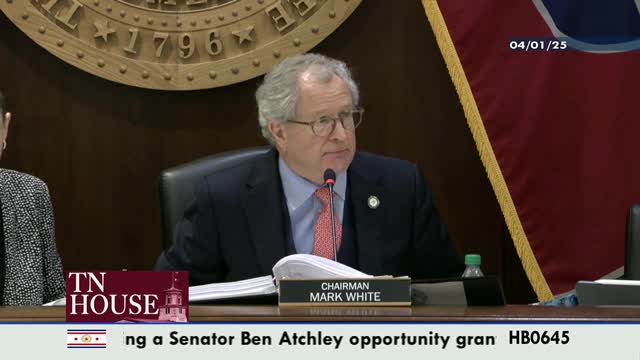
A proposal to allow Western Governors University–Tennessee (WGU Tennessee) to receive Ben Ashley Opportunity Grant funds failed in the House Education Committee on a tie vote, 8-8 with one member present not voting. The motion failed for lack of a majority.
Leader Garen Garrett, the bill sponsor, said the measure would extend a scholarship program to nontraditional working adults who attend WGU Tennessee in high‑need fields such as nursing, education and information technology. Garrett described his own experience attending an evening law program while working full time and said WGU’s model gives rural and working students an affordable route to degrees.
WGU Tennessee leaders told the committee they have awarded more than 13,000 degrees to working adults in the state since their authorization in 2013, and they emphasized contributions to workforce needs. Chancellor Kim Estep and WGU representative Ginger Hauser said the institution serves students who otherwise would not be able to pursue campus‑based programs.
Opponents, including Chairman Sopiki during debate, warned that expanding the scholarship to an online, non‑brick‑and‑mortar institution risks diverting limited grant dollars from Tennessee’s community and private colleges and universities. Members raised concerns the bill could open the door to additional out‑of‑state or for‑profit online providers seeking the same funding and urged that the Ben Ashley fund be fully funded for current eligible students before adding new recipients.
After extended debate on the policy and fiscal implications, committee members moved to call the question. The clerk reported an 8‑8 tie with one present not voting; the bill did not advance.