Get Full Government Meeting Transcripts, Videos, & Alerts Forever!
Get email alerts on the County Budget Revenue Forecast topic
No spam. Unsubscribe anytime.
King County Forecast Council adopts March revenue forecast and approves 2025 work plan
Summary
King County Forecast Council members voted unanimously March 17 to adopt the council's March preliminary economic and revenue forecast for the King County budget and to approve the Office of Economic and Financial Analysis's 2025 work plan.
King County Forecast Council members voted unanimously March 17 to adopt the council's March preliminary economic and revenue forecast for the King County budget and to approve the Office of Economic and Financial Analysis's 2025 work plan.
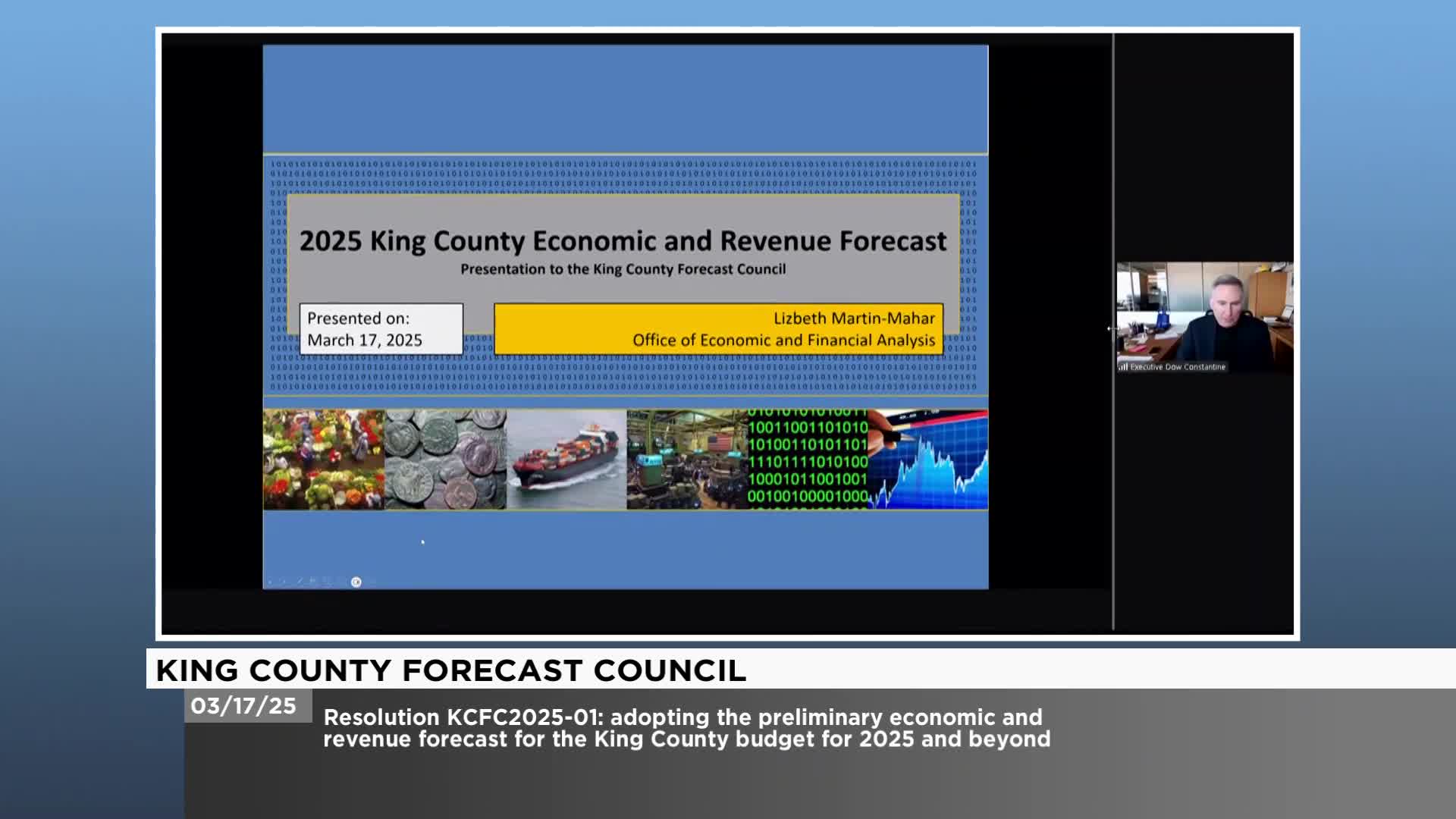
The council adopted the forecast after a presentation by Elizabeth Martin Mahar, chief economist for King County. Martin Mahar told members the March forecast shows total county-related revenues of about $3.0 billion for 2024, a decline to about $2.7 billion for 2025, and combined biennial revenues of roughly $5.5 billion under the office's baseline projections. She said the March forecast is higher than the August 2024 forecast on non-general-fund revenues largely because it reflects a hospital tax and a higher flood levy rate not previously in the baseline.
Martin Mahar said several revenue lines performed above the August forecast for 2024: sales tax receipts were about $28.7 million (roughly 1 percent) above the August projection; hotel and rental-car taxes exceeded forecast by about $5.5 million; and penalties and interest on property taxes were about $2.9 million above forecast. She said four revenue sources (gambling tax, E-911, cannabis tax, and recording documents) came in slightly below expectations.
The presentation highlighted that a hospital tax and a higher flood levy together account for much of the projected increase in property-tax-related revenue for 2025; Martin Mahar said those two factors add about $111 million above the previous forecast and that total revenues across all sources are about $104.3 million (3.5 percent) above the August baseline. She also noted that, excluding the hospital tax, total revenues would be about $17.6 million lower than the prior forecast.
Looking forward to the 2025-27 biennium, the office projects weaker sales tax receipts, with taxable-sales volumes down about $84.6 million compared with prior expectations; the forecast shows total revenue excluding the hospital tax down about $35 million (roughly 0.6 percent) over the next biennium. The office estimated a roughly $12 million reduction to the general fund in the forecast horizon and said it will publish an alternate, more pessimistic forecast (including a recession scenario) within about a week.
Martin Mahar summarized regional and national risks the office considered: lower consumer sentiment, uncertainty over federal fiscal policy and tariffs, possible workforce impacts from federal layoffs and immigration policy changes, and a continued decline in commercial assessed values (office buildings fell more than 30 percent in the most recent assessment cycle). She said King County employment growth was only 0.3 percent in 2024 versus 1.3 percent nationally and that taxable sales were the only major indicator to register a year-over-year decline in 2024.
Council members asked for and received more detail about assessed values and new-construction estimates. Martin Mahar said 2025 assessed value countywide was about $873 billion, with roughly $10.4 billion attributable to new construction; she said assessed-value growth for 2025 (about 4.8 percent) trailed the unusually large 2023 growth spike.
The council also approved the office's 2025 work plan, which changes the forecast cadence to March, July and November/December (eliminating the August forecast). Martin Mahar said the office will continue to coordinate with the assessor's office and will provide the council with alternative scenarios (including a pessimistic scenario) during the July cycle.
Votes at a glance: the council recorded roll-call votes of 4-0 to approve (1) the resolution adopting the preliminary economic and revenue forecast for the King County budget (item read as KCFC 2025-01) and (2) the resolution approving the 2025 work plan for the Office of Economic and Financial Analysis (item read as KCFC 2025-02). The roll call recorded ayes from Dow Constantine, Council member Dively, Council member Mosqueda and Council member Dombowski; no no votes or abstentions were recorded.
Chairing and leadership: at the start of the meeting the council completed internal organization business. Members nominated and confirmed Council member Dombowski as chair for 2025 and nominated Executive Dow Constantine as vice chair; both nominations passed by voice vote earlier in the meeting.
Next steps and materials: Martin Mahar said she will circulate the slide deck and a pessimistic alternative forecast and post both to the office's website. The council indicated it may request additional briefings on the economic impact of housing and on policy levers that could support new construction and revenue growth.
(Direct quotes in this article come from the meeting transcript: "For the record, I am Elizabeth Martin Mahar, chief economist for King County," and Dow Constantine: "We created this office of economic and financial analysis actually through charter amendment in 2008 because we wanted everyone to have confidence in our...forecast.")