Get Full Government Meeting Transcripts, Videos, & Alerts Forever!
Get email alerts on the Public Defense Statewide topic
No spam. Unsubscribe anytime.
New State Public Defender outlines large budget requests after October transition
Summary
The State Public Defender told lawmakers the new agency needs additional one‑time and ongoing appropriations to implement statewide public defense, cover transcript costs after a Supreme Court ruling, onboard counties and raise contract rates and staffing to meet caseloads and statutory duties.
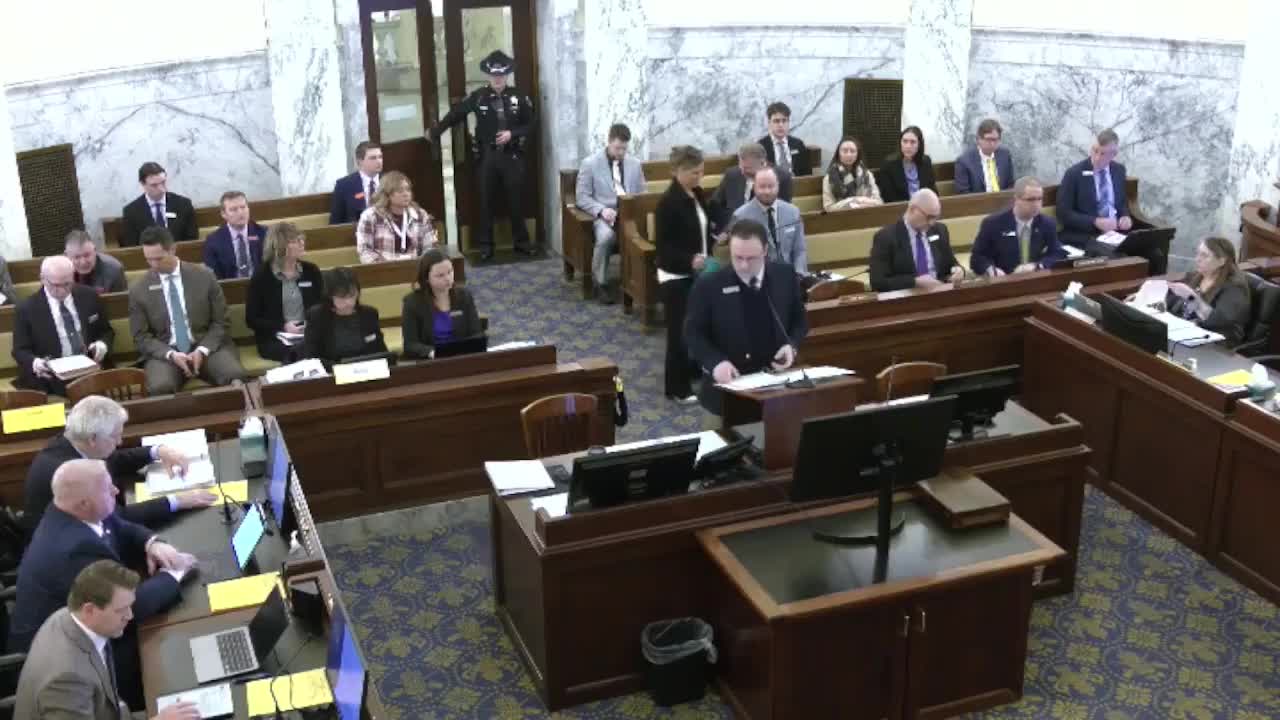
Christopher Lahoset, budget and policy analyst with the Legislative Services Office, described the components of the newly created State Public Defender and the agency’s fiscal requests to the Joint Finance‑Appropriations Committee.
Lahoset told the committee the office is a new agency created in “Title 19 Chapter 60 Section 3 of Idaho Code” and that its budget relies primarily on a dedicated State Public Defense Fund created under Idaho Code §57‑8207, which received a $39 million cash transfer from the tax relief fund. He summarized the agency’s FY25 authorized appropriation of about $52,000,015 and described several supplemental and ongoing requests.
“First, the agency requests an additional one‑time supplemental of $2,500,000 in spending authority in the current fiscal year to fully utilize that $39,000,000 cash transfer,” Lahoset said. He said the agency earmarked that amount in part to provide representation under the Child Protective Act (CPA). He also summarized a governor’s supplemental recommendation of $390,200 for transcript costs tied to a Dec. 5 Idaho Supreme Court ruling in State v. Blasick that shifted transcript cost responsibility to the state in certain cases.
The agency requested a one‑time FY25 supplement of $5,427,600 for additional personnel and contracting costs to recruit and retain employees and increase contract rates for attorneys and investigators. For FY26, Lahoset summarized the agency’s requests including $2,500,000 ongoing to fully utilize the $39,000,000 cash transfer; $16,000,380 and $80,800 from the general fund for operating costs (primary and conflict contract attorneys, investigators, experts, capital litigation costs, technology and transcripts); and authorization for an additional 17.96 full‑time positions to onboard four institutional offices (Benewah, Elmore, Jerome and Shoshone counties).
Eric Frederickson, the State Public Defender, told the committee the agency entered operation Oct. 1 and that the transition exposed gaps in staffing and funding. “We walked into 1,300 withdrawals and cases,” Frederickson said, describing an initial triage period where agency leadership and district defenders handled litigation while the new agency stood up.
Frederickson and committee members discussed several implementation challenges: (1) recruiting and retaining lawyers in rural counties, (2) the ethical and constitutional problems with prior flat‑fee contracts and the need to increase contract rates, (3) counties’ statutory obligation to provide facilities until 2029 and how that interacts with state onboarding of district offices, and (4) uncertainty about some costs previously borne by counties (psychosexual evaluations, transcripts and other evaluation costs).
Frederickson said the agency has started moving from a caseload measure to a workload model tied to a statewide case management system, and that some counties will be onboarded in phases. He also said some matters not contemplated by statute—private terminations, custody actions and other appointments where no local attorney is available—have been routed to the state agency and required litigation to define scope.
Committee members pressed for more detail on “miscellaneous” expenditures (about $3.58 million listed for training, transcripts and miscellaneous) and on which expenses remain with counties versus the state; Frederickson said some statutory clarifications will be required. He also emphasized that salary equalization across counties and pay adjustments for attorneys handling more complex cases were part of the staffing solution.
Ending: The committee did not take a vote; the agency’s suite of supplemental and ongoing requests will be considered in the FY26 budget process. Several committee members asked for more detailed line‑item backup and for follow‑up briefings on county facility arrangements and contract rate schedules.