Get Full Government Meeting Transcripts, Videos, & Alerts Forever!
Get email alerts on the Education Budget topic
No spam. Unsubscribe anytime.
State Board of Education budget pitch centers on workforce grants, IT and school safety
Summary
Kevin Campbell, the Legislative Services Office budget analyst, presented the Office of the State Board of Education's FY2026 budget requests, highlighting a one-time $15 million public–private workforce capacity grant, ongoing centralization of audit, IT and school safety staff and further enhancements to IT, data and school security programs.
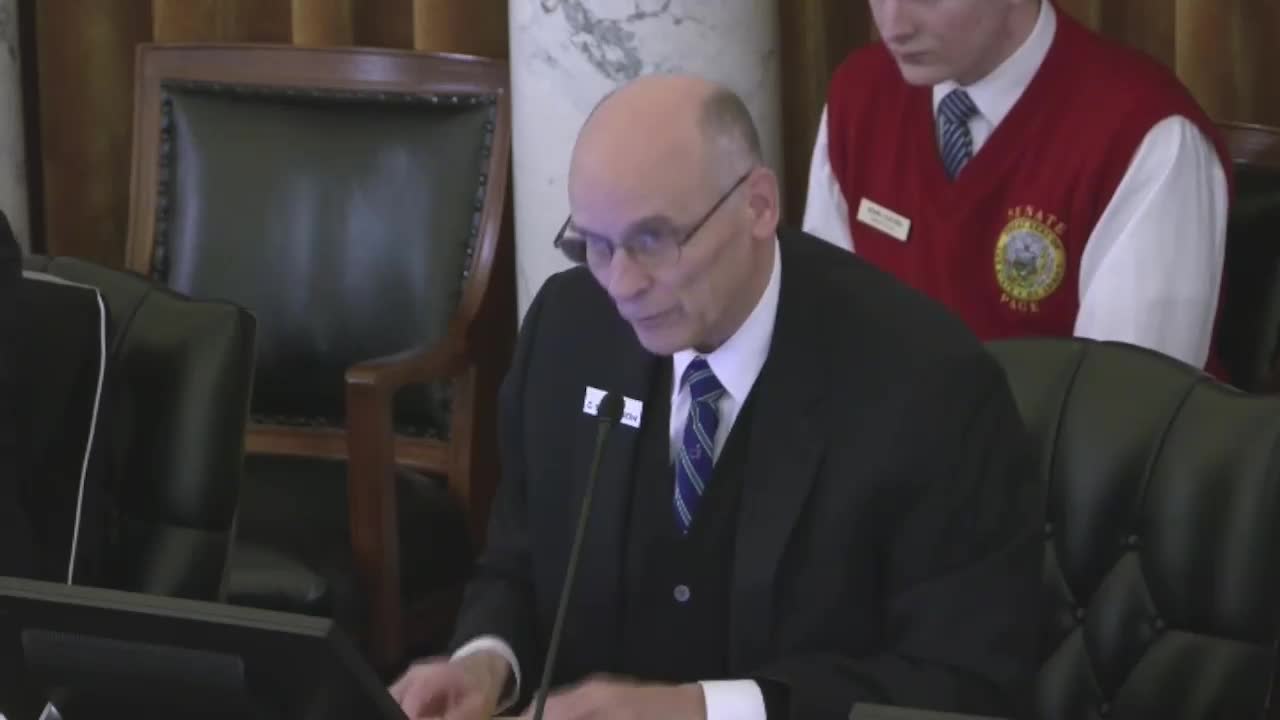
Kevin Campbell, a budget and policy analyst with the Legislative Services Office, told the Joint Finance Committee the Office of the State Board of Education (OSB) budget includes significant recent growth and several large enhancement requests. "Today, I'm presenting you with the budget for ... the Office of the State Board of Education," Campbell said, opening the presentation.
The presentation identified three OSB divisions — administration, IT and data management, and school safety and security — and said OSB currently has 84.25 authorized full-time positions with eight vacancies and a five-year average authorized full-time position count of 55.95. Campbell said a recent $30 million ongoing Empowering Parents grant, added in FY2024, accounts for a notable portion of the office's growth.
OSB Executive Director Joshua Whitworth, introduced by Board President Dr. Clark, described the logic behind a larger central office. "One of the primary motives of the board's directive is to look at system inefficiencies where that might exist," Whitworth said, adding that centralizing functions — audits, risk management, IT and school-safety work — allows the board to standardize policy and support institutions and districts that lack local capacity.
Whitworth and Campbell highlighted the largest single FY2026 enhancement in the governor's request: a one-time $15 million public–private workforce capacity grant. The proposal would provide state funds to institutions that raise private matching dollars; Campbell said the proposed match ratios are 1:1 for Boise State University, Idaho State University and the University of Idaho, and 1:2 for Lewis–Clark State College and the four community colleges. The proposal aims to expand instructional capacity for in‑demand and workforce training programs, particularly where facilities, faculty and equipment are limiting student enrollments.
Other FY2026 requests identified by Campbell include 14 ongoing enhancements (five new positions, such as an IT systems/infrastructure engineer and a database engineer), behavioral threat assessment teams for K‑12, a revision to the base funding model for Independent Study Idaho, and two one-time requests for replacement vehicles and computers. Campbell noted OSB also received transfers in recent years — for example, IT and data staff moved from the State Department of Education, and a $5 million broadband program transferred from SDE to OSB in FY2025.
Committee members pressed for further detail. Representative Petzke asked why the central office had grown from roughly 60 FTPs to more than 80 and whether funds might be better spent at institutions. Whitworth answered that the transfers (audit, risk management, school safety and IT) were intended to reduce duplication and create systemwide standards, and that centralized audit and risk functions help ensure efficient use of institutional funds. He said the OSB IT team supports roughly 300,000 students and that bringing certain IT positions in‑house may be more cost-effective than relying on contractors.
Senator Cook asked for more detail on contractor costs, maintenance backlogs and performance measures tied to requested IT positions; she asked for current backlog numbers and expected outcomes if positions were funded. Whitworth said bringing roles such as database and infrastructure engineers in-house would allow staff to serve multiple programs and address backlog items without recurring high contractor costs.
Several members asked about specific programs: the Independent Study Idaho program (described by Whitworth as a flexible, self‑paced delivery model, historically fee‑supported at roughly $60 per credit), the school safety and security assessment fund (statutorily funded by an annual transfer of $300,000 from the public school income fund), and the board's recent policy action on DEI‑related student fee programs. Whitworth and other committee members stressed that most services tied to DEI or historically marginalized communities have been funded through student fees and optional opt‑in processes and not through state appropriations.
Representative Horman and others pressed whether any FY2026 requests require underlying legislation; Whitworth said the behavioral threat assessment proposal requires legislation and already has a sponsor and a bill in committee. On the workforce grant, Whitworth said eligibility would be guided by local industry demand—technical advisory and business advisory committees and the state workforce council—and listed high‑demand fields discussed by institutions and industry (mining, forestry, welding/fabrication, mechatronics, nuclear engineering training tied to regional projects).
Campbell and Whitworth acknowledged the committee's request for more detail. Campbell offered to follow up on which enhancement requests would require legislation. Several legislators asked OSB for performance measures, IT plans, contractor‑cost breakdowns, and a refined list of workforce programs the proposed public–private grant would support prior to deliberation on the budget.
The committee did not take any formal votes during this hearing; members directed staff and OSB to provide follow‑up materials to inform later decisions.
Whitworth closed by reiterating the board's emphasis on "systemness"—centralizing certain functions to reduce duplication and to support districts and institutions that lack technical staff and other capacity. He said the office will provide requested implementation details, program eligibility criteria for the workforce grant and additional cost breakdowns to the committee for use in upcoming work sessions.
The committee scheduled follow-up work group discussions to review requested documentation before any formal budget decisions are made.