Get Full Government Meeting Transcripts, Videos, & Alerts Forever!
Get email alerts on the Hiv Prevention topic
No spam. Unsubscribe anytime.
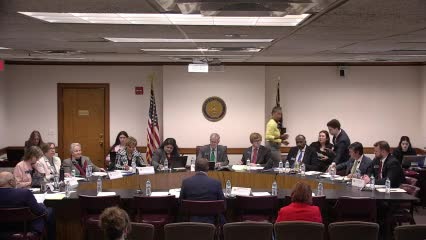
Senate committee approves bill letting pharmacists provide HIV prevention drugs after training
Summary
A Georgia Senate committee voted unanimously to advance Senate Bill 195, which would allow trained pharmacists to dispense 30- to 60-day supplies of pre-exposure prophylaxis (PrEP) and, under a physician protocol, administer long-acting injectable prophylaxis for HIV.
A Georgia Senate committee voted unanimously to advance Senate Bill 195, which would permit pharmacists who complete a required training program to dispense oral pre-exposure prophylaxis (PrEP) and post-exposure prophylaxis (PEP) for HIV and, under a physician protocol, administer long-acting injectable prophylaxis.
The measure, presented by Chairman Hufstedler, requires pharmacists to complete a training program (the bill sets an implementation date by Jan. 1), instructs pharmacists to attempt to notify a patient’s primary care physician or provide information about available primary-care options, and allows pharmacists to dispense a 30-day supply with an option to extend up to 60 days for eligible patients. For injectable prophylaxis the bill requires a written protocol agreement with a physician who is in active practice and available for immediate consultation. The bill also includes criminal and administrative penalties for pharmacists who provide drugs without a required protocol or training and a prohibition on administering these medications from a vehicle.
“The Department of Public Health had a lot of input on this bill,” Chairman Hufstedler said, noting the department suggested changes that were included. Hufstedler discussed cost considerations during his presentation, saying treatment costs can be substantially higher than prevention and that generic PrEP medications are available at markedly lower monthly prices: “the pre exposure medicine alone is I had numbers of about $60 a month for generic. I found out that there's some generic for 23 out there,” he said.
Senator Mangum praised the bill’s approach and asked about diagnosis rates, citing a line in supporting material that “for every 100 people with HIV, only 87 know their HIV status.” Hufstedler and other committee members framed the bill as one step to reach people who do not regularly see a physician and to reduce later, costlier care by preventing infections. Senator Kirkpatrick asked about liability and whether independent pharmacies commonly carry insurance; Cindy Shepherd, representing the Georgia Pharmacy Association, told the committee independent pharmacies do carry liability coverage and that the association “totally support[s] this bill 100.”
Committee debate included several operational details: pharmacists must be trained in contraindications (for example, severe liver or kidney disease, pregnancy/breastfeeding), physician protocol agreements must specify consultation methods, and penalties are tiered for repeated violations. The bill also prohibits pharmacists from administering the medication while remaining in a vehicle.
Senate Bill 195 was moved “do pass” by Senator Mangum and seconded by Chairman Brass. The committee approved the motion unanimously; the transcript records the passage as unanimous but does not include a roll-call tally. Support letters and testimony placed in committee materials included input from the Georgia Department of Public Health and a letter from a policy director in Washington, D.C., referenced by Hufstedler.