Get Full Government Meeting Transcripts, Videos, & Alerts Forever!
Get email alerts on the Foster Care Budget topic
No spam. Unsubscribe anytime.
Health and Welfare director seeks $14 million supplemental, new prevention team to curb rising foster-care costs
Summary
The Department of Health and Welfare asked the House Health and Welfare Committee for a $14 million supplemental to cover current-year foster-care overages and outlined a larger staffing request for prevention and foster-family recruitment intended to reduce future costs.
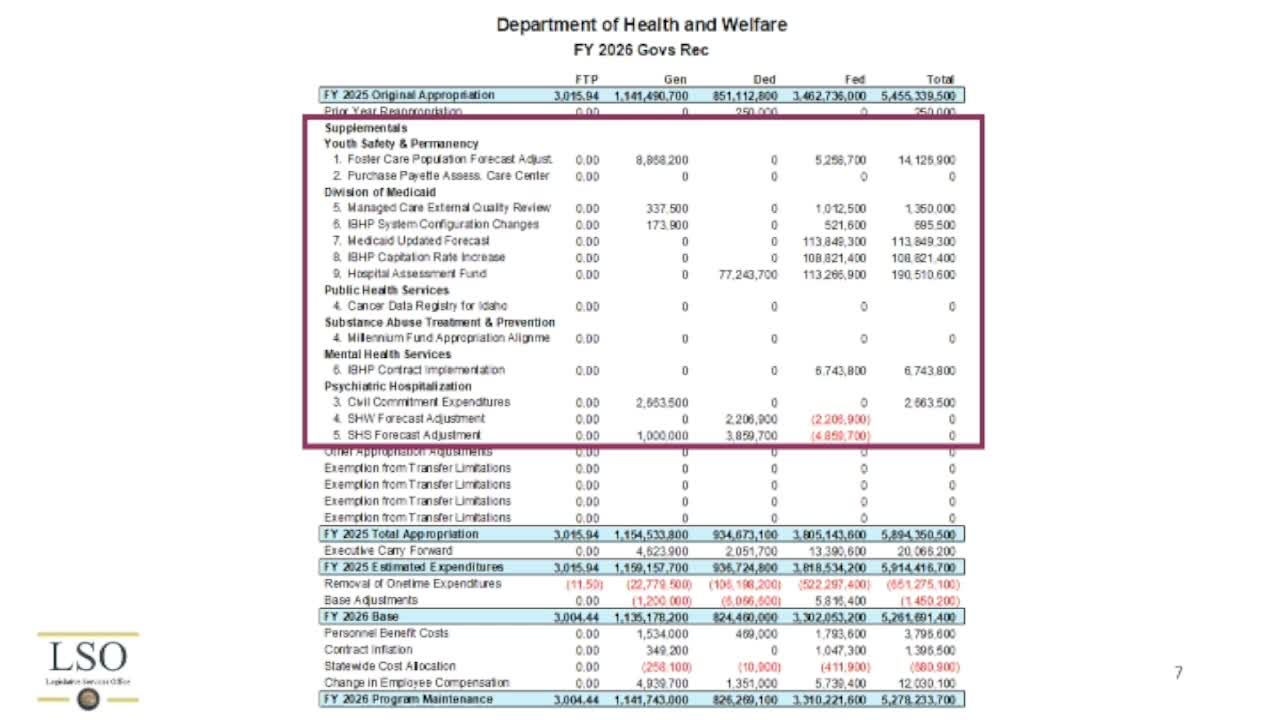
At a meeting of the House Health and Welfare Committee, Department of Health and Welfare Director Alex Adams told members the department is requesting a $14 million supplemental to cover higher-than-expected foster-care costs incurred in the current fiscal year.
The supplemental request is the immediate remedy, Adams said, while the department’s fiscal year 2026 budget would include investments—including a prevention specialist team and foster licensing staff—intended to reduce reliance on higher-cost congregate placements and lower long-term spending.
Alex Williamson, budget and policy analyst with the Legislative Services Office, presented the department’s supplemental requests and said the line item is labeled “foster care population forecast adjustment.” Williamson noted the department’s request reflects rising costs driven by increased mental-health needs, substance-use issues and a shortage of community-based placements.
“Because the Payette Assessment and Care Center is so new, I think they reevaluated if purchasing it outright was the right move for this year,” Williamson said when members asked why the department did not move forward with an earlier purchase plan.
Adams said the Payette Assessment and Care Center has been an important short-term option for children who otherwise were placed in short-term rentals and other congregate settings. Adams said last year the department recorded 176 children in short-term rentals; as of November, that number was zero. He said the department decided to continue leasing the Payette facility rather than purchasing it this fiscal year while it develops a longer-term plan. Adams gave the purchase price cited earlier in committee as $1,700,000.
Adams described the $14 million supplemental as a current-year “bailout” for expenses already incurred. He said the supplemental grew year over year—citing prior supplementals that rose from about $1 million to $2 million, then $5 million, and now $14 million—and attributed that escalation to heavy use of congregate care.
“We are an entitlement program. If a child is committed to the custody of the department, we have a legal obligation to pay for their care,” Adams said. He added that foster care placements are less costly than many congregate settings and described the department’s strategy as “flip the script”—keeping more children safely at home and increasing the number of foster and kinship placements.
Adams said foster care is about $16 a day, while congregate care averages about $3.80 a day, and told the committee the department is trying to shift children into lower-cost, higher-outcome placements. He said efforts to recruit foster families have improved the ratio from roughly 74 foster families per 100 children entering care to about 93 per 100.
The department’s FY26 request reduces the department’s initial ask of about 100 new full-time positions to a governor-recommended 58 FTP; within that total, the prevention specialist team would add 36 positions and about $3 million. Additional requested staff would focus on foster-program clinical work and licensing to decrease bottlenecks for approving new foster families.
Representative Lavin asked whether the supplemental represents a long-term investment that will save money. Williamson and Adams said the supplemental pays current-year costs; the department’s FY26 investments are intended to “bend the cost curve” but require up-front spending. Representative Rubel asked why recruiting had emphasized ‘‘church to church’’ outreach; Adams said recruitment targets communities where prior research shows higher yield but emphasized foster licensing is open to all faiths and backgrounds.
Committee members praised the department’s work on reducing congregate placements, and members were told the department has also partnered with the Office of the Governor on initiatives such as paid family leave to encourage foster-family sign-ups.
Votes at a glance: the committee approved the minutes from Feb. 5, Feb. 6 and Feb. 10 on a motion from Representative Egbert; the motion passed with vocal “ayes” and no recorded roll-call opposition.
The committee will decide tomorrow whether to forward recommendations to the Joint Finance-Appropriations Committee (JFAC). Director Adams said the department expects further discussion during that process.
Ending: The committee did not take further votes on policy or on FY26 requests during this session; its next meeting will consider recommendations to JFAC and other budget items.