Get Full Government Meeting Transcripts, Videos, & Alerts Forever!
Get email alerts on the Health Insurance Appropriation topic
No spam. Unsubscribe anytime.
Joint finance panel approves $14,130 health‑insurance appropriation per FTE for FY2026
Summary
The Joint Finance‑Appropriations Committee voted to increase the state’s health‑insurance appropriation to $14,130 per eligible full‑time equivalent position for fiscal year 2026; the change alters reserve projections and adds roughly $48.4 million statewide.
The Joint Finance‑Appropriations Committee on Friday approved an increase in the state’s health‑insurance appropriation to $14,130 per eligible full‑time equivalent position for fiscal year 2026, a compromise between the committee’s CEC recommendation and the governor’s proposal.
The measure, moved by Senator Chuck Winder (Senator Woodward moved the compromise motion) and seconded by Representative Tanner, was described by committee staff as a midpoint between the committee recommendation of $13,960 per FTE and the governor’s recommendation of $14,300. Committee staff said the compromise would raise health‑insurance appropriations statewide and adjust smaller, employer‑paid benefit budgets such as workers’ compensation and Social Security contributions.
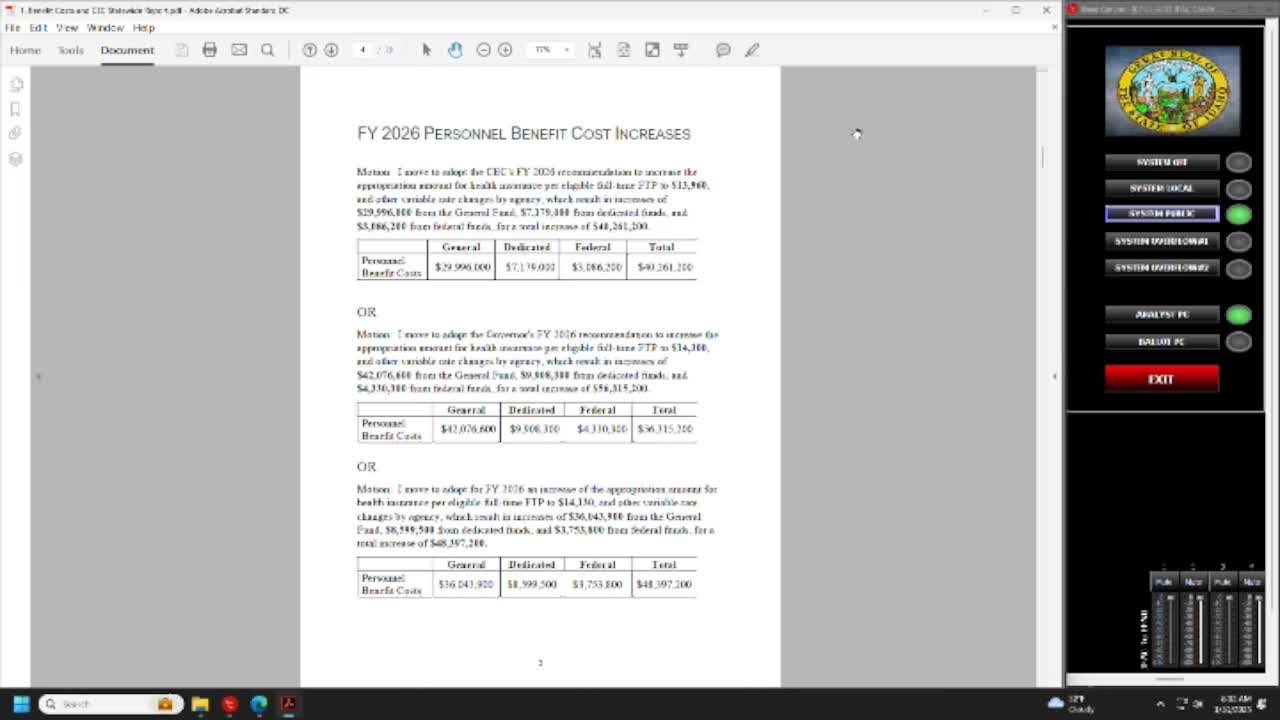
Committee analyst Mr. Bybee described three dollar‑amount motions on the table and told members the motions differed mainly on the per‑FTE health‑insurance figure: $13,960 (CEC recommendation), $14,300 (governor), or $14,130 (a midpoint compromise). Bybee also said the motions include smaller, agency‑specific adjustments for employer costs.
The committee record shows the fiscal effect assigned to the adopted $14,130 figure: increases of $36,043,900 from the general fund, $8,599,500 from dedicated funds and $3,753,800 from federal funds, for a total increase of $48,397,200. Earlier in debate Mr. Bybee gave projected reserve‑fund balances tied to the three options: $51,600,000 projected year‑end reserve for the $13,960 option and $61,400,000 for the $14,300 option; he said the $14,130 midpoint had not been separately calculated in that moment.
Lawmakers debated whether to fully reflect what supporters called the “actual cost” of insurance or to use reserve funds to offset premiums for another year. Senator Ward Engelking argued the committee should “be reflecting the actual cost of insurance,” saying using reserves to buy premiums down creates a larger apparent increase in later years. Representative Furness questioned actuarial projections, saying actuarial firm Milliman’s forecasts have historically erred on the conservative side and arguing for the committee recommendation instead of the higher options.
Roll call on the adopted motion produced unanimous affirmative tallies among members voting: the Senate recorded 8 ayes, 0 nays, 2 absent/excused; the House recorded 9 ayes, 0 nays, 1 absent/excused — a combined total of 17 ayes, 0 nays, and 3 absent/excused. The committee chair said the motion passed and “without objection will carry a due pass recommendation.”
The committee then moved on to separate change‑in‑employee‑compensation (CEC) motions; those items were not resolved at Friday’s meeting and will be revisited at a later date.
Notes: The committee discussion and votes were held under the body’s joint voting procedures. The committee record includes the staff packet and language that were available to members in advance.