Get Full Government Meeting Transcripts, Videos, & Alerts Forever!
Get email alerts on the Conservation Programs topic
No spam. Unsubscribe anytime.
Idaho Soil and Water Conservation Commission reports high district satisfaction, details Waukapa and CREP spending
Summary
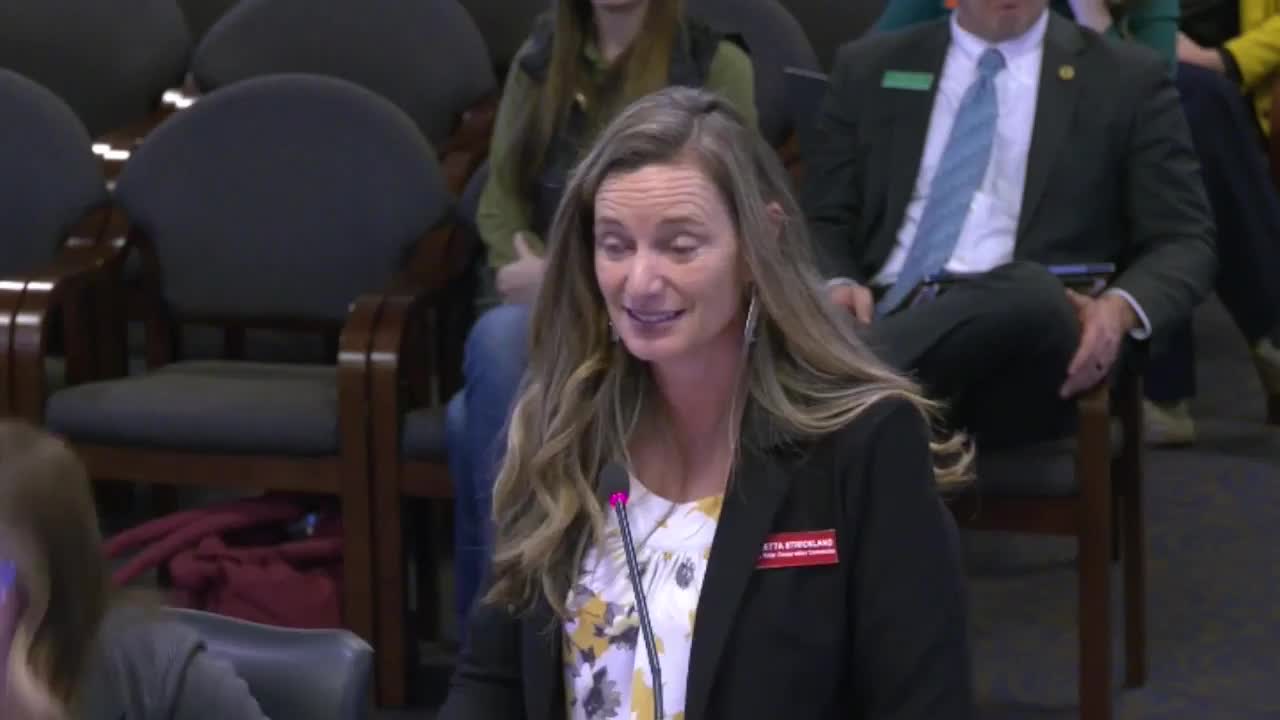
Loretta Strickland, acting administrator and agricultural program manager for the Idaho Soil and Water Conservation Commission, presented the commission’s FY2024 performance report to the House Agriculture Affairs Committee on Feb. 14, reporting nearly $8 million in expenditures, growing district satisfaction, and unmet demand for Waukapa cost‑share funding.
Loretta Strickland, acting administrator and agricultural program manager for the Idaho Soil and Water Conservation Commission, presented the commission’s fiscal year 2024 annual and performance report to the House Agriculture Affairs Committee on Feb. 14 in Boise. The report summarized revenue and expense totals, district‑level support, and demand for the Waukapa cost‑share program.
The commission reported total annual revenues of about $3,950,000 and expenditures of just over $7,900,000 in FY2024, Strickland said. She told the committee that $1,580,000 appropriated for distribution to the state’s 50 conservation districts “was disbursed per statute and rule.” She said that the first $725,000 was distributed equally among the 50 districts (about $14,500 each) and that the remaining match funds were allocated proportionately under IDAPA rules. Strickland said the median match allocation was $13,834 and that the ratio of match to local support was 1.49-to-1, “just $297,000 short of the 2-to-1 maximum allowed under statute.”
The report lists four core agency functions: district support and services, comprehensive conservation services, fiscal administration, and outreach. Strickland said staff assisted 1,031 landowners, recorded nearly 12,000 hours of commission staff time for district projects, and logged 2,771 staff hours providing technical assistance to landowners in the Eastern Snake Plain Aquifer CREP program. She also said commission staff worked to develop two TMDL implementation plans and that EPA did not approve any new TMDLs in FY2024, which the agency said allowed it to focus staff time on its WACPA (water quality for agriculture) implementation work.
The commission’s RCRDP loan program, Strickland said, assisted financing on projects covering 8,221 privately owned acres; commission work helped implement best management practices on 63,075 acres. On outreach, Strickland noted the monthly newsletter and social‑media outreach aimed at sharing district successes with other districts and the public.
On Waukapa (the state cost‑share program revived with general fund appropriations in 2022), Strickland said demand has far exceeded available dollars. From FY2022 through FY2024, $10,000,000 was appropriated to Waukapa. In that period the commission received 170 project proposals requesting about $20,200,000 in cost share that would have leveraged roughly $55,600,000 in conservation work when combined with partner and landowner match. In FY2024 specifically, Strickland said $5,000,000 was appropriated and 80 proposals were received; 50 projects were funded that combined state Waukapa funds with other money to yield about $17,700,000 in total project value. “For every dollar the state invested in Waukapa in fiscal year 20 24, Idahoans accomplished $3.54 worth of conservation,” she said.
Committee members asked for more detail about unfunded proposals, the share of investments by category, and how state funds reach districts. Strickland summarized Waukapa investments by category: roughly $4,350,000 for irrigation infrastructure and efficiency, $949,000 for livestock best management practices (riparian fencing, off‑site water developments, heavy‑use pads), $949,000 for stream bank and erosion BMPs (sediment basins, culvert replacement), $203,000 for soil‑health BMPs, and $942,000 for district administrative funds. Melanie Ziegler, the commission’s fiscal manager, explained the commission’s general‑fund base appropriation, the agency’s 3% growth authority on its base, and the use of dedicated funds to operate the RCRDP loan program.
Representatives from the Idaho Association of Soil Conservation Districts (IASCD) — including Devin Fielding (IASCD treasurer and North Bingham County supervisor), Tory O’Neil (IASCD vice president and Custer District supervisor), and Travis Jones (IASCD director) — described locally led projects. They highlighted work with young producers, irrigation upgrades (example: pivot upgrades paid partly with landowner sweat equity), watershed restoration, and community infrastructure projects where districts helped with bridge replacements and stream‑bank stabilization after flooding. Tory O’Neil emphasized outreach to youth through programs such as Envirothon and local fifth‑grade tours as critical to future stewardship.
Committee members discussed how state appropriations flow to districts, the role of the legislature and Governor’s Office in supplemental funding, and whether projects addressing aquifer recharge were part of Waukapa proposals; Strickland said she did not recall any funded projects specifically identified as aquifer recharge, though some proposals aimed to improve on‑farm groundwater use efficiency.
The commission requested continued legislative support for voluntary, locally led, nonregulatory conservation. Strickland closed by thanking the committee and offering to take additional questions.
Ending: The committee’s discussion following the presentation focused on funding mechanisms, the composition of funded projects, and statewide demand for Waukapa funds; no formal committee action on the report was recorded during the hearing.