Get Full Government Meeting Transcripts, Videos, & Alerts Forever!
Get email alerts on the State Budget topic
No spam. Unsubscribe anytime.
Governor’s 2026 executive budget emphasizes education, water, transportation and reserves
Summary
Division of Financial Management Administrator Laurie Wolf presented Gov. Brad Little’s executive budget to the Joint Finance and Appropriation Committee, proposing targeted new spending for public schools, transportation, water and wildfire response while holding $100 million for tax relief and increasing rainy‑day reserves.
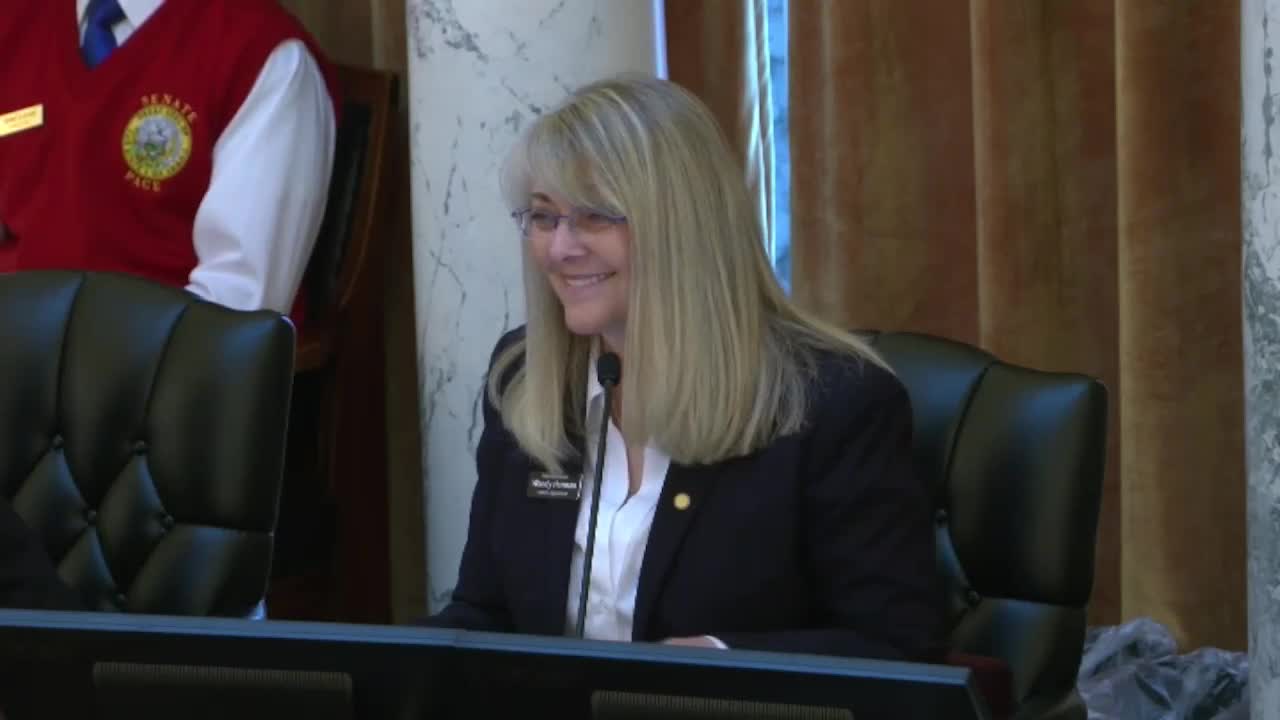
Laurie Wolf, administrator of the Division of Financial Management, told the Joint Finance and Appropriation Committee on Jan. 8 that Gov. Brad Little’s executive budget for fiscal 2026 is built to be “structurally balanced” while continuing the administration’s priorities on education, workforce programs, infrastructure and natural‑resource management.
The governor’s proposal projects total general‑fund revenue of roughly $6.2 billion for FY 2026 and recommends about $151 million in ongoing and one‑time enhancements on top of maintenance costs. Wolf said the administration used a conservative revenue forecast, left a projected ending balance of roughly $227 million for FY 2026 and proposes transfers to state stabilization funds to bolster reserves.
Why it matters: The package would funnel new money into several areas that legislators identified as priorities during the committee’s orientation, while also directing funds into savings and holding a $100 million placeholder for tax relief. Committee members pressed Wolf on tradeoffs between new spending and tax cuts, and on several large one‑time requests tied to recent events, such as wildfire suppression costs.
Wolf summarized major elements of the request. On education, the governor would add about $150 million for public schools, including an $83 million recommendation for teacher pay increases and roughly $30 million for school employee health insurance. The budget also sets aside $50 million in revenue adjustments for “education choice initiatives,” contingent on legislative policy action, Wolf said.
On transportation, the budget recommends a $50 million transfer to a congestion‑mitigation and expansion fund administered by the Idaho Transportation Department; Wolf said the amount would enable bonding for additional high‑value projects once ITD exhausts existing bonding capacity. She said the state still faces $8–10 billion in unfunded expansion needs across Idaho.
Natural resources and emergency response also feature prominently. Wolf said the governor recommends a supplemental $60 million to replenish the state’s fire suppression account for FY 2025 and an ongoing $40 million for FY 2026 to help stabilize fire‑suppression funding. She described the ongoing transfer as a hedging measure intended to avoid scrambling for funds in the event of severe fire seasons.
Workforce and housing proposals included $25 million for workforce training (a $15 million one‑time grant program that requires private match and $10 million ongoing for career‑technical education operations) and a $15 million one‑time transfer to the state’s workforce housing fund.
Public safety and cyber security: the budget would add $10 million in ongoing general fund for statewide cyber security infrastructure and $500,000 to continue the state’s fentanyl interdiction program. On prisons and contraband, Wolf said the governor recommended $3.4 million for state prison security and contraband mitigation.
State public defense: Wolf said last year’s appropriation of about $52 million funded the consolidation of public defense from counties to the state on Oct. 1, 2024. Because of a December Idaho Supreme Court decision clarifying the state’s payment responsibilities and because consolidated operations have incurred higher costs, the administration proposes a FY 2025 supplemental of $5.4 million and an FY 2026 one‑time enhancement of $16.8 million; Wolf said the total FY 2026 recommendation to support state public defense would be about $83 million. She described parts of the funding as one‑time pending policy decisions about future funding sources, including potential transfers to the public defense fund that receive sales tax distributions.
Committee questions focused on tradeoffs between tax relief and spending, the rationale for adding ongoing fire funding, the size and intent of the transportation transfer, and how workforce training grants will be allocated. Wolf said the administration sought to balance returning money to taxpayers with commitments to infrastructure and services, and that many one‑time items are targeted to capacity‑building rather than ongoing program expansion.
The presentation concluded with Wolf reaffirming the administration’s emphasis on conservative revenue estimates, maintaining healthy reserves and prioritizing education, roads, water and public safety.
Looking ahead: The committee will review agency‑level detail in coming days; Wolf and DFM staff will return to answer more specific questions when agencies present their budgets to JFAC.