Get Full Government Meeting Transcripts, Videos, & Alerts Forever!
Get email alerts on the Construction Reappropriation topic
No spam. Unsubscribe anytime.
ITD asks for reappropriation authority, cash transfers and ongoing federal funding authority to finish multi‑year road projects
Summary
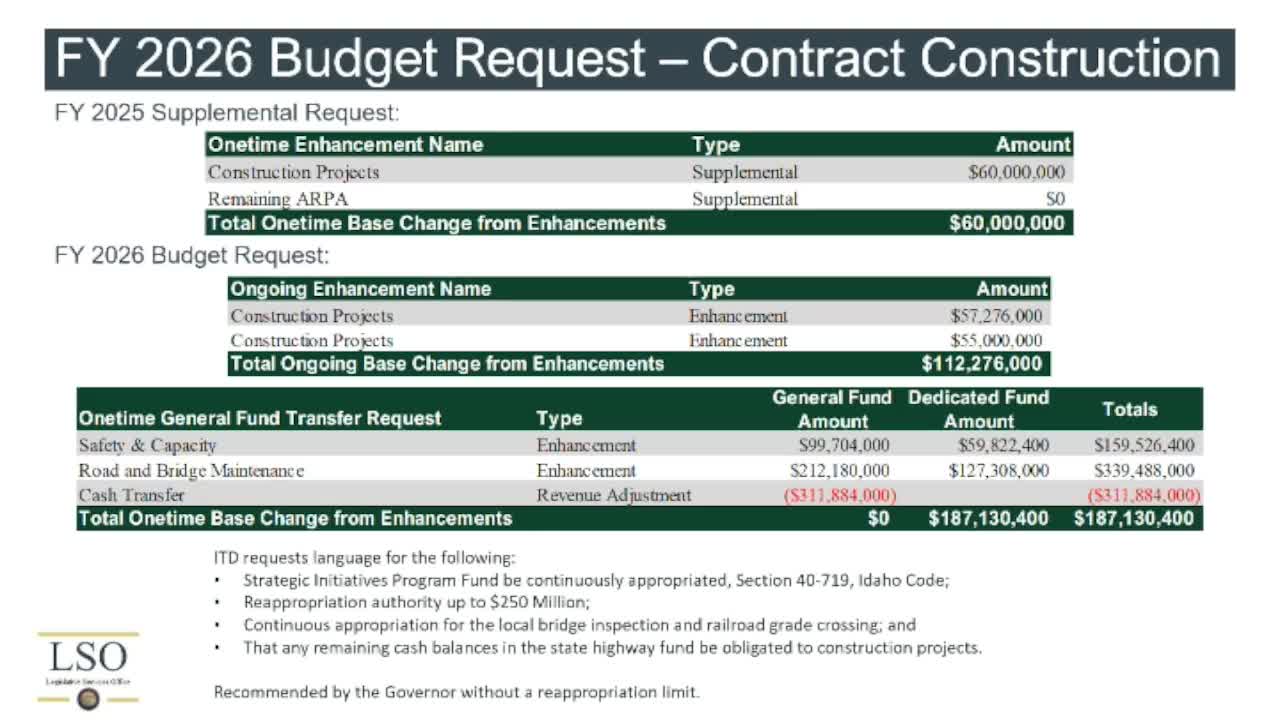
The Idaho Transportation Department asked the Joint Finance‑Appropriations Committee for supplemental and ongoing appropriation authority to cover obligated, multi‑year construction payments, saying current caps can leave the department short when contractors invoice large payouts.
The Idaho Transportation Department asked the Joint Finance‑Appropriations Committee for multiple appropriation adjustments to ensure it can make contractor payments on large, multi‑year highway projects. ITD officials told the committee that a sizable amount of construction remains contracted or obligated and that annual appropriation limits are constraining payments rather than project budgets.
Brooke Dupree, Legislative Services Office analyst, summarized the requests: a FY25 supplemental of $60 million (about $10 million from State Highway Local and $50 million from State Highway Federal funds) to cover revenues above appropriation; FY26 ongoing capital outlay requests of about $57.3 million and $55.0 million tied to increased federal funding (IIJA) and reappropriation authority up to $250 million. Dupree also described a governor‑recommended request for one‑time general‑fund cash transfers — $99,704,000 for safety and capacity projects and $212,000,000 for road and bridge maintenance — and noted the Strategic Initiatives Program Fund is continuously appropriated in statute; ITD asked that the committee not override that continuous appropriation with a single‑year cap.
Chief Administrative Officer Dave Tolman told the committee that, as of the end of FY24, ITD had “a little over $600,000,000” of obligated but unspent construction commitments across multiple funding sources. He said the current $250 million reappropriation limit can leave the department short of spending authority when large multi‑year contracts reach heavy payout periods, which in some months can require $50–$80 million in contractor payments.
Representative Tanner and others asked whether the requests would fund new projects or simply provide authority for contracted work in progress. Director Scott Stokes explained the requests primarily cover active multi‑year contracts and provide spending authority to complete payments, not to create unreviewed new projects. Stokes and Tolman said the Strategic Initiatives Fund’s continuous appropriation status is intended to help smooth payments on multi‑year projects and that legislative appropriation caps can unintentionally require ITD to delay contractor payments.
Committee members expressed concern about oversight of large transfers and about setting precedents for continuous appropriations; ITD reiterated it will provide project status updates and noted many large bonded or TE CM‑funded projects are still under contract with completion timelines over the next several years. The director said past bonding (GARVEE, TECM) and strategic initiatives transfers are part of the funding mix and that the department will continue to report project progress to the committee.