Get Full Government Meeting Transcripts, Videos, & Alerts Forever!
Get email alerts on the Budget Process topic
No spam. Unsubscribe anytime.
LSO explains decision-unit budget model and how JFAC will move from base to FY2026 original appropriation
Summary
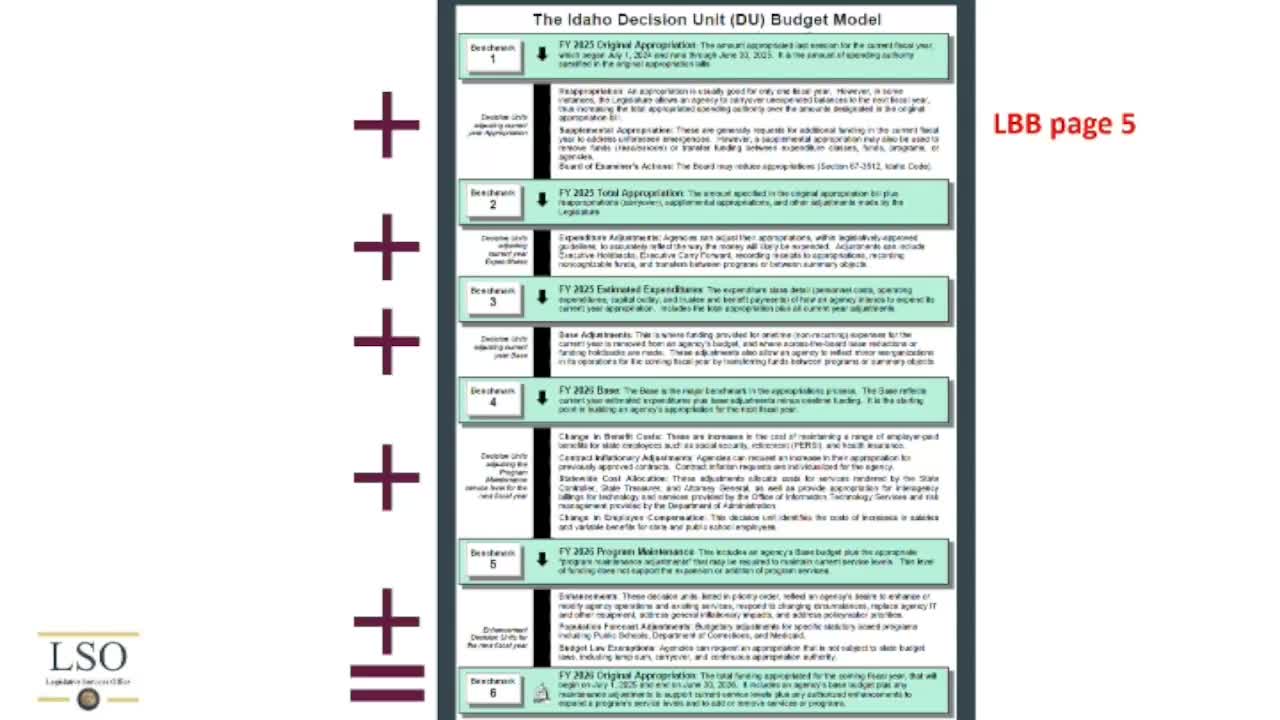
Legislative Services Office explained that Idaho's budget process uses a decision-unit model: starting from last year's original appropriation, applying executive adjustments and base resets, then moving to program-maintenance and enhancement proposals to set the next year's original appropriation.
Deputy director Jared Tetrault of the Legislative Services Office walked committee members through the state's decision-unit budget model and the practical steps JFAC will use to set FY2026 appropriations.
Method and benchmarks: Tetrault described six benchmarks analysts use each fiscal cycle. Benchmark 1 is the prior-year original appropriation; subsequent steps incorporate reappropriations, executive carry forward, midyear transfers, and anticipated expenditures for the current year. Benchmark 4 represents the current-year estimated expenditures after allowable executive adjustments. Benchmark 5 is the program-maintenance proposal (changes such as benefit adjustments, contract inflation, statewide cost allocation, and employee compensation). Benchmark 6 becomes the next year's original appropriation after enhancements are applied.
Why it matters: Tetrault said following the decision-unit model keeps changes auditable and makes it easier for the committee to track what is base spending versus one-time or policy-driven increases. "In Idaho, the state builds budgets one piece at a time," he said, explaining that keeping items in technical boxes makes it easier to see the effects of each decision on the overall appropriations picture.
Practical notes: Tetrault highlighted that dedicated funds and federal funds are separated in statewide reports; he described the fund-analysis, comparative, and decision details pages in the budget book that JFAC members will use to review agency requests and the governor's recommendations. He also explained "non-cognizable" (non-state) funds and the executive authority to recognize such funds under Idaho code when federal or other receipts arrive after the legislature adjourned.
Next steps: Tetrault said agency presentations and program-maintenance working groups will begin promptly; staff will provide comparative reports and decision-detail pages to guide committee decisions.