Get Full Government Meeting Transcripts, Videos, & Alerts Forever!
Get email alerts on the Stabilization Funds topic
No spam. Unsubscribe anytime.
State's stabilization accounts near record levels; committee hears options on statutory cap and reserves
Summary
Legislative Services Office reported that transfers in the governor's budget would push the budget stabilization fund and public education stabilization fund toward historical highs, explaining statutory caps, a temporary waiver enacted last year, and how those reserves would be used during a downturn.
Keith Bybee and committee members discussed the size and statutory treatment of Idaho's savings accounts during the JFAC budget briefing.
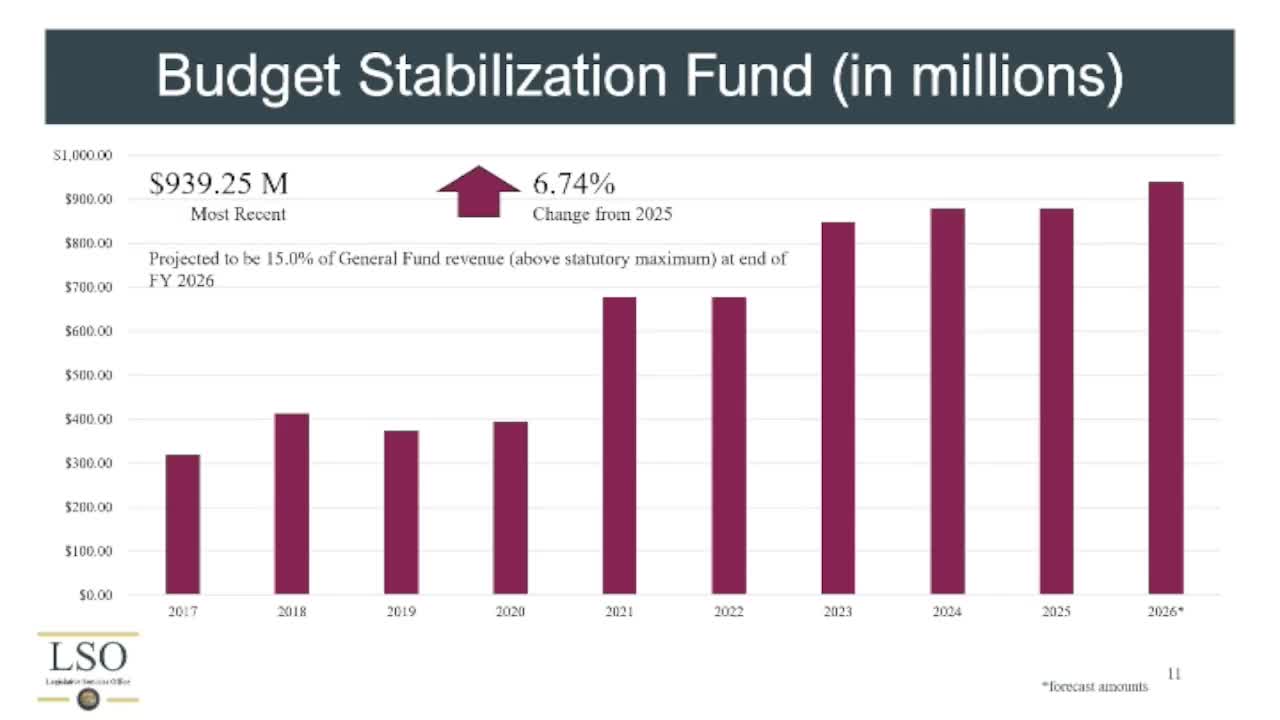
Bybee told the committee the governor's proposed $59 million transfer to the budget stabilization fund would raise that fund to about $939 million if made, which he described as the largest balance on record. "That additional $59,000,000 represents a 6.7% increase from fiscal year 2025," Bybee said, and he explained that the statutory cap is 15% of general fund revenues."
Background and legal context: Bybee noted that last year the legislature temporarily set aside the code section that would automatically move amounts exceeding the statutory cap back to the general fund. That bookkeeping change allowed lawmakers to retain funds in the savings account instead of triggering automatic transfers out. Committee members discussed the policy trade-offs of staying under the cap versus allowing the account to temporarily exceed it and the historical consequences of low reserves in the 2009 recession, when agencies faced deep cuts.
Public education stabilization fund: Bybee described the PSIF as an "overdraft protection" for public school support that automatically covers differences between expected and actual support units at year end. With the governor's proposal the PSIF balance would rise toward $293.6 million, a roughly 20% increase and near the fund's statutory cap (also expressed as a percentage of the public school support program).
Why it matters: committee members were reminded that savings and reserves are one tool to manage an economic downturn alongside program cuts. A member noted that during the 2009 recession, the state relied heavily on reserves and spending cuts to balance budgets and some departments experienced cuts approaching 35 percent. The committee discussed how the current cash position—driven by strong recent revenue collections and transfers to savings—affects choices about whether to increase transfers to reserves or to fund ongoing commitments.
Next steps: the committee will weigh whether to authorize the transfers proposed by the governor, to maintain the temporary waiver of the statutory cap, or to adopt alternative uses for the available cash during appropriation deliberations.