Get Full Government Meeting Transcripts, Videos, & Alerts Forever!
Get email alerts on the Benefits And Personnel topic
No spam. Unsubscribe anytime.
JFAC approves contract inflation and cost allocation adjustments; health insurance and employee compensation unresolved
Summary
The committee approved ongoing contract inflation and statewide cost allocation changes but could not agree on health insurance baseline or employee compensation; staff warned reserve levels and potential risk charges if insurance reserves drop below a 10% contractual minimum.
The Joint Finance‑Appropriations Committee approved two technical statewide budget adjustments Wednesday: ongoing contract inflation payments and updated statewide cost allocation billings. Both votes passed with majorities from the Senate and the House delegations.
Contract inflation: The committee approved the governor's FY2026 request to fund ongoing contract increases (for example, multi‑year lease rate inflators) totaling $3,356,400 in combined funds, including $1,291,500 from the general fund. The motion was made by Representative Miller and seconded; recorded votes showed a majority in both delegations and staff said the motion passes.
Statewide cost allocation: The committee also approved adjustments that move charges among agencies for centralized services (attorney general fees, legislative audit costs, state controller fees, risk management, state treasurer and the office of IT services). The motion adopted the governor's recommendation for net increases of $5,540,500 across all fund types, of which $3,636,200 is general fund. That motion also passed with a majority from both chambers.
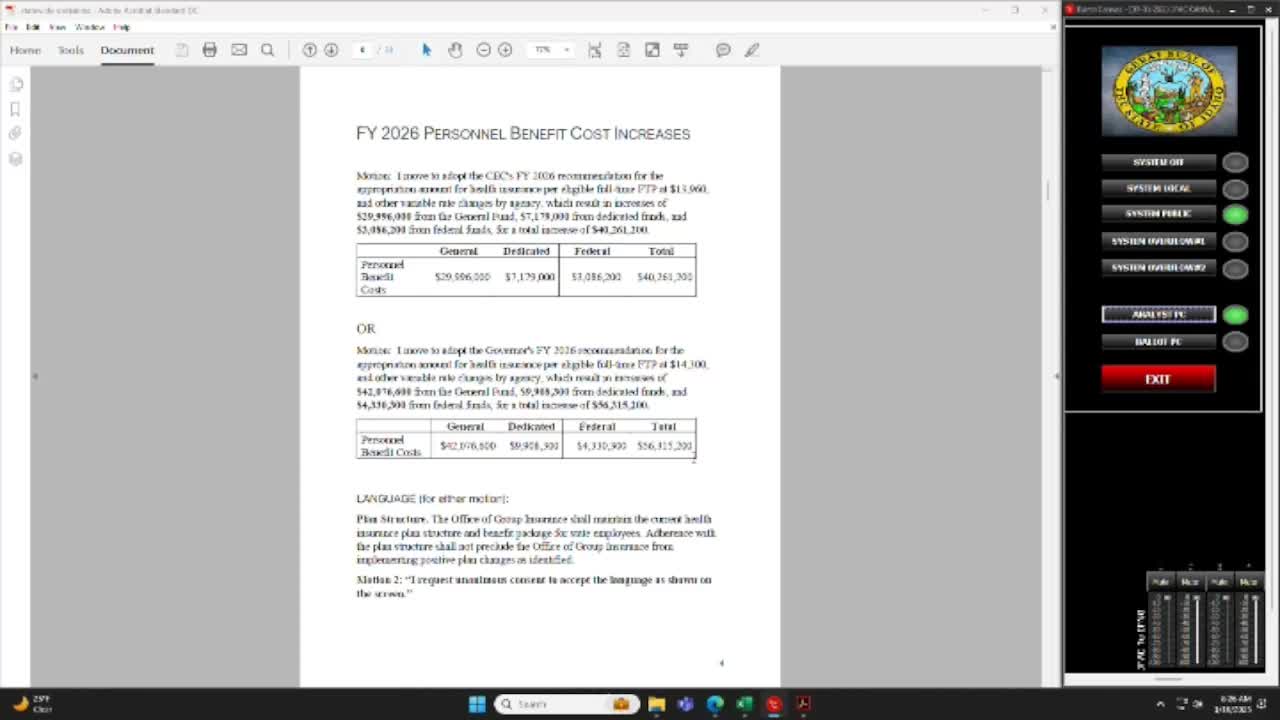
Health insurance and personnel benefit costs: Committee members extensively debated whether to set the state's per‑eligible‑position health insurance base at the Economic Outlook/CEC committee proposal of $13,960 or the governor's recommended $14,300. Analysts told the committee the choice affects the Office of Group Insurance reserves and the state's exposure under its contract with the carrier.
Actuarial context: The committee received Milliman projections showing a total plan cost for FY2026 of roughly $482,000,000. Staff and the Office of Group Insurance said a 10% contingency reserve (contractual minimum) equates to about $51,600,000; the fund balance today was described in testimony at roughly $80.5 million. Committee staff said adopting the lower $13,960 number would reduce the projected reserve to about $51.6 million (near the 10% floor); the governor's $14,300 figure would leave about $61.4 million, roughly $10 million more of cushion. Office of Group Insurance staff warned a shortfall below the contractual 10% could trigger a risk charge assessed to the state.
Vote outcome and next steps: Members considered a substitute motion to adopt the CEC recommendation and voted; that substitute failed to win the required majority of both delegations. The later vote on the governor's proposal similarly failed to record the dual‑chamber majorities required by committee practice. As a result, the committee did not adopt a health insurance per‑position base or the related personnel benefit package during this meeting. Committee chairs said the issue will be revisited when staff can provide additional information.
Why it matters: The health insurance base affects agency budgets, local school districts (through public school support amounts), and the contingency reserve for the state's employee insurance program. A lower adopted base preserves general fund in the near term but increases the risk the reserve approaches the contractual minimum, which could trigger additional costs later.