Get Full Government Meeting Transcripts, Videos, & Alerts Forever!
Get email alerts on the Chronic Wasting Disease topic
No spam. Unsubscribe anytime.
Idaho clarifies domestic CWD rules after first two positive detections in domestic herds
Summary
The committee approved temporary rule changes to align Idaho’s domestic cervid (CWD) rules with House Bill 591 and to require collection of both brain stem and lymph node tissue for official Chronic Wasting Disease testing; agency officials said the state has confirmed the first two domestic herd positives.
The House Agriculture Affairs Committee approved docket 0204192401, which aligns the Department of Agriculture’s domestic cervid (domestic survey) rules with changes made by House Bill 591 of the 2024 legislature and clarifies tissue-sampling standards for chronic wasting disease (CWD).
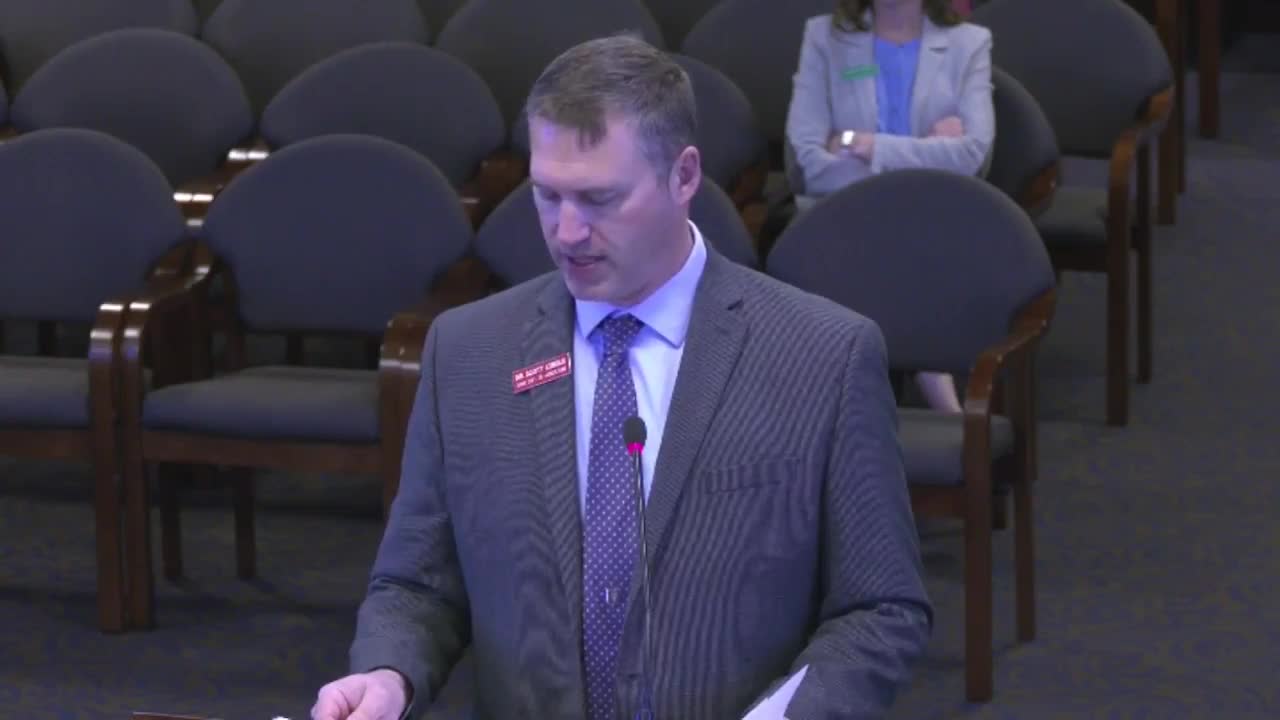
Scott Lively, state veterinarian and administrator of the Division of Animal Industries, told the committee that House Bill 591 added multiple statutory definitions and clarified options for producers after a positive CWD finding. The department struck duplicative definitions from rule and added a definition of “animal health emergency.”
Lively said the department is updating the official test definition to require both obex (brain stem) and lymph-node samples for official CWD testing, noting that both tissues provide more reliable detection than a single tissue sample. “Now the standard is actually to collect both the brain stem and the lymph node,” he said.
The presentation acknowledged that Idaho identified its first two confirmed CWD cases in domestic herds. Lively described early investigations as indicating likely transmission from other domestic ranches rather than direct wildlife-to-domestic transmission, and said herd management plans and statute adjustments were intended to give producers options to continue operations. He emphasized there is no approved live test for CWD; confirmation requires postmortem tissue testing. “There is not an approved live test,” he said; “the affected animals were already dead.”
When asked about testing frequency after a positive, Lively said House Bill 591 did not specify testing percentages; testing expectations will be developed within herd management plans tailored to each operation. He said import protocols for captive cervids remain rigorous (including five‑year herd history and testing requirements) and acknowledged the disease’s long incubation and detection challenges.
The committee approved the rule docket by voice vote. Lively said the department will work with affected producers on herd management plans and continue collaborative work with the Department of Fish and Game on wild surveillance.