Get Full Government Meeting Transcripts, Videos, & Alerts Forever!
Get email alerts on the Public Defense State Agency topic
No spam. Unsubscribe anytime.
State Public Defender requests supplemental and ongoing funding as agency absorbs county services
Summary
The newly created Idaho State Public Defender requested multiple one-time and ongoing appropriations, including authority to spend a $39 million transfer, plus supplemental funding for transcripts and higher contract/ personnel costs as the office integrates counties and assumes work previously handled by counties.
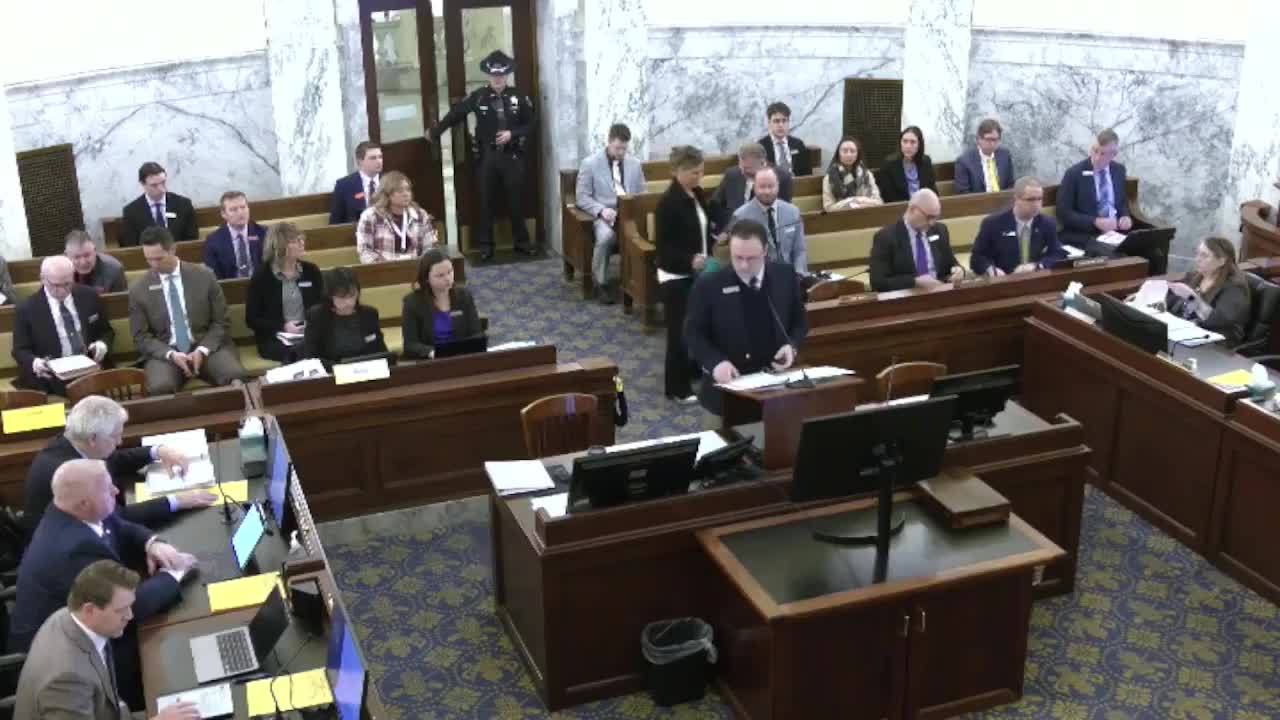
The Idaho State Public Defender’s office requested a package of one-time and ongoing appropriations to absorb county public-defense responsibilities and cover unanticipated costs after the agency began operations this year. State Public Defender Eric Fredericksen told the Joint Finance-Appropriations Committee the office needs both the cash and legislative appropriation to pay contract attorneys, experts and transcripts and to staff newly established institutional offices.
The request centers on a dedicated State Public Defense Fund created in statute and funded in part by a $39 million transfer from the tax relief fund; that transfer is described in the budget presentation as established in “section 57, 8 20 7 of Idaho code.” Christopher Lahoset, a budget and policy analyst with the Legislative Services Office, told the committee the agency seeks a $2.5 million one-time supplemental in FY25 to fully utilize that cash transfer and an additional $2.5 million ongoing in FY26 to continue doing so. Lahoset said the $39 million transfer was directed by statute and that “agencies need both cash and appropriation from the legislature to spend it.”
Nut graf: The State Public Defender was formed by recent legislation to centralize public-defense responsibilities and funding. Committee members pressed agency leaders about higher-than-expected costs after the October 1 transition, a December Idaho Supreme Court ruling on transcript costs, and the practical implications of bringing counties into the state system.
Fredericksen said the office’s funding estimates were made early in the transition and relied on pandemic-era caseloads that proved misleading. “October first looked different than it did October 15,” he told the committee, describing rapid changes in caseload volume and the need to replace flat-fee contract arrangements the office judged constitutionally inadequate. He said the agency has seen “increased capital costs” and wider use of evaluations and experts that were previously paid by counties.
Specific requests and recommended items discussed by the committee included: - A $2,500,000 one-time supplemental appropriation in FY25 to access the $39,000,000 cash transfer and provide representation under the Child Protective Act (CPA), per Lahoset’s presentation. - A $390,200 one-time supplemental in FY25 the governor recommended to cover transcript costs after the Idaho Supreme Court ruling in State v. Blasick that the state is responsible for certain transcript costs. - A $5,427,600 one-time supplemental recommended by the governor for FY25 for additional personnel and contract rate increases; Lahoset said counties’ updated financial data showed the initial forecast was short. - An FY26 request that includes $16,000,380 (plus $80,800 from the General Fund) to increase the public defense operating budget for primary and conflict contract attorneys, investigators, experts, capital litigation, training and transcripts. - Authorization requests for about 17.96 full-time positions and $226,700 ongoing to support new institutional offices as counties are onboarded (Benewah, Elmore, Jerome and Shoshone counties were named in the presentation). - The governor’s recommended one-time transfer of $16,867,400 from the general fund to the State Public Defense Fund to support recruitment, retention and higher contract rates.
Committee members pressed staff and Fredericksen on operational details: whether supplemental funds could be spent before fiscal year end (Fredericksen said the agency’s goal is to spend the money in FY25 and return unspent funds), which costs are county obligations until 2029 (the statute requires counties to provide facilities until that date), and what the $2,000,000 line for experts includes (the agency said capital-case expert costs and psychosexual evaluations are among the items counties previously paid).
Fredericksen described early operational challenges after the October 1 transition: the office faced large numbers of case withdrawals, district defenders and agency leaders temporarily handling courtroom dockets, and the loss of many contract attorneys who had previously worked under flat-fee arrangements. He said the unified system aims to equalize pay and representation across counties so that a defendant in a small rural county gets comparable representation to a defendant in Boise.
Fredericksen also said the agency is working with the Department of Human Resources to establish a uniform pay structure to better recruit in rural counties, and that some positions are difficult to staff without higher compensation or benefits. He said demand for contract attorney coverage for rural counties and certain specialized services generated immediate cost pressure that the agency could not fully predict during implementation.
The committee asked for additional detail on what the budget lines labeled “training, transcripts and miscellaneous expenditures” would cover; Fredericksen said some statutory changes might be necessary to align who pays for certain evaluations and that the agency is still cataloging those costs. He also said work is underway on a statewide case management system to support workload-based staffing rather than the older caseload measure.
Ending: The committee did not take votes during the hearing. Staff said more detailed budget breakouts are available in the budget book entries referenced by Lahoset (LBB 5-103) and committee members asked the agency to provide additional cost breakdowns, geographic allocations for previously funded workforce-housing awards and further detail on expert costs and transcript projections.