Get Full Government Meeting Transcripts, Videos, & Alerts Forever!
Get email alerts on the Medicaid Supplementals topic
No spam. Unsubscribe anytime.
Committee hears $190 million hospital assessment, capitation and quality-review supplementals in Medicaid request
Summary
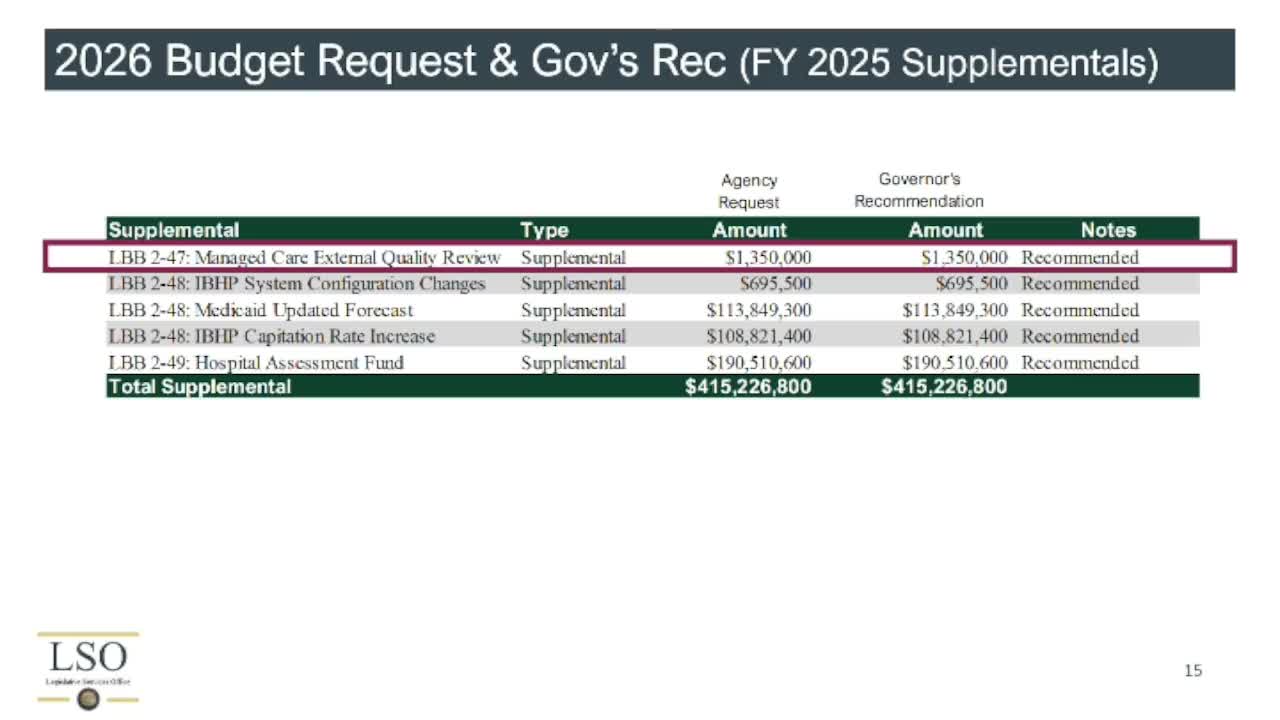
Analysts and the Department of Health and Welfare described five fiscal 2025 supplementals and multiple ongoing 2026 enhancement requests, including a $190 million hospital assessment supplemental, a $108.8 million capitation-rate adjustment for managed care plans and funds for an external quality review required by CMS.
Alex Williamson, budget and policy analyst with Legislative Services, outlined five supplementals recommended by the governor for fiscal 2025 and additional ongoing enhancement requests tied to Medicaid operations.
Williamson told the committee the fiscal 2025 supplementals include a one-time request of about $1.3 million to comply with a federal requirement for an External Quality Review (EQR) of managed care plans. She said previous requests for proposals failed to attract vendors and an RFI showed market prices have risen compared with historical payments.
Another supplemental would fund system configuration and testing tied to onboarding a new vendor for Idaho's behavioral health plan; that request included an estimated $113.8 million in one-time interest in benefit payments from federal funds driven by hospital and developmental disability (DD) service expenditures, Williamson said.
A capitation-rate increase for managed care plans was presented as a separate request of about $108.8 million, split across the plans: approximately $33 million in the expansion plan, $1.9 million in the coordinated plan, $14.8 million in the enhanced plan and about $58 million in the basic plan.
The largest supplemental listed is a $190 million request related to the hospital assessment fund. Williamson said $77 million would come from dedicated funds (the hospital assessment fund) and about $113 million from federal funds. The department and analysts tied this to Senate Bill 1350 of 2022 and to recent changes in the methodology for calculating the upper payment limit (UPL) for hospitals and skilled nursing facilities; hospitals later reported assessment liabilities higher than earlier forecasts, creating a supplemental need for the state to process the increased assessments.
Looking to fiscal 2026, the committee also was shown an MMIS (Medicaid management information system) procurement request in year three of a five-year process with a state portion of $11.7 million already set aside in a dedicated fund and a federal portion estimated at $105 million.
Williamson noted a population forecast adjustment request of about $367 million would include caseload, cost-based pricing, mandatory pricing effects for federally qualified health centers and utilization changes. She also flagged a roughly $45 million shift from federal funds to general funds related to the FMAP change.
Department officials confirmed some line items are responsive to federal requirements. Director Alex Adams said the EQR and CAHPS surveys are federally required when the state uses managed care and called the requests "needs not wishes." Williamson acknowledged a typo in the budget book where the EQR supplemental was listed as one-time when it should be ongoing.
Committee members requested follow-up details on how the hospital assessment works and whether statute or policy changes would be required to redirect assessment proceeds. Williamson said redirecting the assessment would require policy changes.
Ending note: the committee was told forecasting variability is inherent in Medicaid budgeting, and that supplementals are commonly needed when actual payments and assessments differ from prior forecasts. The department said it will provide monthly transparency reports and expanded forecasting to help the legislature anticipate future supplementals.