Get Full Government Meeting Transcripts, Videos, & Alerts Forever!
Get email alerts on the Bsu Budget And Compliance topic
No spam. Unsubscribe anytime.
Boise State president defends LAUNCH enrollment gains, says $1.5M in non‑taxpayer funds used to defend lawsuit and outlines budget priorities
Summary
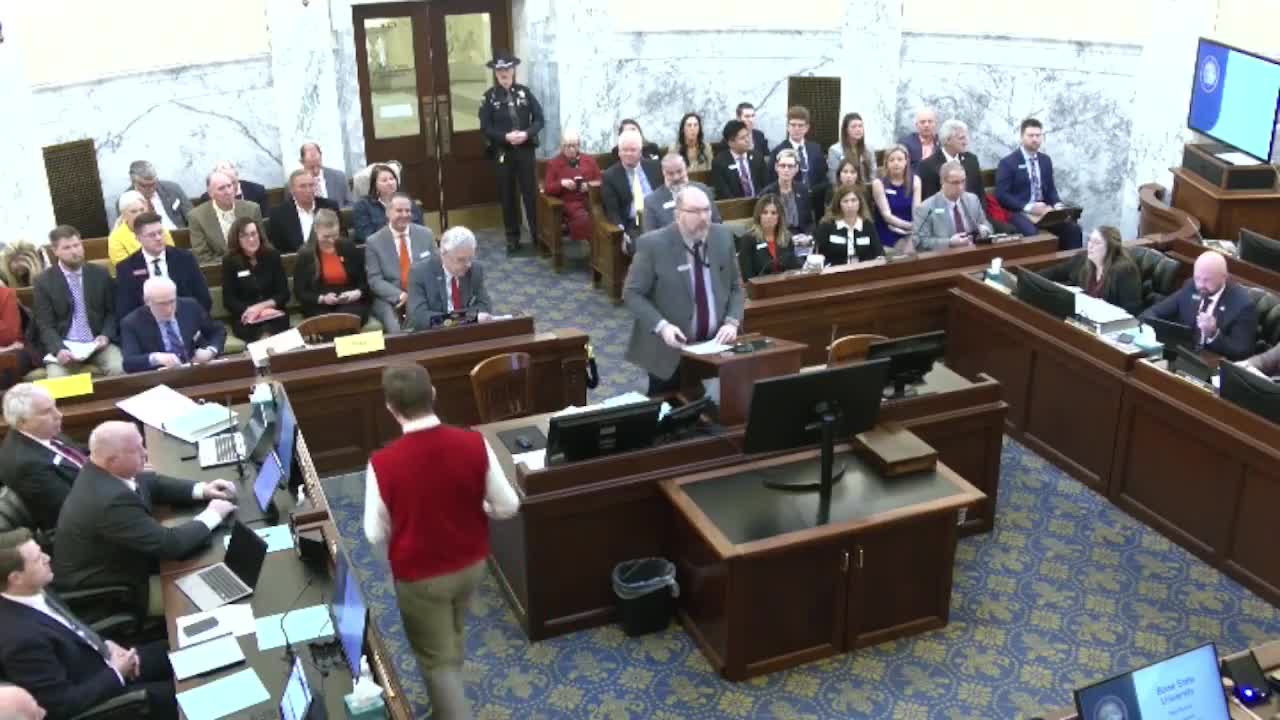
Marlene Tromp, president of Boise State University, told the Joint Finance-Appropriations Committee on Wednesday, Jan. 29 that the university has increased student access through the LAUNCH program, improved graduation rates, and used non‑taxpayer funds to defend litigation related to campus operations.
Marlene Tromp, president of Boise State University, told the Joint Finance-Appropriations Committee on Wednesday, Jan. 29 that the university has increased student access through the LAUNCH program, improved graduation rates, and used non‑taxpayer funds to defend litigation related to campus operations.
Tromp said Boise State has 1,300 students enrolled in LAUNCH, with 600 students relying on LAUNCH as their sole financial support. She said the program connects students to high-demand fields including nursing, computer science and radiological sciences.
On litigation costs
When asked about the Big City Coffee lawsuit, Tromp told the committee that Boise State ‘‘used only non taxpayer funds to support the defense of that lawsuit’’ and provided a cost figure: ‘‘We've spent about $1,500,000.0. We do not anticipate that the appeal will add a significant amount to that total at this time,’’ she said. Tromp said employees who testified did so as part of their employment or using personal time, and that she would provide additional detail to the committee on costs and what funds were used.
Free-speech initiative and campus programming
Tromp described the Institute for Advancing American Values and programming intended to foster civil discourse on campus. She credited programs such as ‘‘Idaho Listens’’ for convening community audiences from different political backgrounds and said Boise State’s faculty senate and student government have adopted the Chicago principles to emphasize free expression. ‘‘We are committed to neutrality and our students get to make up their own minds,’’ Tromp said.
DEI centers and staff reductions
Tromp described several prior centers that have been ‘‘transformed’’ toward student-success goals. She said the university previously employed eight staff in centers associated with equity or similar services and that staff numbers were reduced by five. Tromp said Boise State has realigned work to serve targeted student populations such as rural students and first-generation students and pointed to a 39% improvement in graduation rate over five years as evidence of results from the restructured approach.
Budget model and FY2026 request
Kevin Campbell, the Legislative Services Office analyst presenting budget slides, said Boise State’s personnel costs account for about 81.8% of expenditures, with operating at about 16.5% and capital at 1.7%. Campbell described recent changes including prior-year operational capacity enhancements and other adjustments; Boise State seeks to direct requested OCE funding toward compensation (CEC) for FY2026, and listed a requested enrollment workload adjustment of $195,700.
Performance budgeting and workforce training
Tromp said Boise State operates a responsibility-centered management model that gives academic units control of revenue and expenses and credited that model with greater efficiency and balanced budgeting. She highlighted workforce training tied to semiconductor industry growth, saying Boise State now operates specialized equipment (an XTRON) used in deposition for semiconductor research and training; that equipment is, she said, unique in North America outside private industry. Tromp described program growth in computer science and engineering, and said additional funding could expand graduates in nursing (an estimate of roughly 40 additional nursing graduates per year if funded) and grow cybersecurity support for rural businesses.
Student coursework and course options
Committee members asked whether courses that discuss gender, diversity or related topics remain required. Tromp explained that Boise State’s UF 100/200 sequences contain many sections and that students can select sections by topic. ‘‘No student is required to take a DEI class,’’ Tromp said; she added that the university provides curriculum aligned with state and federal law and seeks to allow a ‘‘free range of voices.’’
Statute compliance request
A committee member asked Tromp to provide written assurance that Boise State courses comply with Idaho Code 33-138 and 33-139 (the dignity and nondiscrimination provisions and restrictions referenced during the hearing). Tromp agreed to provide the committee additional information and said the university would follow state directives.
Other items and committee follow-up
Tromp described Boise State’s approach to defending the university under state law when employees are sued and repeated that the university uses restricted or non-taxpayer funds for legal defense in this case. She also noted Boise State’s enrollment gains, rising graduation rates, and said the university has the lowest administrative spend per student in the state under its budgeting model.
Ending
Tromp closed by reiterating Boise State’s role in producing workforce-ready graduates and urged continued investment in programs to expand capacity in nursing, cybersecurity, engineering and construction management if additional state funds become available.