Get Full Government Meeting Transcripts, Videos, & Alerts Forever!
Get email alerts on the Bsu Student Success And Accountability topic
No spam. Unsubscribe anytime.
Boise State president touts higher graduation rates and campus free‑speech efforts; says $1.5M non‑tax funds used to defend lawsuit
Summary
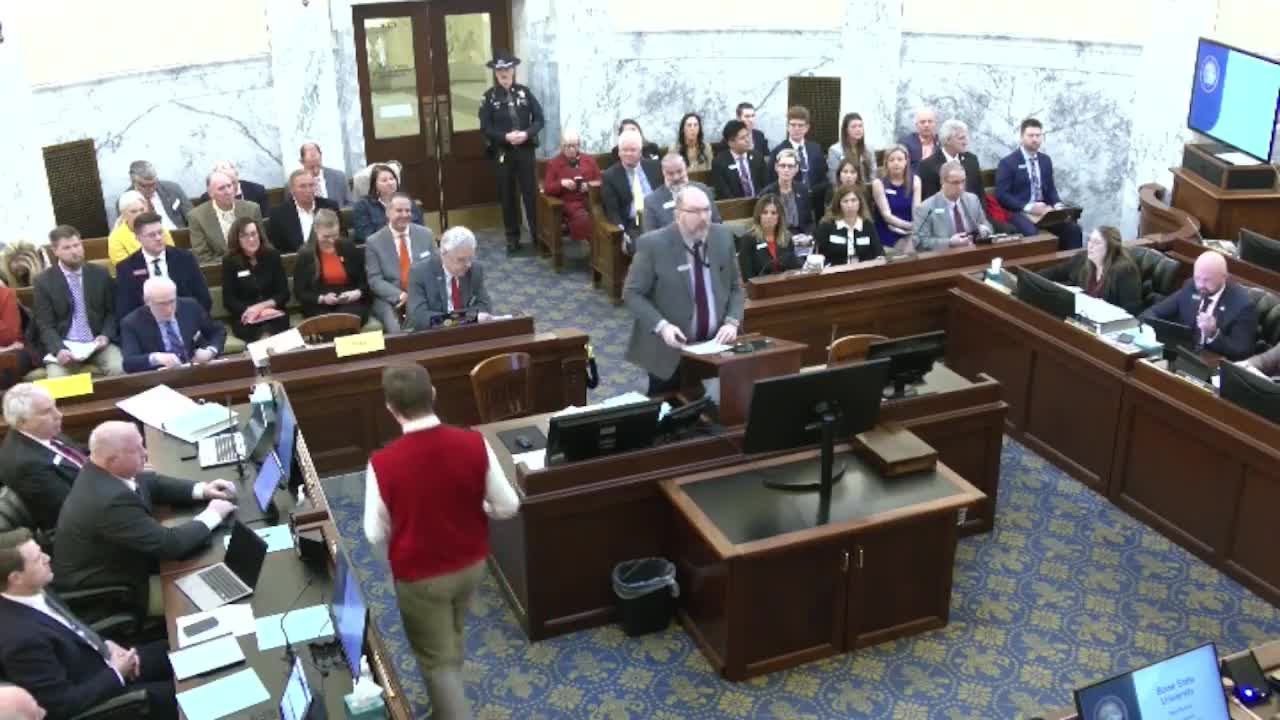
Boise State University President Marlene Tromp told the Joint Finance‑Appropriations Committee on Jan. 29 that the university has improved graduation rates, is operating on a responsibility‑centered budget model and spent roughly $1.5 million from non‑tax funds to defend a lawsuit.
Boise State University President Marlene Tromp told the Joint Finance‑Appropriations Committee on Jan. 29 that the university has improved graduation and retention metrics, is operating on a responsibility‑centered budgeting model and used non‑tax funds to cover roughly $1.5 million in legal defense costs related to a recent lawsuit.
Tromp spoke after Legislative Services analyst Kevin Campbell presented BSU's FY2026 request. She described program shifts intended to boost student success, defended campus efforts to support free expression and said the university is monitoring potential impacts from recent federal funding guidance.
Tromp said Boise State has 1,300 students enrolled in the LAUNCH program, with about 600 relying on LAUNCH as their only financial support. She highlighted workforce‑aligned fields such as nursing, computer science and radiological sciences, and said the university has seen meaningful gains in graduation rates: "in the last 5 years we've improved our graduation rate 39%," she told the committee.
On DEI centers, Tromp said the university has reduced staff tied to legacy programs and restructured several units. She told the committee that staff reductions total five positions from prior DEI‑related work, and that some of the effort has been reframed as student success work serving specific populations such as veterans, rural students and first‑generation students.
Senators and representatives pressed Tromp about course offerings and whether students are required to take classes on gender or diversity topics in general education sequences (UF 100/200). Tromp said UF 100 and UF 200 have many sections and students may select the section they prefer; she repeatedly said no student is required to take a specific gender or DEI course. She also described the Institute for Advancing American Values, which hosts a range of campus events and helped the faculty senate and the student government adopt the University of Chicago principles on free expression.
Senator Carlson raised the Big City Coffee litigation and asked about costs. Tromp said "we used only non taxpayer funds to support the defense of that lawsuit" and that the university has spent about $1.5 million so far; she said she did not anticipate a materially larger amount from an appeal at that time and agreed to provide the committee a detailed accounting.
Tromp addressed federal‑funding uncertainty that arose from an Office of Management and Budget memo and related actions. She said Boise State staff estimated a potential exposure of about $25 million on some federally supported programs before a court injunction paused the guidance; the university is reviewing the implications and coordinating with state finance staff.
Tromp described Boise State's budget model as responsibility‑centered management, which she said has helped the university balance its budget, lower administrative cost per student and incentivize academic units to be fiscally efficient. She also noted opportunities from semiconductor industry growth, saying the university is expanding engineering and related programs to meet workforce demand and citing unique research equipment in Boise State's lab footprint.
Tromp closed by offering to provide requested follow‑up: itemized legal defense spending (sources and categories) and written assurance about course compliance with Idaho law on nondiscrimination. The committee did not take formal action during the session; members requested additional documents.