Get Full Government Meeting Transcripts, Videos, & Alerts Forever!
Get email alerts on the Critical Areas Ordinance Update topic
No spam. Unsubscribe anytime.
Executive staff brief King County committee on proposed critical area regulations; public asks for better notice and enforcement
Summary
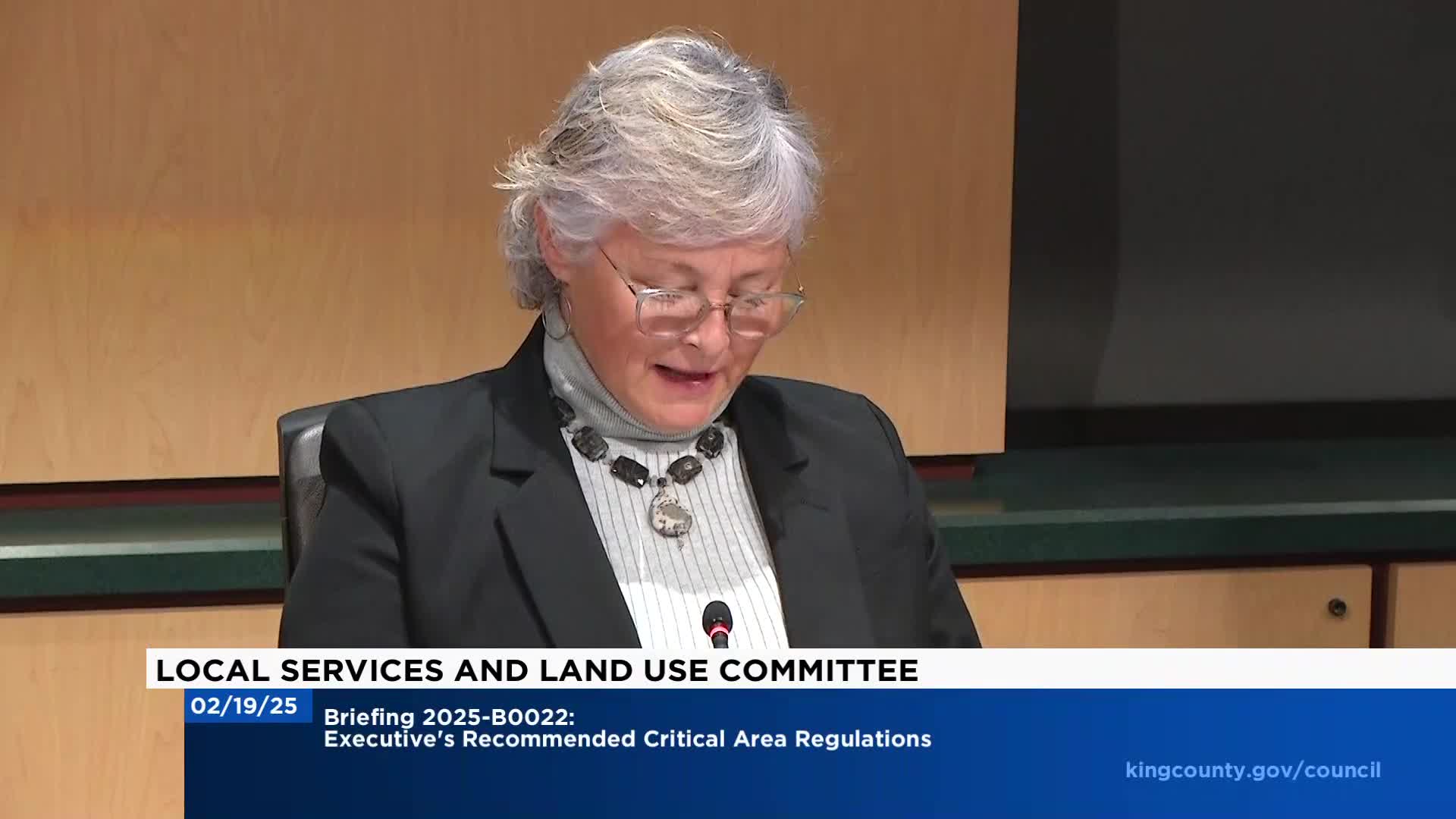
County executive staff briefed the King County Council Local Services and Land Use Committee on proposed updates to the county’s critical area regulations on Feb. 19, including increases to riparian buffers, stronger protections for Category 1 wetlands, new alluvial‑fan and tsunami hazard standards, and other technical and enforcement measures.
County executive staff briefed the King County Council Local Services and Land Use Committee on Feb. 19 about a proposed update to the county’s critical areas regulations, which the county must adopt under the Washington State Growth Management Act by December 2025.
Megan Smith of the Department of Natural Resources and Parks (DNRP) and Robin Probsting of the Department of Local Services (DLS) summarized the scope of critical areas (wetlands, fish and wildlife habitat conservation areas, riparian areas, critical aquifer recharge areas, frequently flooded areas and geologically hazardous areas) and explained that state law requires jurisdictions to use the best available science (BAS), demonstrate special consideration for salmonids and show that adopted measures will achieve no net loss of ecological functions and values.
Proposed code changes described by staff include increased riparian area widths in unincorporated King County, higher mitigation ratios for unavoidable impacts to riparian areas that align with Department of Ecology guidance, stronger protections for high‑value wetlands (Category 1 estuarine and coastal lagoon wetlands), new alluvial‑fan hazard standards (separating those risks from general landslide hazard rules), tsunami hazard area standards for island and coastal places, and provisions allowing climate‑adapted plant lists for mitigation and restoration to support resilience. Staff also outlined continued regulatory flexibility for existing commercial agriculture, including clarified permit exemptions for certain farm drives and manure storage and potential flexibility through farm management plans; grazing allowances on existing commercial agricultural parcels were noted as distinct from new development standards.
Smith noted the county has updated wetland and stream mapping and made those maps publicly available, and the best available science report explains how the county balanced scientific guidance against other policy goals such as accommodating affordable housing and supporting agriculture. She told the committee the executive’s package focuses on both regulatory and non‑regulatory tools — including conservation investments, stormwater management updates and a 30‑year forest plan — to protect critical area functions.
Public comment came from Sandeep Bisla, a Woodinville resident, who said the first time he learned his property was affected by a critical area designation was during a permitting review and asked whether the county could notify homeowners during the home‑buying process and offer more leniency or options for properties with existing exceptions. Chair Perry invited the commenter to follow up by email and said the county would look into it.
Council members pressed staff on specific points. Vice Chair Deshaun Quinn asked about riparian buffer distances and whether the county had engaged farmers and tribes. Staff said the BAS review led to recommended increases in buffer widths (state recommendations include ranges and county scientists proposed increases short of some maximums to balance competing policy goals) and described outreach: briefings and meetings with more than a dozen groups including rural unincorporated area councils, the Agriculture Commission, King Conservation District, and environmental and housing groups. Staff also reported formal invitations to consult went to five tribes; three tribes — Tulalip, Snoqualmie and Suquamish — agreed to meet. Committee discussion referenced historical controversy around past CAO updates and emphasized robust outreach.
Director Lianne Richardson of DLS addressed enforcement and staffing. She said enforcement is complaint‑driven today, that the Council added code enforcement capacity in the budget, and that DLS has hired and is onboarding additional staff: a fifth hire is onboarding, a sixth is scheduled to start in April, and funding effectively supports two full hires (a funding/FTE mismatch means fewer hires than authorized). Richardson said the department intends to prioritize education first, then enforcement, and that code updates to improve usability and new customer bulletins and training are planned to support consistent implementation.
Committee Chair Sarah Perry said the CAO legislation will require multiple committee “touches,” and Council staff will return with analysis at the committee’s April meeting. Staff noted the draft ILA and the BAS report are in the packet and that the updated maps will remain publicly available.
No formal committee vote was taken on the critical areas package at the Feb. 19 briefing; staff said the CAO will return for additional review and recommended actions later in the process.