Get Full Government Meeting Transcripts, Videos, & Alerts Forever!
Get email alerts on the Taxes topic
No spam. Unsubscribe anytime.
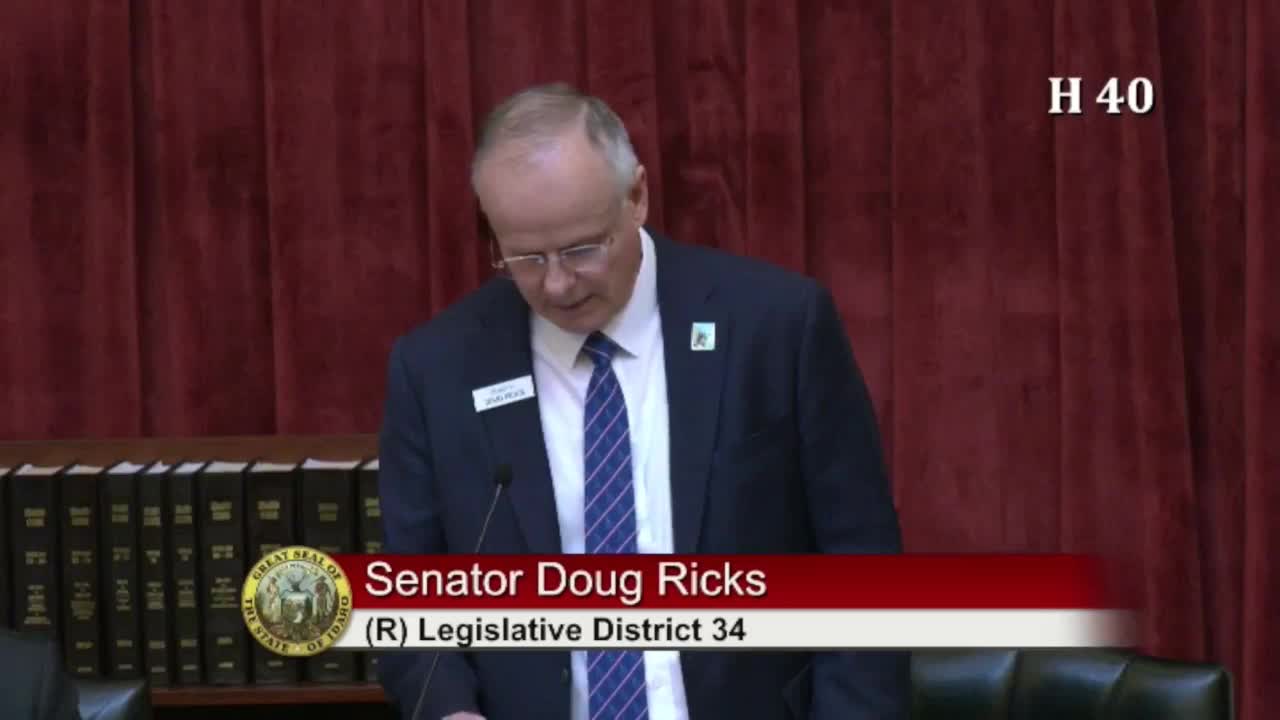
Senate passes large income tax cut in 27-8 vote after extended debate
Summary
The Idaho Senate passed House Bill 40 on March 4, 2025, a package that reduces the individual and corporate income tax rate and includes a military pension exemption and other provisions. Debate ran nearly three hours; the measure passed 27-8.
BOISE, Idaho — The Idaho Senate on March 4 passed House Bill 40, a three-part tax package that reduces the state income tax rate and adds targeted exemptions, by a vote of 27 in favor and 8 opposed.
“House Bill 40 has 3 main parts,” sponsor Senator Rex said in opening debate, describing what he called the “largest” income tax cut in state history: a cut that reduces the income tax rate from 5.695 percent to 5.3 percent, an exemption for military retirement income, and the removal of capital-gains taxation on certain bullion sales. The sponsor told the Senate the income-tax change is estimated to cost about $240 million annually and that the military pension exemption would cost roughly $12 million.
Why it matters: Supporters said the cut will put money back in taxpayers’ pockets and stimulate spending; opponents said the timing is risky given recent revenue softness and national economic uncertainty. The Senate’s decision moves the bill back to the House for further action.
Supporters and opponents debated the bill’s size and timing at length. “I will be voting aye,” Senator Tara Blaylock said during the roll call, adding she trusts people to spend their own money. Senator Guthrie, who described himself as a rancher, opposed the measure’s size while explaining why he spoke up: “I have no illusions today with this issue that’s before us... the outcome is all but decided, yet I find myself standing in front of that train,” he said, urging a more measured approach or an amendment to split relief across priorities.
Senator Sarah Wintrow called the measure “the most irresponsible” tax cut she’s seen given what she described as revenue instability, telling colleagues the bill is “regressive” and that savings cited for working families are modest. Wintrow contrasted two handout estimates circulated on the floor: the bill’s sponsor cited a $389 annual saving for a hypothetical family of four with $137,000 in income; Wintrow cited a different calculation that estimated about $127 for a family of four earning $147,000.
Several senators urged caution because monthly revenue reports have trended below forecast in recent weeks. “Revenue has become an afterthought,” Senator Cook said in debate, arguing that the chamber should set an official revenue number before enacting large cuts. Others pressed that Idaho’s budget is balanced and that reserves exist to cover near-term fluctuations.
Text and fiscal details: The bill reduces the income tax rate from 5.695 percent to 5.3 percent (an effective reduction in the rate as described on the floor), exempts some or all military retirement income (sponsor estimate: ~$12 million annual cost), and excludes certain capital gains on bullion from Idaho taxable income (sponsor estimate: ~ $1 million annual effect). The sponsor characterized the income-tax cut as a roughly $240 million reduction in state receipts.
Vote and next steps: After debate closed, the Senate voted to pass House Bill 40, 27-8. The presiding officer announced that with a majority in favor, the measure passed the Senate and will be returned to the House of Representatives.
What the debate left on the record: Supporters framed the bill as returning money to taxpayers and stimulating local economic activity. Opponents repeatedly flagged short-term revenue declines and broader economic uncertainty, urging smaller, targeted cuts or delaying action until the Legislature sets official revenue projections. Several senators suggested splitting the military-pension exemption into a separate measure so it could be considered on its own merits.
The Senate’s passage does not by itself change law; the House must consider the Senate amendments and take final action.