Get Full Government Meeting Transcripts, Videos, & Alerts Forever!
Get email alerts on the Higher Education Budget Accountability topic
No spam. Unsubscribe anytime.
ISU president says forensic-pathology funds will be returned, pledges tighter controls; outlines FY2026 request
Summary
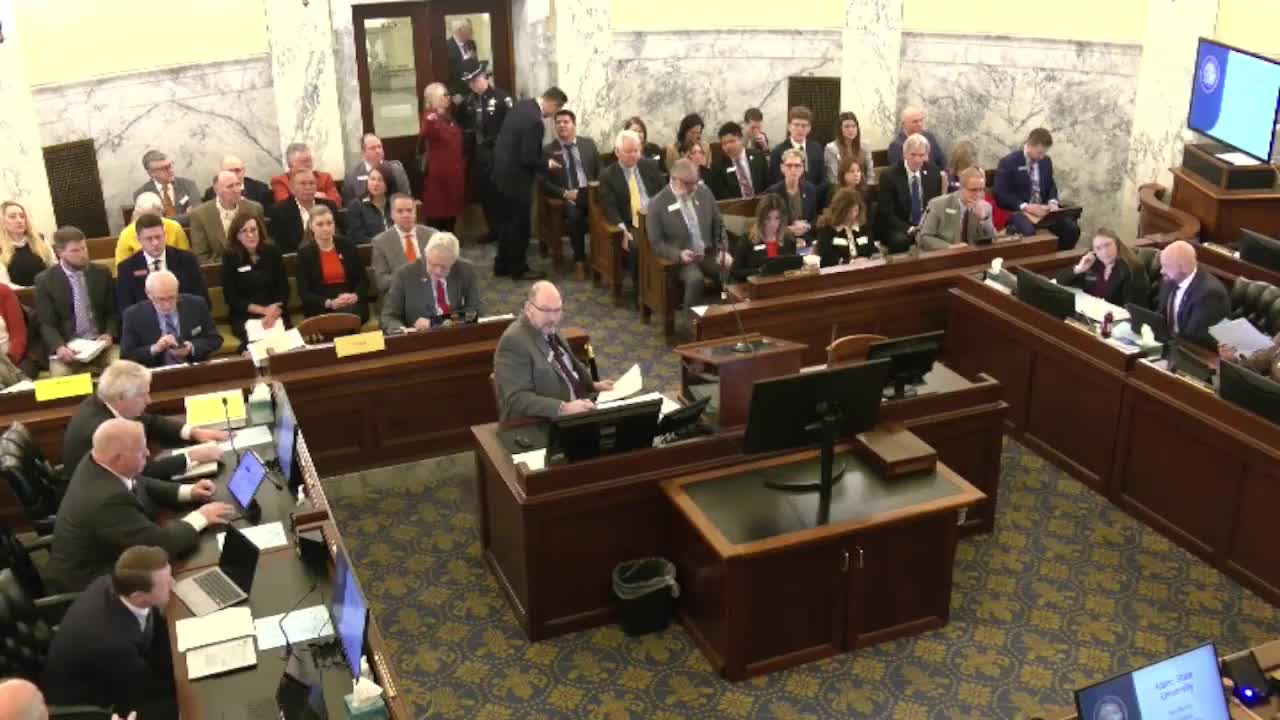
Idaho State University President Rob Wagner told the Joint Finance‑Appropriations Committee on Jan. 29 that ISU will return remaining funds tied to an Eastern Idaho forensic pathology project and has begun putting new financial controls in place.
Idaho State University President Rob Wagner told the Joint Finance‑Appropriations Committee on Jan. 29 that ISU will return remaining funds tied to an Eastern Idaho forensic pathology project and has begun putting new financial controls and accountability measures in place.
Wagner made the remarks during a campus budget briefing after Legislative Services analyst Kevin Campbell reviewed ISU's FY2026 request. The committee also heard details on enrollment, spending patterns and recent organizational changes at the university.
Wagner said ISU learned in late 2023 that the county partner no longer desired a forensic pathology facility on ISU's Pocatello campus and that ISU had spent a small portion of the appropriation on a consultant. "I believe Idaho State University should have kept those funds," Wagner said, adding the university will take responsibility and make sure legislative intent is followed.
The committee was told an audit has been requested and that a staff report is online. Representative Manwaring and other members praised Wagner's decision to return funds, and the co‑chairs emphasized that "appropriation law is law."
Campbell opened ISU's budget presentation with data from the legislative budget book and flagged a technical error in the tuition and fees slide, saying the slide reflected budget‑process figures that did not match the State Treasury beginning fund balance; he said the Legislature would be updated if the numbers are corrected. Campbell said ISU has more than 12,000 students, about 1,244 full‑time equivalent staff and a base budget of roughly $171.1 million.
On expenditures, the committee was shown a breakdown in which 74.8% of ISU spending is personnel, 21.2% operating and 3.9% capital outlay. ISU's FY2026 request included $907,300 in operational capacity enhancement, $233,700 described as an endowment funds adjustment, and $988,100 in the enrollment workload adjustment.
Wagner described steps the university has taken in student services and compliance. He said ISU closed its diversity resource center and gender resource center (effective Nov. 15), reallocating two FTE: one to student involvement to support student clubs and one to the office of equal opportunity and Title IX reporting directly to the president. Wagner said the university also created the Bengal Success Center to centralize academic‑success work for all students.
Wagner emphasized workforce and health‑sciences initiatives and the university's interest in partnering with other public entities. He said ISU is pursuing a closer relationship with the Idaho College of Osteopathic Medicine (ICOM) to increase clinical and residency pipelines and noted ISU's growing health‑sciences enrollments.
Committee members asked about federal grant pauses and workforce pressures. Wagner and Campbell discussed the challenges of recruiting and retaining staff and the need to balance budget optimization with competitive pay.
Wagner closed by emphasizing access, workforce outcomes and flexible on‑ and off‑ramps for students pursuing certificates, degrees and retraining. He told the committee ISU will take responsibility for past accounting and improve tracking to ensure future appropriations are used according to legislative intent.
The committee did not take a formal vote on ISU matters during the session; members asked for follow‑up materials and for the audit results when they are available.